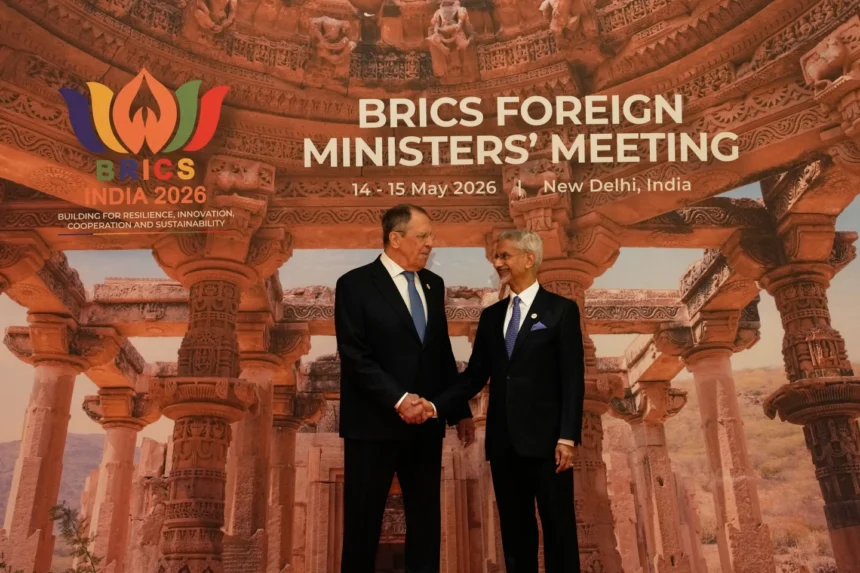
Foreign ministers from the BRICS nations opened a pivotal two-day summit in the Indian capital on Thursday, May 14, 2026. The meeting takes place as the bloc—recently expanded to include major energy players—struggles to maintain a unified front against a backdrop of the Iran-U.S.-Israel war and skyrocketing global oil prices.
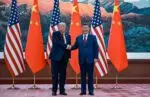
The gathering serves as a critical diplomatic counterpoint to President Donald Trump’s concurrent summit with Xi Jinping in Beijing. While the “big two” negotiate in China, the BRICS ministers are attempting to position the Global South as a stabilizing force in an increasingly fractured world order.
A Bloc Divided by War
Despite the presence of high-profile diplomats like Russia’s Sergey Lavrov and Iran’s Abbas Araqchi, the summit has been overshadowed by internal friction. The conflict in the Middle East has placed several BRICS members in direct opposition to one another:
- Internal Condemnation: Reports surfaced that at least one member state (widely suspected to be an ally of Western interests) pushed for official language condemning Iran’s actions in the Strait of Hormuz.
- The Consensus Gap: Iranian Deputy Foreign Minister Kazem Gharibabadi warned that insisting on such language sends a “signal to the world that BRICS is divided.”
- Strategic Absences: Notably, Chinese Foreign Minister Wang Yi remained in Beijing for the Trump summit, sending Ambassador Xu Feihong to New Delhi instead—a move seen by some as a prioritization of bilateral U.S. ties over the bloc’s collective agenda.
Economic Priorities: Energy, Food, and Fertilizer
Indian Foreign Minister Subrahmanyam Jaishankar opened the session by emphasizing the bloc’s role in shielding developing nations from “geopolitical flux.” The primary focus of the talks includes:
- Energy Security: With the Strait of Hormuz paralyzed, oil prices have surged, disproportionately affecting the economies of the Global South.
- Supply Chain Stability: Addressing the rising costs of food and fertilizer, which have been exacerbated by the disruption of Iranian and Russian trade routes.
- Financial Independence: Ongoing discussions regarding “de-dollarization” and creating alternative payment systems to bypass Western-led financial institutions.
The Evolution of BRICS
The New Delhi meeting highlights the sheer scale of the expanded bloc. Since its founding by Brazil, Russia, India, and China, the group has grown into a diverse—and sometimes contradictory—juggernaut:
- 2010: South Africa joins.
- 2024: Egypt, Ethiopia, Iran, and the UAE join.
- 2025: Indonesia becomes a full member.
While the expansion has increased the group’s share of global GDP and energy reserves, it has also imported regional rivalries. The tension between Iran and the UAE, both now members, and the perennial competition between India and China, continue to test the “foundational principle” of consensus that BRICS prides itself on.
As the summit continues into Friday, the world will look to the final communique to see if India can bridge the gap between its warring and competing members, or if the “geopolitical madness” mentioned by EU officials earlier this week has finally reached the BRICS table.