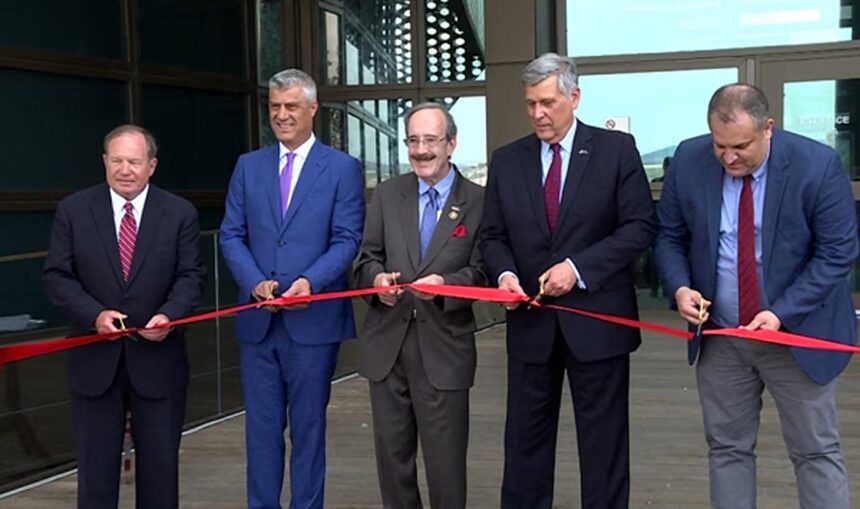
The United States House Committee on Foreign Affairs has approved a bill proposing that a building at the U.S. Embassy in Pristina be named the “Eliot L. Engel Building,” in honor of former U.S. Congressman Eliot Engel, widely regarded as one of Kosovo’s strongest supporters in Washington.
The bill, H.R. 8562, sponsored by Democratic Congressman Ritchie Torres, was approved by the committee on May 13 with 39 votes in favor and seven against.
The legislation must now proceed through additional procedures in the U.S. House of Representatives and the U.S. Senate before it can become law.
Eliot Engel passed away on April 10 at the age of 79. In Kosovo, he was widely honored for his contributions to the country, with the Kosovo Assembly holding a special session dedicated to his legacy.
According to the text of the bill, the United States Chancery building in Pristina would officially be designated as the “Eliot L. Engel Building,” and all future references in U.S. laws, maps, regulations, and official documents would use this name.
The bill was introduced on April 28 by Ritchie Torres alongside Republicans Michael McCaul and Brian Mast, as well as Democrat Gregory Meeks. All four lawmakers previously succeeded Engel in leadership roles within the Foreign Affairs Committee.
The current chairman of the committee, Brian Mast, said that given Engel’s longstanding support for Kosovo, it was fitting for the embassy building in Kosovo to bear his name.
“As a member of Congress, he fought hard during the 1990s to support U.S. intervention and stop the atrocities being committed against ethnic Albanians in the Balkans, and later worked toward U.S. recognition of Kosovo,” Mast stated.
During debate on the bill, Democratic Congressman Gregory Meeks spoke about Engel’s political legacy after his departure from Congress in January 2021 following more than three decades in office.
Meeks said Engel’s greatest political legacy lies in the young state of Kosovo.
“Eliot was among the earliest and strongest advocates for the United States and NATO to protect Kosovars suffering from horrific war crimes and genocide committed by Serbian forces,” Meeks said, recalling that Engel had urged Washington to recognize Kosovo’s independence and had continued advocating for justice and accountability for victims of war crimes across Kosovo and the Western Balkans.
“He was — and remains — deeply honored in Kosovo, where streets have been named after him, and even his image has appeared on postage stamps. I remember conversations with him about those honors and how proud he was of them,” Meeks added.
Meanwhile, Republican Congressman Keith Self, while supporting the bill, argued that Engel would have wanted Congress to do more for Kosovo.
His remarks came after he proposed an amendment during an earlier agenda item that would condition U.S. military aid to Greece on the recognition of Kosovo’s independence.
Greece remains one of four NATO member states and five European Union countries that do not recognize Kosovo, a major obstacle to Pristina’s integration into both organizations.
“Yes, it is worthwhile to name a building in honor of Eliot Engel. But I believe that if Engel were here today, he would want us to go beyond this because he understood Kosovo’s importance in the Western Balkans,” Self said.
“While I think he would appreciate the naming of a building in his honor, I believe he would prefer that we advance Kosovo as a key pillar of stability in the Western Balkans instead.”
Eliot Engel and Kosovo
Democrat Eliot Engel represented part of the Bronx in New York City — home to a large Albanian-American community — since 1989.
He was among the leading supporters in the U.S. Congress of Kosovo’s independence, declared in 2008. His strong advocacy made him widely respected in Kosovo, while in Serbia he remained a controversial figure.
During a congressional hearing in 2020 focused on the Western Balkans, Engel reflected on his repeated visits to Kosovo.
“I have traveled to every country in the Western Balkans many times. I have met leaders from countless parties and have fallen in love with the rich diversity of cultures, ethnicities, and religions. But no place has touched my heart more than Kosovo.”
Engel entered Congress during the violent breakup of Yugoslavia and became heavily involved in regional disputes through his role on the Foreign Affairs Committee, eventually gaining a reputation as one of Washington’s foremost Balkan experts.
He was also among the first American lawmakers to call on the administration of Bill Clinton in 1998 to intervene and halt the actions of Yugoslav and Serbian forces in Kosovo.
A decade later, Engel became one of the strongest voices in Congress advocating for U.S. recognition of Kosovo’s independence.