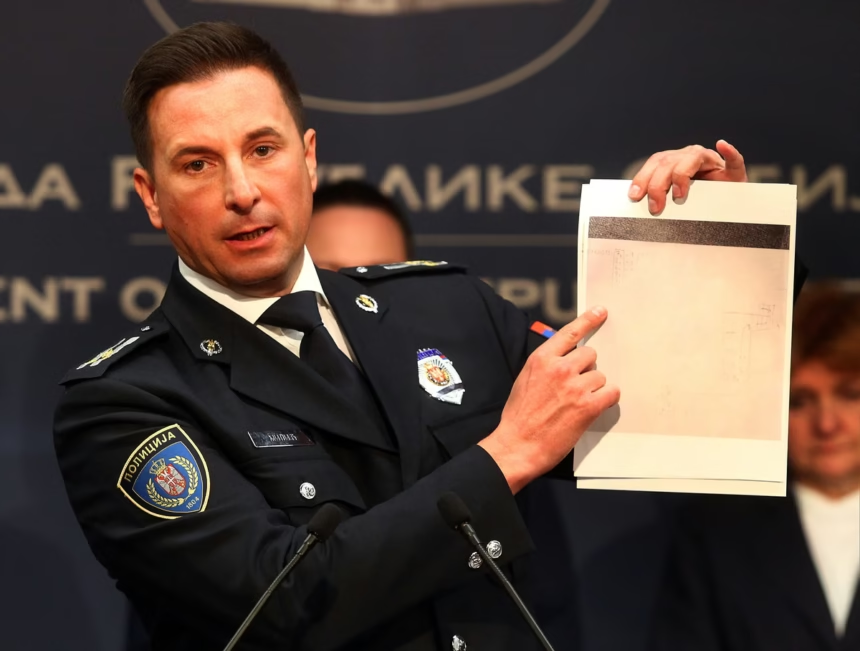
Prominent Belgrade attorney Ivan Ninić made a guest appearance on TV Nova’s morning show Probudi se (Wake Up), shedding light on the high-profile arrest of Veselin Milić, the Chief of the Belgrade Police Directorate, in connection with the gangland murder of Aleksandar Nešović (known as “Baja”) at a restaurant in the affluent Senjak neighborhood.
During his appearance, Ninić revealed explosive details from decrypted Sky ECC applications, exposed a double standard in state-run media coverage, questioned the source of the police chief’s multimillion-euro real estate portfolio, and linked him to historical state-sponsored cover-ups.
The Sky ECC Leaks: How Zvonko Veselinović Halted Milić’s Promotion
According to Ninić, decrypted messages from the encrypted Sky ECC network reveal intense behind-the-scenes political maneuvering within Serbia’s ruling structures. At a time when Veselin Milić was the frontrunner to become the Director of the Serbian Police, controversial Kosovo-Serb businessman Zvonko Veselinović allegedly intervened.
“Criminals on the Sky application discussed how Veselinović complained directly to Andrej Vučić [the brother of Serbian President Aleksandar Vučić],” Ninić stated. “Veselinović explicitly warned that his group would cease all assistance with party logistics and the gathering of capillary votes for the ruling party if Milić were appointed Director of Police. The criminal underground was actively dictating top-tier police appointments.”
Instead of securing the directorate, Milić’s promotion was blocked, though he remained the powerful head of the Belgrade police force and formerly served as a direct advisor to President Vučić.
The Senjak Murder and Alleged Crime Scene “Sanitization”
The case centers on the shooting death and subsequent disappearance of Aleksandar Nešović Baja at Restoran 27 in Senjak. The Higher Public Prosecution suspects that Chief Milić actively lured Nešović to the location by convincing him to arrive without his usual security detail. Following the murder, Nešović’s body was transported away, prompting police to search near Lake Jarkovac.
Ninić believes the Ministry of Interior (MUP) and state officials initially intended to bury the story, drawing parallels to the highly suspicious 2018 death of whistleblowing attorney Vladimir Cvijan, which was kept from the public for years.
“If the information regarding the event at the Senjak restaurant hadn’t gone viral on social media, who knows where this investigation would have ended,” Ninić noted. He pointed out that individuals linked to regional organized crime—such as Miloš Medenica from Montenegro, who remains a fugitive—began leaking details online. “There were simply too many witnesses. Information began to hemorrhage, forcing the authorities into damage-control mode.”
Ninić added that the crime scene was handled by a “seasoned professional,” leading to the systematic destruction of evidence. “The scene was completely sanitized, security footage is missing, and biological traces were scrubbed clean, exactly like something out of a movie.”
President Vučić Accused of Acting as Milić’s “Defense Attorney”
Ninić sharply criticized President Aleksandar Vučić’s public statements regarding Milić’s arrest, accusing the head of state of shielding corrupt officials within his inner circle.
When questioned by journalists about the quiet arrest of the police chief, President Vučić invoked the presumption of innocence, asking if the police should have publicly handcuffed Milić “like Dragan Džajić” only to pay out state damages later if acquitted.
“In defending criminals from his own ranks, Vučić has truly ‘beaten the game,'” Ninić argued. “The presumption of innocence apparently does not apply to students, university professors, or civic activists. When they are arrested, whether on the street or in their homes, it must be meticulously documented, filmed, and immediately forwarded to state-tabloids like Informer. But for Milić, there is a VIP treatment. This is because Milić is a core member of an organized criminal cartel operating under the institutional umbrella of the state, and the President has stepped into the role of his defense attorney—just as he did for Predrag Koluvija [the owner of the Jovanjica marijuana farm].”
Milić currently faces charges of failing to report a criminal offense and aiding a perpetrator after the fact. Ninić warned that if convicted of both charges in conjunction, Milić could face up to eight years in prison, though he fears the judiciary will attempt to downplay the police chief’s role to grant him a lenient plea deal.
Multimon-Euro Property on a Public Servant’s Salary
The attorney raised serious questions regarding the staggering wealth accumulated by the detained police chief, noting that Milić purchased a 200-square-meter luxury apartment in the elite Dedinje district—valued at no less than €1.3 million—while drawing a monthly state salary of just 170,000 dinars (approx. €1,450). Furthermore, Milić’s parents own an adjacent 200-square-meter property in the same building.
“No state institution has ever investigated whether Veselin Milić’s asset portfolio aligns with his legal income,” Ninić said, also pointing out his collection of high-end luxury watches and designer clothing. “The building itself was legalized by the Stajić brothers, who were later prosecuted but are no longer spoken about. Can an ordinary street cop or a criminal investigator ever dream of purchasing property like that? This demonstrates that he was the heart of a corrupted system, acting as a liaison between rival criminal clans.”
Links to the Savamala Scandal and a Dangerous Fallout
This is not the first time Ninić has identified Milić as a central figure in state corruption. In 2017, Ninić tweeted that the key to dismantling state-sanctioned crime would be granting Milić the status of a cooperating witness.
Ninić, who previously defended Goran Stamenković—the lone police officer convicted for the infamous 2016 Savamala demolitions—maintained that the illegal operation could not have occurred without the Belgrade Police Chief’s complicity.
“It was structurally impossible to organize the Savamala incident without the explicit knowledge of Veselin Milić, because it required the complete blocking of the police dispatch and emergency services during his active shift. Yet, he was never even summoned for questioning.”
Ninić concluded by noting that while Milić is currently in detention, prison might paradoxically be the safest place for him. By allegedly setting up Nešović, Milić has crossed lines with Dejan Stojanović (alias “Keka”), a notorious Belgrade clan leader who has resided outside of Serbia for two decades.
“Keka has known Aleksandar Vučić for nearly thirty years,” Ninić concluded. “Do you truly believe a criminal of Keka’s caliber will forgive the murder of his close associate? Do you think Keka lacks the reach to send a message, even inside a prison wall?”