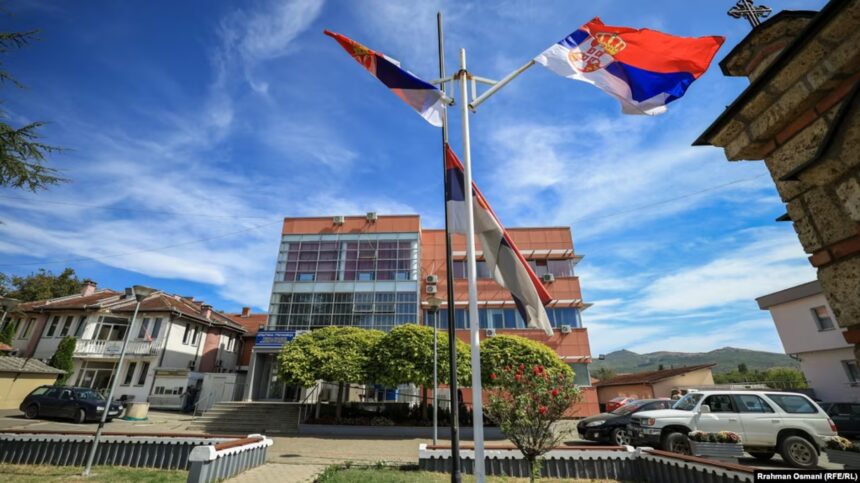
Gordana Nedeljković and Miroslav Ristić from the territory of the municipality of Gračanica have been informed that they have been dismissed from their jobs, allegedly because, as they themselves claim, they do not support the Serb List, but rather the Party for Freedom, Justice and Survival led by Nenad Rashiq.
Nedeljković, until May 14, worked as a laboratory technician at the Health Center in Gračanica, while Ristić was employed at the Technical High School as a practical teaching professor.
These institutions, as well as all other educational and health institutions in Serb-majority areas in Kosovo, operate under the system of Serbia and are mainly led by members and officials of the Serb List the main political party of Serbs in Kosovo, which operates with the support of official Belgrade.
Two other individuals employed in Serbian institutions in Kosovo also confirmed to Radio Free Europe that they were dismissed from work for political reasons, but requested to remain anonymous.
Repeated claims of intimidation and political pressure
This is not the first time members of the Serb community in Kosovo have accused the Serb List of blackmail or intimidation ahead of electoral processes.
In several cases, Radio Free Europe has reported on these claims, but the interlocutors have mostly insisted on anonymity due to fear of consequences.
Political opponents of the Serb List have also frequently stated publicly that their candidates have been intimidated.
One of the strongest voices was Serbian politician Oliver Ivanović leader of the “Freedom, Democracy, Justice” list in the 2017 local elections in Kosovo months before he was killed.
During that electoral campaign, due to intimidation of Serbs in northern Kosovo, four candidates from his list withdrew, while his car was also set on fire in North Mitrovica.
Nedeljković says that after 35 years of experience, she has become unemployed because her husband, Aleksandar, is politically active in Nenad Rashiq’s party.
Ristić, who has worked in education for 20 years, also claims he was dismissed because he supports Rashiq’s party.
Speaking to Radio Free Europe, they say they will try to challenge the dismissal decisions in court.
“I received the decision on Thursday, which states that I engage in politics, that I spread nationalism and hate speech. Nothing is related to my work,” Nedeljković said.
The dismissal decision seen by Radio Free Europe states that for a long period Nedeljković publicly expressed her political views, contrary to the “interests for which the Serb population in Kosovo and Metohija” is defined, which lives in the institutional system that the Republic of Serbia does not recognize.”
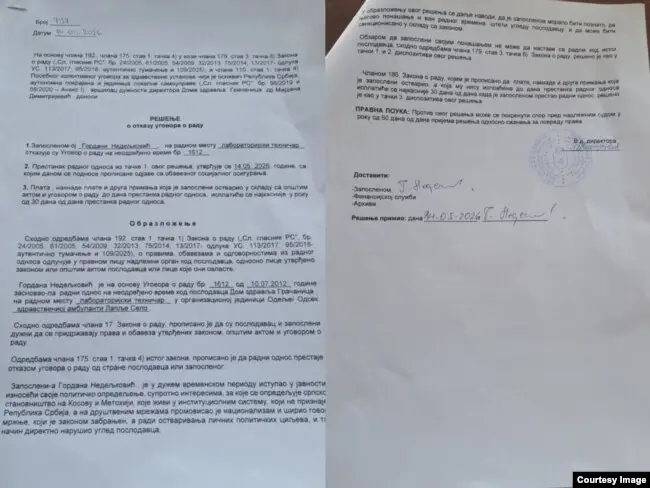
The director of the Health Center in Gračanica, Mirjana Dimitrijević, declined to comment for Radio Free Europe on the dismissal of Nedeljković and other employees who claim they lost their jobs for political reasons.
On the other hand, the director of the Technical High School, Boban Petrović, denied that Ristić was dismissed for political reasons, saying that he did not have a work license.
Ristić confirmed that the lack of a license was mentioned in the dismissal decision, but insists that the real reason is political.
“They found that I do not have a work license, but according to the Law on Practical Teaching, I do not need one. I also asked the school lawyer to take the licensing exam, but she told me it was not necessary,” he said.
Ristić said he has been employed in education since 2007, received a permanent contract in 2013, and until now no one had asked him for a work license.
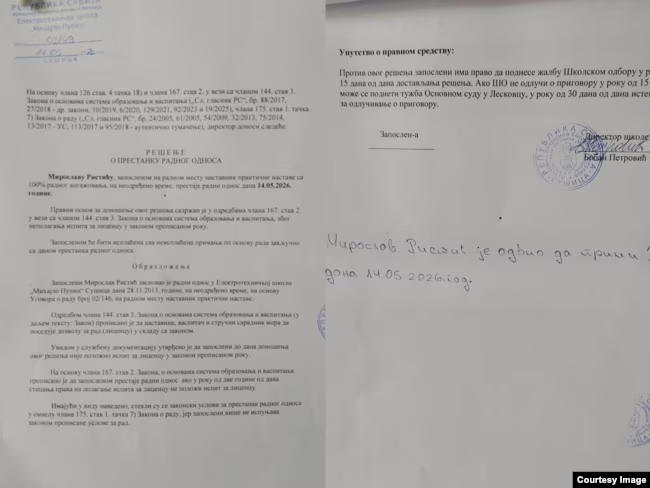
He also claims that in order to obtain the license, the educational institution must submit a request and pay the costs.
The Law on the Fundamentals of the Education System of Serbia stipulates that a teacher, educator, and professional associate may work if they have a work license.
However, according to information available on the website of the Serbian Ministry of Education, the licensing procedure is initiated by the institution where the candidate is employed, after successful completion of the internship.
Ristić added that he was previously warned not to publicly support Rashiq, but he did not comply with those warnings.
“There were verbal threats, not written ones. I believe it is my democratic right to support whoever I want. These pressures have been going on for years,” he said.
He also said his health insurance under the Serbian system was revoked, making further medical treatment more difficult.
“I have had cancer for five years and they immediately removed my health insurance. I needed a referral to go to a doctor in Belgrade, but they immediately deregistered me,” he added.
Employees in Serbian institutions in Kosovo have health insurance contributions deducted from their salaries under the Serbian system, while the state covers costs for those not employed.
A large number of members of the Serb community in Kosovo are referred for more serious treatments in cities in Serbia such as Belgrade, Kragujevac, or Niš.
Radio Free Europe also contacted the Office for Kosovo in the Government of Serbia, the Ministry of Education, and the Ministry of Health there, asking whether they were aware of such allegations of dismissals, but received no response.
In the early parliamentary elections on June 7 in Kosovo, only Nenad Rashiq’s party will compete against the Serb List, with Rashiq having served two terms as Minister for Communities and Returns in the government of Prime Minister Albin Kurti.
“Some are fired, others are hired”
Aleksandar Nedeljković, whose wife Gordana was dismissed from work due to his political engagement, says members of the Serb community face continuous pressure from the Serb List and that many of them are afraid even to communicate with those who support Rashiq.
“It is very difficult. This is an act of intimidation, hardly anyone dares to speak with us. In private yes, but not publicly. After these dismissals, people are afraid,” he said.
Nedeljković added that the Serb List promises jobs and financial assistance from Serbia to those who vote for it, while those who do not support it face job losses.
In Kosovo, over the past year and a half, two parliamentary elections and local elections have been held.
During election campaigns, the Serbian state has opened hundreds of new jobs in its health institutions in Kosovo which has been described publicly as “interference in the electoral process” or “securing votes for the Serb List.”
The Office for Kosovo has also announced monthly payments of 20,000 dinars (around 180 euros) as assistance from the Serbian state.
On the other hand, Rashiq’s political opponents have accused him of abuse of office as Minister for Communities and Returns in the Kosovo government, saying he has secured “safe votes” through the distribution of household items, appliances, or subsidies.
During election campaigns, Rashiq has handed over keys to houses built by the ministry he leads or launched the construction of new housing units.
What does the Serb List say?
Nenad Rashiq, at the Kosovo government session on May 14, accused the Serb List of exerting “pressure” and “fear” on his supporters, calling on competent institutions to react.
He claimed that around 20 of his supporters have been dismissed from work, while around 40 more are expected to receive dismissal decisions in the municipality of Gračanica alone.
Rashiq also claimed that his supporters and party members are being stopped at border crossings with Serbia by the Serbian Security and Intelligence Agency (BIA), where they are asked who they will vote for in the June 7 early parliamentary elections.
The Serb List has denied these accusations, saying Rashiq has no legitimacy and is trying to justify his expected defeat in the upcoming elections.
In the December elections last year, the Serb List won nine of the ten reserved seats for the Serb community in the Kosovo Assembly, while Rashiq’s party won one mandate.
“It is clear that the ‘donated’ positions in municipal election commissions, public enterprises, as well as his attempts to misuse funds from the ministry he leads, are not producing the expected results,” the Serb List said.
Double salaries for some, none for others
A 2024 Radio Free Europe investigation showed that some employees in Serbian health and education institutions in Kosovo receive salaries also from the Kosovo government budget.
Employees in Serbian-run educational institutions in Kosovo receive an additional so-called “Kosovo allowance,” which reaches 50 percent of the base salary, meaning total income ranges from around 900 to over 1,300 euros per month.
Teachers’ salaries in the Kosovo system are around 600 euros.
In addition, Serb List officials and members mainly run Serbian institutions in Kosovo.
For example, the party leader Zlatan Elek is also director of the Clinical Hospital Center in North Mitrovica, while his deputy, Dragisha Milović, is mayor of Zvečan in the Kosovo system.
The mayor of North Mitrovica in the Kosovo system, Milan Radojević, is also director of the Pension and Disability Insurance Fund in the Serbian system branch in Mitrovica.
Serb List MP Igor Simić heads the Republican Pension and Health Insurance Fund of Serbia. He has also declared income as a professor at the Faculty of Economics in the Serbian system, with total earnings exceeding 3,000 euros per month.