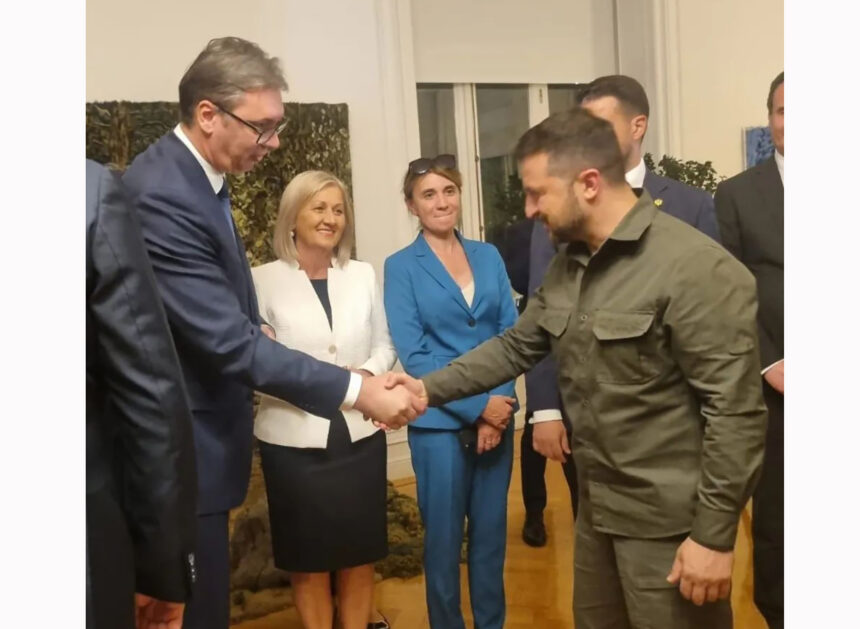
Volodimir Zelensky will not be visiting Belgrade this week, despite a wave of high-profile reports suggesting a historic diplomatic breakthrough.
The initial leaks, published on Monday by N1, claimed that the Ukrainian President was set to lead a state delegation to Serbia—marking his first official visit to the country since taking office in 2019 and since the 2022 Russian invasion of Ukraine. However, Ukrainian media outlets, including Ukrainska Pravda, quickly shut down the speculation, confirming that Zelensky is bypassing Belgrade.
Instead, the Ukrainian delegation will be spearheaded by Taras Kachka, the Deputy Prime Minister for European and Euro-Atlantic Integration.
A Move to “Balance” Geopolitics with Lower Stakes
Foreign policy commentator Boško Jakšić told Nova that without Zelensky’s physical presence, the upcoming visit loses its heavy geopolitical punch. He views it as a routine continuation of Belgrade’s delicate balancing act between Moscow and Kyiv.
“Everything is in the service of a certain balancing act. Ukraine and Serbia have never severed diplomatic relations,” Jakšić observed, adding that the visit will not yield major negative domestic consequences for the ruling Serbian Progressive Party (SNS).
“Pro-Russian Progressive voters still view Moscow as the key strategic orientation, but they are ready to tolerate this because Vučić will simply explain to them that cooperation with Ukraine is necessary. I don’t see any negative effects here. In this country, nothing seems to shake the status quo anymore—not even the arrest of the Belgrade police chief—so why would a Ukrainian delegation?” Jakšić remarked.
While Jakšić doubts that Serbian diplomacy possesses the long-term foresight to have planned this strictly as a calculated maneuver, he notes that a visit from high-ranking Ukrainian officials will naturally have a positive, albeit mild, “smoothing over” effect on Serbia’s strained relations with the European Union. Diplomatic sources in Belgrade still expect the two nations to sign a joint Memorandum of Understanding regarding bilateral trade cooperation.
Domestic Opposition: A Smokescreen for Corruption and Cartel Scandals
Serbian opposition leaders immediately hit back, accusing President Aleksandar Vučić of trying to orchestrate a massive international media distraction to bury a string of domestic organized crime and corruption scandals rocking his administration.
The Weaponry and Energy Bargain
Democratic Party (DS) MP Milivoje Hajdinović (referencing a statement by Srđan Milivojević on X) questioned whether Vučić—whom he termed a “cornered mafia boss”—had agreed to host Ukrainian officials out of pure desperation. He suggested the administration is ready to concede control of the state oil monopoly (NIS) and appease Western demands before Vučić immediately pivots to China on Sunday to sign “humiliating, colonial” agreements.
Shifting Focus from the Senjak Assassination
Zdravko Ponoš, president of the SRCE party, was even more direct. He claimed the high-level Ukrainian visit was intentionally leaked to draw public attention away from the high-profile gangland murder at “Restaurant 27” on Senjak, an incident that recently resulted in the historic arrest and imprisonment of Belgrade’s powerful Police Chief, Veselin Milić.
“Zelensky’s rumored arrival on Thursday was meant to distract both those in Serbia who love Putin and those who can’t stand him from the Senjak assassination,” Ponoš stated on X. “It also serves to blindside Europeans ahead of Vučić’s upcoming trip to China. He personally called Ursula [von der Leyen] to cheer her up with the news about Ukraine so she wouldn’t grill him later on what he signs in Beijing.”
A Volatile Track Record: Belgrade, Kyiv, and Moscow
The relationships between Vučić and Zelensky have historically been transactional and tense, played out primarily on the sidelines of international summits.
- June 11, 2025 (The Odesa Summit): Aleksandar Vučić made his sole wartime visit to Ukraine for the Ukraine-Southeast Europe Summit in Odesa. However, Serbia notoriously refused to sign the joint summit declaration because the text contained explicit calls for international sanctions against the Russian Federation.
- The Munitions Paradox: While Belgrade routinely sends humanitarian and financial aid to Ukraine, the primary friction point with Moscow remains persistent investigative reporting from Russian and Ukrainian media confirming that Serbia has been systematically supplying billions in weaponry and artillery ammunition to the Ukrainian military through third-party international intermediaries.