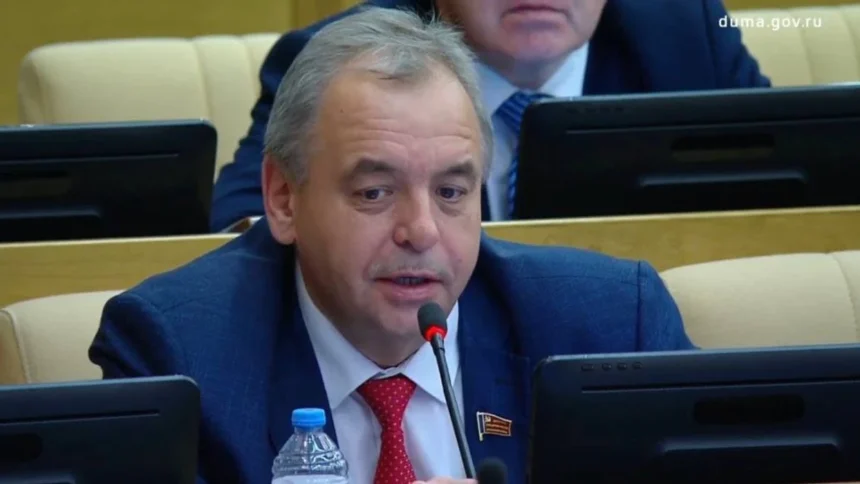
In a highly unusual break from tightly controlled Kremlin orthodoxy, a sitting member of the Russian State Duma has publicly warned that Russia’s economy cannot survive a prolonged continuation of the war in Ukraine, calling for its swiftest possible end.
The alarming remarks were made by Renat Suleymanov, a 61-year-old federal lawmaker representing the Novosibirsk region for the Communist Party of the Russian Federation (KPRF), during an interview with the regional news outlet Kontinent Sibiri. Independent monitoring groups, including the Russian outlet Agentstvo, noted that this appears to be the first time since the 2022 invasion that a serving member of the Russian parliament has openly questioned the state’s economic capacity to sustain the war.
Tanks and Shells Have No Consumer Value
Suleymanov pointed out that massive military expenditures are creating severe, structural imbalances that threaten the domestic market. According to Russia’s approved 2026 federal budget, combined defense and security spending has ballooned to 16.84 trillion rubles ($184 billion)—accounting for roughly 40% of the entire federal budget and completely eclipsing total social spending.
“It is perfectly obvious that the economy cannot survive a prolonged continuation of the special military operation,” Suleymanov stated. “Tanks and shells have no consumer value: the economy produces them, but they cannot be consumed by the population. They are pure expenditure.”
The lawmaker acknowledged that while the defense sector artificially drives short-term employment and wage growth, it heavily drives inflation up and aggressively crowds out necessary capital investments, infrastructure development, and social welfare programs. “That’s why the swiftest possible end to the SVO is simply necessary,” he added, noting that the conflict has now lasted longer than the Soviet Union’s involvement in World War II.
   [RUSSIA'S 2026 BUDGET IMBALANCE]
   Military & Security Spending: 16.84 Trillion Rubles (40% of Budget)
   ------------------------------------------------------------------ >>> 1.5x HIGHER
   Total Social & Welfare Spending: 10.8 Trillion Rubles
The Post-War Crisis: Demobilization and Destruction
Suleymanov warned that even if the war concludes rapidly, trimming the defense budget will unleash a secondary wave of economic and social crises that the state is currently unprepared to manage.
The lawmaker expressed deep concern over the imminent demobilization of forces and the transition of wartime manufacturing back to the civilian sector:
- Labor Force Shock: “What happens to the people employed in the defense industry? To those who are under arms right now? A million people will return to civilian life. Where are the jobs, the decent wages, and the social reintegration?”
- The Cost of Annexation: Suleymanov highlighted the catastrophic financial burden of rebuilding Ukrainian territories currently occupied by Russia. “I saw Mariupol in 2022 and the steppes of the Kherson region in 2023: there are no houses left, no Soviet-era irrigation. Reconstruction will require enormous budget expenditure going forward.”
A Stark Shift in Political Rhetoric
Suleymanov’s public sounding of the alarm marks a dramatic U-turn from his previous hardline positions. In April 2022, the Novosibirsk deputy explicitly stated that Moscow should only negotiate with Kyiv on terms of “total capitulation,” and he previously lauded Vladimir Putin’s military mobilization as a “painful necessity to ensure victory.”
Political analysts suggest this sudden pivot to economic anxiety reflects a cautious adjustment of public statements within the Russian political environment ahead of the upcoming autumn parliamentary elections, as domestic dissatisfaction over soaring inflation and economic stagnation continues to mount beneath the surface.