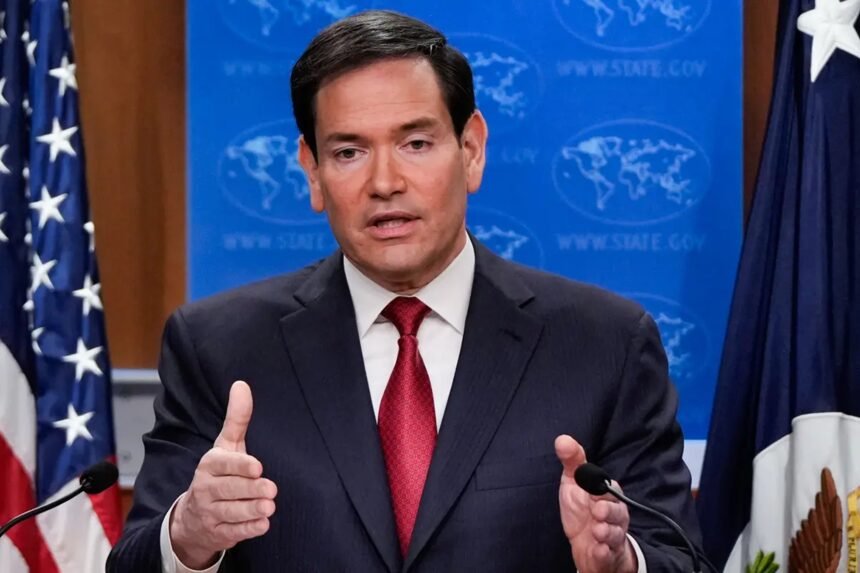
US Secretary of State Marco Rubio landed in Sweden on Thursday ahead of a highly contentious NATO Foreign Ministers’ meeting, tasked with a grueling diplomatic mission: reassuring terrified European allies while simultaneously defending the White House’s sudden, unilateral drawdown of American forces on the continent.
The ministerial gathering, taking place on May 22 in Helsingborg, is one of the final high-level diplomatic checkpoints before leaders convene for the decisive NATO Summit in Ankara this July.
While the State Department framed Rubio’s agenda around Arctic security and a firm demand for aggressive European defense spending, the summit is being overshadowed by deep European panic over a string of recent Pentagon rollbacks that have blindsided allied commands.
Plunged Into an “Information Blackout” over US Rollbacks
The anxiety sweeping European capitals stems from recent executive maneuvers by President Donald Trump that many fear signal a structural gutting of America’s collective defense guarantees at a highly volatile geopolitical moment.
   [RECENT PENTAGON EASTERN FLANK AMENDMENTS]
   • Troop Drawdown:       Axing 5,000 active-duty US soldiers from permanent bases in Germany.
   • Rotational Freeze:    Canceling a pre-planned deployment of 4,000 combat troops to Poland.
   • Missile Suspension:   Halting the deployment of ground-launched Tomahawk cruise missile battalions in Germany.
Speaking to Radio Free Europe on the condition of anonymity, a senior European diplomat warned that Washington’s erratic unilateralism is actively eroding the alliance’s cornerstone of deterrence.
“The worst part is the fact that the continent seems to be kept in an information blackout regarding the actual scale of this withdrawal,” the diplomat remarked, noting that frontline Baltic states are now struggling to finalize defensive planning. “NATO’s effectiveness relied on the idea that it was unbreakable. Now, in a ‘divorce,’ you begin to see the cracks appear.”
White House handlers have scrambled to downplay the shifts. Vice President JD Vance recently stated that the administration’s primary objective remains bolstering “European independence and sovereignty,” while Pentagon Spokesperson Sean Parnell dismissed the Polish cancellation as a “standard rotational delay.”
Rubio Targeted as the “Stable Voice” Amid Congressional Pushback
For European leaders, Rubio represents a critical institutional lifeline. Widely perceived in Brussels and across Eastern Europe as a traditional, steady transatlanticist, Rubio is being relied upon to buffer the more isolationist impulses of the administration.
   [THE BIPARTISAN WASHINGTON COUNTER-BALANCING]
   • Rep. Don Bacon (R):     Backing Rubio to reinforce Article 5 while pushing allies for financial equity.
   • Rep. Michael McCaul (R): Condemning the administration's sudden withdrawal from Poland; enacting Congressional vetoes.
   • Sen. Jeanne Shaheen (D): Warning of aggressive Russian sabotage networks spanning the Baltic and Arctic corridors.
Bipartisan pushback against the administration’s defense cuts is boiling over in Washington. Speaking at the Carnegie Endowment for International Peace, Representative Michael McCaul, Chairman Emeritus of the House Foreign Affairs Committee, forcefully defended the alliance.
“NATO has kept us out of a world war for 80 years, so it has value,” McCaul stated, revealing that Capitol Hill is actively leveraging its legislative weight to block the White House’s military retreats. “I welcomed shifting some of these troops to Poland, putting them right next to the existing threat. But then the administration argued for pulling out of Poland. Congress has now stepped in and said no.”
Senate Confirmation Hearings: Eyes on the Arctic and a 5% GDP Goal
The deep institutional tug-of-war was explicitly mirrored during Senate confirmation hearings for new ambassadorial nominees on May 20:
- Norway: Nominee Michael Kavoukjian labeled Oslo as “the eyes and ears of the alliance in the Arctic,” vowing to build a hard intelligence wall against mounting Russian and Chinese sub-surface operations.
- Albania: Nominee Eric Wendt struck a hard-line administration stance on burden-sharing, pledging to aggressively pressure Tirana to dramatically scale up its defense spending to an unprecedented 5% of its GDP by 2035.
Rubio’s trial in Sweden will test his ability to walk an exceptionally fine diplomatic tightrope: projecting the President’s “America First” demands for financial equity without fracturing the foundational unity of an alliance facing a highly assertive and heavily armed Russian Federation.