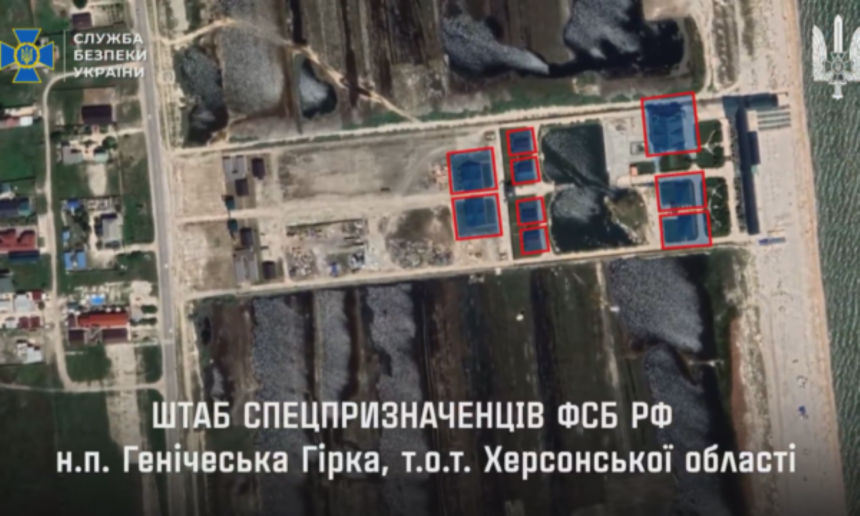
In a highly coordinated, deep-penetration strike, Ukrainian special forces have successfully targeted and destroyed a regional headquarters of the Russian Federal Security Service (FSB) in the temporarily occupied territory of the Kherson oblast.
The precision operation, carried out by elite operators from the Security Service of Ukraine (SBU) Special Operations Center “Alpha,” also eliminated a sophisticated Russian Pantsir-S1 air defense system guarding the complex.
Ukrainian President Volodymyr Zelensky confirmed the strategic success via an official statement on social media, uploading declassified aerial footage showing multiple drones simultaneously striking target structures in the resort village of Henicheska Hirka, located along the Arabat Spit near the Sea of Azov.
   [TACTICAL STRIKE PROFILE: HENICHESKA HIRKA]
   • Target Asset 1:   Russian Federal Security Service (FSB) Field Command HQ.
   • Target Asset 2:   Pantsir-S1 Mobile Surface-to-Air Missile & Artillery System.
   • Operational Arm:  SBU Special Operations Center "Alpha" Drone Unit.
   • Enemy Losses:     Estimated 100 personnel killed or severely wounded.
   • Strategic Impact: Cripples air defense protection and intelligence coordination.
Overwhelming Force Against Occupying Command Structure
According to military intelligence briefs, the targeted former hotel complex had been seized by Moscow’s domestic intelligence apparatus to act as a command-and-control node behind front lines.
The site was heavily fortified to buffer Russian forces against ongoing Ukrainian counter-intelligence initiatives in the south.
Zelensky praised the surgical deployment of the drone fleet, emphasizing that the physical destruction of the facility has significantly degraded local Russian occupation logistics:
“Our warriors achieved excellent results. A Russian FSB headquarters has been struck, and a Pantsir-S1 surface-to-air missile system has been destroyed in our temporarily occupied territory,” President Zelensky announced. “Thanks to just this single operation, Russian losses amount to around one hundred occupiers killed and wounded. The occupiers must feel that they have no choice but to end this war.”
The simultaneous destruction of the Pantsir-S1 platform—a self-propelled system valued at nearly $15 million and specifically designed to defend military infrastructure from low-flying drone swarms—underscores the technical sophistication of the SBU’s penetration tactics.
                  [THE SBU SURGICAL STRIKE PIPELINE]
                                  │
         1. INTELLIGENCE LOCATIONS (Arabat Spit Command Node Identified)
                                  │
                                  ▼
         2. DRIFT SEPARATION (Electronic warfare assets bypass Pantsir-S1 radar)
                                  │
                                  ▼
         3. CONCURRENT IMPACT (Simultaneous drone detonation on HQ structures)
                                  │
                                  ▼
         4. THE FALLOUT (Total structural collapse; 100 casualties confirmed)
Russian Retaliation Strikes Civilian Infrastructure
While Moscow has maintained its typical policy of institutional silence regarding high-profile losses in occupied zones, the Russian military responded to the tactical defeat by launching artillery salvos across the Dnipro River into Ukrainian-controlled residential sectors of Kherson.
Local administrative authorities reported that the retaliatory barrages tore through civil areas, causing widespread damage to residential buildings.
Kherson Regional Governor Oleksandr Prokudin confirmed the human toll of the bombardment via the Interfax news agency:
“As a direct consequence of ongoing Russian aggression over the past 24 hours, one innocent civilian has lost their life, and nine others have sustained varying degrees of shrapnel and blast-related injuries,” Prokudin stated.
The regional administration reaffirmed that emergency services remain on-site clearing debris, even as Ukrainian long-range strikes continue to systematically hollow out Russia’s air defense grid and command networks ahead of anticipated summer operations.