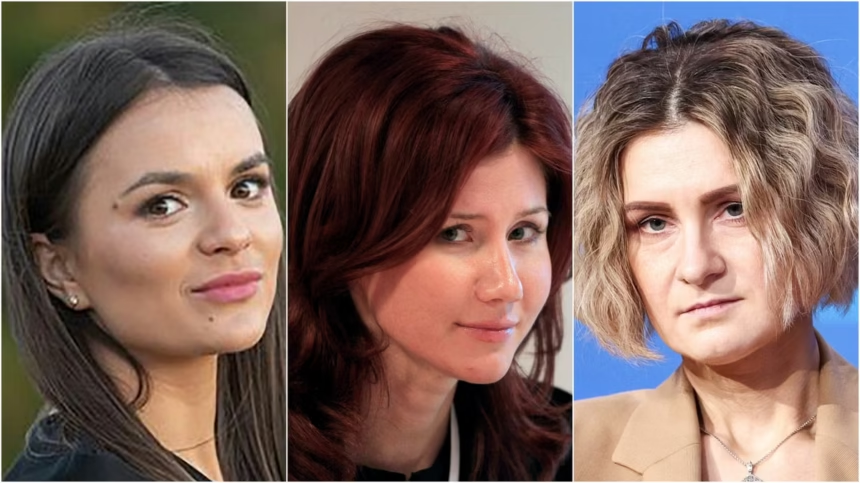
An alleged Russian intelligence plot involving Serbia has drawn renewed attention to a decades-old tactic used by Moscow’s security services: recruiting women to infiltrate political and social circles, gather intelligence, manipulate targets and, in some cases, facilitate operations against Russian opponents.
The case centers on Russian artist and former Pussy Riot member Margarita Konovalova, better known as Rita Flores, who claims that Russia’s Federal Security Service (FSB) recruited and coerced her into working for the agency for nearly three years.
According to Konovalova, the most dangerous assignment she received came in the summer of 2025, when she was allegedly ordered to lure her former partner, Pyotr Verzilov, to Serbia, where Russian operatives were supposedly planning to kidnap and kill him.
Konovalova disclosed her account on August 24, 2026, in an interview with lawyer Dmitry Zakhvatov, who helped her leave Russia. Her allegations have been reported by independent Russian media, although key elements of her account have not been independently verified.
If confirmed, the alleged operation would demonstrate how Russian intelligence can exploit personal relationships and emotional ties to gain access to targets and potentially facilitate violent operations outside Russia.
Serbia allegedly chosen as the location for an assassination plot
Konovalova claims that FSB officers first searched her apartment on February 17, 2023, threatened her and her family and forced her to cooperate with the service.
She says she was given the codename “Harley” and initially tasked with collecting information on artists and political activists, including their movements, contacts and private lives.
By mid-2025, however, she claims her assignments became considerably more serious.
According to her account, the FSB instructed her to re-establish contact with Verzilov, a former Pussy Riot member and former publisher of the independent Russian outlet Mediazona. Because the two had previously been in a relationship, she could allegedly approach him without immediately raising suspicion.
The plan, she claims, was to persuade Verzilov to travel to Serbia, where Russian operatives would abduct and kill him.
The Art Newspaper reported that Konovalova was allegedly offered up to three million rubles, approximately $36,000, for her participation.
Instead, she contacted Zakhvatov and began seeking a way out of Russia. Preparations for her extraction reportedly lasted about a year, and The Insider reported that she left Russia in August 2026.
The allegations are particularly significant because they place Serbia in the alleged operational chain of a Russian intelligence plot against a Kremlin critic.
From espionage to the “honey trap”
The use of romantic relationships as an intelligence tool long predates the FSB.
Soviet intelligence services developed and repeatedly employed what became known in the West as “honey traps” — operations in which agents establish romantic or sexual relationships with targets to obtain information, gain access or collect compromising material that can later be used for blackmail.
The tactic does not necessarily depend on sexual relationships. Personal trust, friendship, social connections and emotional manipulation can all serve the same intelligence purpose.
Chris Costa, a former U.S. counterintelligence official and former director of the International Spy Museum, has explained that romantic relationships can allow intelligence operatives to establish trust, obtain sensitive information or acquire compromising material that could later be used against a target.
Recent cases suggest that the basic method has survived the collapse of the Soviet Union and has been adapted to modern social networks, professional circles and international travel.
“Alisa”: Building networks inside the American establishment
One of the most recent cases directly linked to the FSB involved Noma Zarubina, a Russian woman from Siberia who lived in the United States.
Zarubina admitted in February 2026 in a U.S. court that she had lied to the FBI about her relationship with the FSB. The U.S. Department of Justice said she concealed her ties to Russian intelligence while cultivating contacts in American society.
According to U.S. authorities, Zarubina arrived in the United States in 2016 and was recruited by the FSB no later than 2020. She was given the codename “Alisa” and was instructed to engage in what was described as “network marketing” — building a broad circle of potentially useful contacts.
She attended seminars, conferences and events involving academics, foreign-policy professionals, government officials and journalists. Her alleged task was to identify people who could become useful to Russian interests and bring them closer to Russian networks.
Zarubina was sentenced to 14 months in prison in June 2026.
Her case illustrates a modern form of intelligence work in which the operative does not necessarily steal classified documents or engage in dramatic clandestine exchanges. Instead, relationships are built gradually through conferences, dinners, social events, private messages and professional networking.
The British case: A beauty specialist and a journalist targeted by a Russian spy network
An even more explicit example emerged in Britain, where Bulgarian national Vanya Gaberova was convicted as part of a Russian espionage network operating across Europe.
Gaberova worked as a beautician in London and was involved in a network that, between 2020 and 2023, targeted individuals and locations on behalf of Russia.
One of the network’s prominent targets was investigative journalist Christo Grozev, known for identifying Russian intelligence operatives and investigating the poisoning of former Russian intelligence officer Sergei Skripal and his daughter in Salisbury.
Gaberova contacted Grozev through Facebook and later participated in surveillance operations targeting him in Austria and Spain.
During the trial, the British court heard that members of the network had considered creating a fake romantic relationship between Gaberova and Grozev.
Investigators also found evidence that the network had discussed producing sexual material that could potentially be used to compromise the journalist.
Gaberova said during the proceedings that she had not known about such plans and had herself been manipulated.
Another woman involved in the network was laboratory technician Katrin Ivanova.
Prosecutors said the two women were intended to have direct contact with targets and could be used as sexual lures. The network also monitored Russian dissidents, journalists and a U.S. military facility in Stuttgart associated with the training of Ukrainian soldiers.
Ivanova and Gaberova were convicted in March 2025 of conspiracy to commit espionage. Ivanova was later sentenced to nine years and eight months in prison, while Gaberova received a sentence of six years, eight months and three weeks.
A Berlin case shows that sex is not always part of the operation
Another case in Germany demonstrates why reducing Russian intelligence recruitment to “honey traps” can be misleading.
German-Ukrainian national Ilona W. was arrested in Berlin in January 2026 on suspicion of working for Russian intelligence.
German federal prosecutors alleged that she had been in contact since at least November 2023 with a man working at the Russian Embassy in Berlin who was allegedly connected to Russian intelligence.
According to investigators, Ilona W. provided information concerning Germany’s defense industry, drone testing and planned deliveries of unmanned aircraft to Ukraine.
She also allegedly used personal connections to help the Russian operative attend political events in Berlin under false names and establish contacts that could be useful to Russian intelligence.
The case demonstrates another important element of Russian intelligence operations: women can be valuable not because they are used sexually, but because they can provide access to people, institutions and social networks that would otherwise be difficult for an intelligence officer to reach.
An old Soviet tactic adapted to the digital age
The use of women in intelligence operations is not unique to modern Russia. Soviet intelligence services used romantic relationships for decades to recruit, manipulate and compromise foreign diplomats, military personnel and intelligence officers.
The difference today is the environment in which these operations take place.
Social media, professional networking platforms, international conferences and increasingly interconnected political and business communities provide intelligence services with new opportunities to identify potential targets and build relationships without immediately appearing suspicious.
The alleged Konovalova case goes further still: if her account is substantiated, it would show how an apparently personal relationship could potentially be transformed into an instrument for a lethal operation abroad.
Anna Chapman and Maria Butina: Two different models of Russian influence
The broader history of Russian intelligence activity in the West also includes highly publicized cases involving women such as Anna Chapman and Maria Butina, although their cases differed substantially.
Anna Chapman was exposed in 2010 as part of a network of Russian “illegals” operating in the United States. She worked for Russia’s Foreign Intelligence Service, the SVR, and built an apparently ordinary life while maintaining clandestine communications with Russian officials.
Butina represented a different model. She was not part of the same type of clandestine “illegal” network. Instead, U.S. authorities said she cultivated relationships with American conservatives, Republicans and people connected to the National Rifle Association.
The U.S. Justice Department said Butina acted under the direction of a senior Russian official, collected information about Americans who could influence U.S. politics and attempted to establish an unofficial channel between Russian political circles and Moscow.
She pleaded guilty in 2018 to conspiring to act as an unregistered foreign agent and was sentenced to 18 months in prison in April 2019.
Together, the cases demonstrate that Russian intelligence operations can take very different forms — from clandestine espionage and covert communications to relationship-building and access operations.
Why the Serbia allegation matters
The allegation involving Konovalova is particularly noteworthy because Serbia has increasingly appeared in reporting and investigations concerning Russian intelligence activity in Europe.
If her claims are independently corroborated, the alleged plan to lure Verzilov to Serbia would raise questions about whether Russian intelligence networks view the country as a suitable environment for covert operations against Kremlin opponents.
It would also reinforce a broader pattern: Russia’s intelligence services do not necessarily depend on professional spies operating under diplomatic cover. They can allegedly use people with ordinary professions, personal relationships and social connections to create access to targets.
At the same time, the allegations surrounding Konovalova should be treated carefully until independent evidence confirms the operational details.
What is already clear from documented espionage cases, however, is that the underlying method is not a relic of the Cold War. Russian intelligence has repeatedly adapted the old techniques of recruitment, infiltration, relationship-building and compromise to the realities of modern Europe.