Russia’s acting representative to the Organization for Security and Co-operation in Europe (OSCE), Aleksandar Volgarjov, has called for Kosovo to be returned “fully” under Belgrade’s control, while using a series of disputed and unsubstantiated allegations about the treatment of Kosovo Serbs to portray Prishtina and Western institutions as responsible for instability in the Balkans.
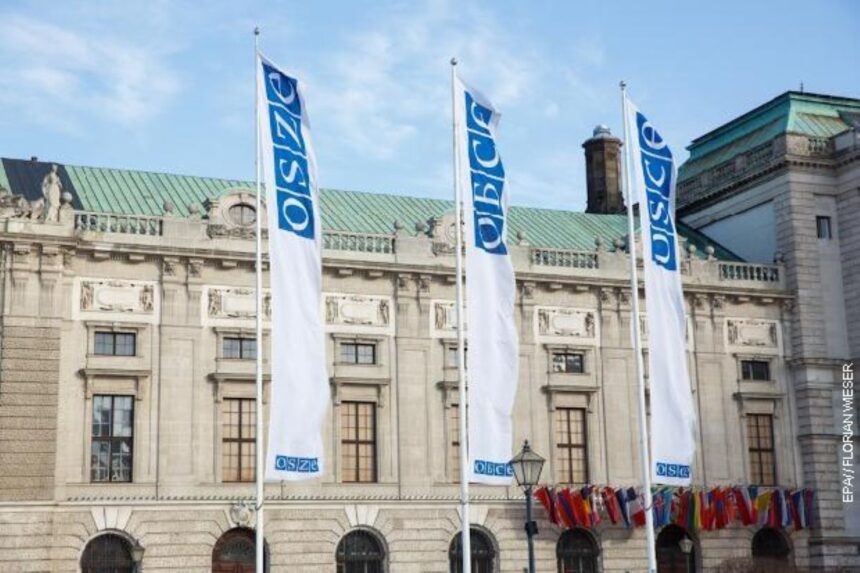
Speaking at a meeting of the OSCE Permanent Council in Vienna, Volgarjov claimed that the “rapid and complete return” of Kosovo under Serbia’s control was necessary to prevent what he described as a “catastrophic scenario” and to restore “historical justice.”
His remarks closely echoed longstanding Russian and Serbian narratives about Kosovo and presented Moscow’s preferred political outcome as if it were an objective requirement for regional stability.
Volgarjov invoked UN Security Council Resolution 1244, insisting that any solution must comply strictly with the resolution and accusing others of attempting to interpret it arbitrarily.
However, his argument omitted the broader political and legal framework that has shaped Kosovo’s status since the 1990s, including the international administration established after the 1998–99 war and the subsequent declaration of independence in 2008.
Russia uses Kosovo to promote its wider geopolitical narrative
Volgarjov devoted much of his intervention to allegations that Kosovo Serbs are facing systematic persecution, claiming that hundreds of “ethnically motivated” attacks and arrests had taken place in recent years.
He also accused Kosovo institutions of systematically violating the property rights of Serbs, carrying out politically motivated prosecutions and using the justice system to pressure the Serbian community.
The Russian diplomat presented these claims as evidence of an organized campaign to remove Serbs from Kosovo and accused Western governments of giving Prime Minister Albin Kurti a “blank check” to pursue such policies.
Yet the sweeping allegations were presented without sufficient independent evidence in his statement. Russia has repeatedly used the situation of Kosovo Serbs as part of its broader criticism of Western policy, while portraying Belgrade as the victim of international pressure and Moscow as a defender of international law.
This framing also overlooks the fact that concerns regarding the rights and security of Kosovo Serbs are addressed through existing international mechanisms, including KFOR, the EU Rule of Law Mission (EULEX) and the OSCE Mission in Kosovo.
Selective use of Resolution 1244
Volgarjov’s invocation of Resolution 1244 is particularly significant because Moscow frequently cites the resolution when arguing that Kosovo should remain under Serbian sovereignty.
However, reducing the Kosovo issue to a single provision of Resolution 1244 ignores the political developments that followed the end of the war, the establishment of international administration and the extensive diplomatic process that preceded Kosovo’s declaration of independence.
The International Court of Justice also concluded in its 2010 advisory opinion that Kosovo’s declaration of independence did not violate international law.
Russia’s argument therefore relies on presenting one element of the post-war framework while largely ignoring subsequent developments and the international legal debate surrounding Kosovo’s status.
Moscow criticizes the West while demanding a geopolitical outcome
Volgarjov also attacked the EU, NATO and the United Nations for what he described as their failure to protect Kosovo Serbs, accusing Western institutions of applying pressure exclusively on Belgrade.
He claimed that KFOR’s security arrangements around Visoki Dečani monastery and the Ibar bridge represented a dangerous reduction of international protection.
Such claims fit into a broader Russian narrative that seeks to portray Western institutions in Kosovo as biased actors rather than as international mechanisms established to maintain security, support the rule of law and facilitate political stability.
The Russian intervention also attempted to redirect attention away from Moscow’s own geopolitical interests in the region.
By calling for Kosovo to be placed “fully” under Belgrade’s control, Russia is not merely commenting on the protection of minority rights. It is advocating a fundamental reversal of Kosovo’s current political order and the position held by the majority of Western countries.
Kosovo as a tool in Russia’s confrontation with the West
Moscow has repeatedly invoked Kosovo when challenging Western positions on Ukraine, Georgia and other territorial conflicts.
The underlying argument is familiar: if Western countries recognized Kosovo’s independence, Russia claims they cannot criticize Moscow’s recognition or support for separatist territories elsewhere.
But the comparison is highly selective.
Kosovo’s post-war status emerged from a specific conflict and prolonged international administration, while Russia’s military interventions and subsequent recognition of Abkhazia and South Ossetia have been rejected by most of the international community.
Using Kosovo as a universal precedent therefore oversimplifies fundamentally different conflicts and legal circumstances.
Volgarjov’s intervention should consequently be viewed not simply as a statement about the rights of Kosovo Serbs, but as part of Moscow’s wider geopolitical messaging against the West.
Moscow’s preferred “solution” would reverse Kosovo’s political reality
The demand that Kosovo be returned completely under Belgrade’s control goes substantially beyond criticism of individual policies by Kosovo institutions.
It represents a call for the reversal of Kosovo’s current political status and for the restoration of Serbia’s direct control over the territory—an outcome rejected by Kosovo’s institutions and by the majority of EU and NATO member states that recognize Kosovo.
Protecting the rights and security of Kosovo Serbs is a legitimate international concern and remains an important part of efforts to stabilize the region. But presenting the restoration of Serbian control as the only route to peace is a political position, not an established fact or an agreed international solution.
Volgarjov’s remarks therefore illustrate how Moscow continues to use Kosovo as a powerful instrument in its confrontation with Western institutions: allegations concerning the Serbian community are placed at the center of the narrative, while the wider political and historical context is selectively presented to support Russia’s preferred geopolitical conclusions.