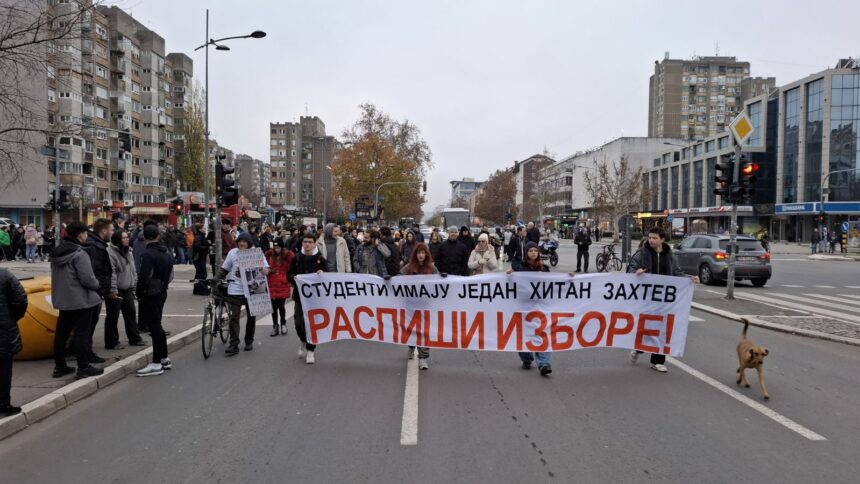
The student movement in Serbia is undergoes a distinct evolutionary shift from grassroots civil resistance into an organized electoral machine. A highly anticipated mass rally scheduled at Belgrade’s iconic Slavija Square for Saturday, May 23, is being analyzed by political scientists not as a standard anti-regime protest, but as a formal pre-election campaign launch.
Organized under the comprehensive slogan “Srbijo, hajde zajedno da definišemo ‘normalno'” (Serbia, let’s define ‘normal’ together), the gathering follows weeks of intense student-led blockades at the Faculty of Dramatic Arts (FDU) in Belgrade and matching academic strikes in Kragujevac.
   [STUDENT ELECTORAL EVOLUTION PROFILE: MAY 2026]
   • Mass Mobilization: Saturday, May 23, at Slavija Square, Belgrade.
   • Strategic Shift:   Transitioning from defensive protests to institutional campaign methods.
   • Tactical Toolkit:   "Door-to-door" canvassing, secure vote tracking, identity stickers.
   • Platform Anchor:   The "Memorandum on Kosovo and Metohija" (Kragujevac Proclamation).
   • Electoral Target:  Consolidating anti-regime votes ahead of late-Autumn snap elections.
“These are Campaign Rallies, Not Just Protests”
Political analyst Aleksandar Ivković, speaking with Deutsche Welle (DW), noted that while the student movement avoids the traditional moniker of a registered political party, its tactical execution mirrors a sophisticated electoral campaign.
“The student movement has been engaging in activities usually reserved for political parties in a campaign—stickers, door-to-door visits, collecting secured votes,” Ivković observed. “The organization of large gatherings or ‘rallies’ like the one on Slavija is part of these activities. This is evidence of the movement’s evolution toward becoming an electoral actor preparing for the ballot box. These are no longer protests where specific demands are made of the authorities; they are pre-election rallies.”
Historian Dragan Popović agreed with this assessment, expecting the students to use the Slavija platform to unveil subsequent planks of their broader socio-political governance program.
The “Kosovo Memorandum” and the Battle for the Mainstream
A source of intense debate across the Serbian political landscape is the recently published “Memorandum on Kosovo” drafted by striking students in Kragujevac—a city they symbolically highlighted as the cradle of modern Serbian statehood. The document explicitly defines Kosovo as an “inalienable and integral part” of Serbia, requiring international diplomatic negotiations.
                    [THE STUDENT INTERNAL SPECTRUM]
                                   │
         ┌─────────────────────────┴─────────────────────────┐
         ▼                                                   ▼
   [THE LIBERAL STRAIN]                                [THE NATIONAL STRAIN]
   Emphasized by Rector Đokić's high-profile           Expressed through traditional rhetoric
   diplomatic delegation visits to Brussels.           and the formal Kragujevac Memorandum.
While critics from liberal factions have flagged the Memorandum’s highly nationalistic vocabulary as a “right-wing shift,” analysts suggest it is a calculated centrist play:
| Policy Vector | Analysis of Content | Strategic Purpose |
| Mainstream Alignment | Framing Kosovo as an integral territorial unit aligns with the majority of the Serbian electorate. | Captures the broad, non-ideological center-ground of anti-regime voters. |
| Rhetorical Style | The use of the word “Memorandum” intentionally evokes deep-seated cultural narratives. | Positions the student movement as legitimate protectors of state sovereignty post-regime change. |
| Electoral Maximization | Avoiding deep ideological purity traps (either purely liberal or purely nationalist). | Minimizes voter loss to established opposition parties by focusing heavily on justice and economic survival. |
The Opposition’s Strategic Dilemma
The rapid rise of the independent student list has put mainstream opposition parties in a highly delicate position. Because the students have systematically rejected traditional coalition formulas or shared lists with older parties, the established opposition must choose whether to unconditionally support the student wave or risk marginalization.
                [OPPOSITION COMPLIANCE & SUPPORT MATRIX]
                                   │
    ┌──────────────────────────────┼──────────────────────────────┐
    ▼                              ▼                              ▼
[FULL ALIGNMENT]            [CONDITIONAL SUPPORT]          [IDEOLOGICAL WAITING]
Green-Left Front (ZLF),     Free Citizens Movement (PSG)   SSP and sections of the
Kreni-Promeni, Democratic   supports but leaves attendance pro-European opposition
Party (DS), and Dveri.      to individual conscience.      remain undecided on lists.
This structural fragmentation occurs against a backdrop of moving target deadlines. President Aleksandar Vučić recently adjusted the projected timeline for the extraordinary parliamentary elections, indicating they will take place sometime between late September and mid-November 2026.
According to Popović, a dominant student list could capture almost the entirety of the anti-regime vote. The survival of traditional opposition politicians will ultimately depend on whether they offer active, boots-on-the-ground support to the student mobilization infrastructure, rather than fighting for space inside a fractured parliamentary model.