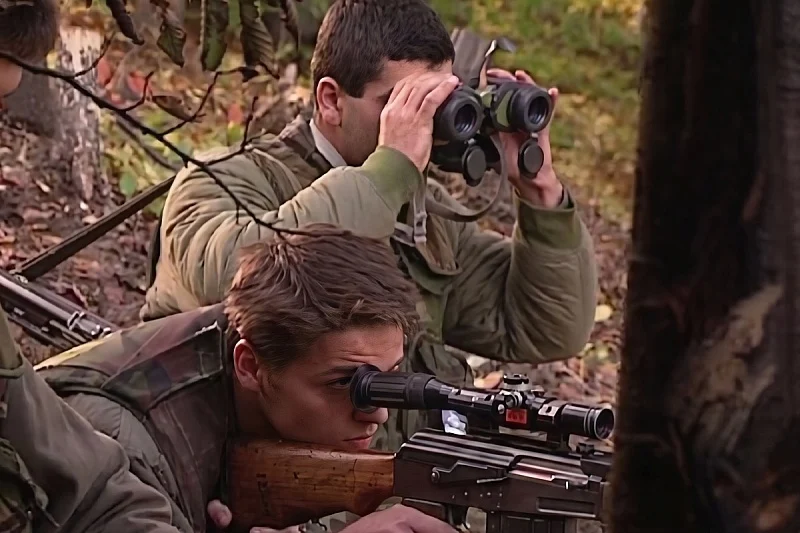
The Federal Prosecutor’s Office of Belgium has officially initiated a criminal investigation into allegations that Belgian citizens participated in the notorious “Sarajevo Safari”—an illicit, dark-web style wartime phenomenon where wealthy foreign nationals allegedly paid massive sums of money to hunt and kill besieged civilians using sniper rifles during the 1992–1996 Bosnian War.
The federal intervention in Brussels follows a judicial precedent set in Milan last November, when Italian prosecutors opened a formal case examining the logistics of foreign mercenary tourists traveling to the frontlines of occupied Sarajevo.
   [WAR CRIMES INVESTIGATION PROFILE: "SARAJEVO SAFARI"]
   • Jurisdictions:     Federal Prosecutor's Office of Belgium & Milan Judiciary (Italy)
   • Primary Source:    Investigative findings by Italian journalist Ezio Gavazzeni
   • Financial Scheme:  Alleged payments of €100,000+ per civilian target
   • Suspected Origins: Belgium, France, Germany, and Italy
   • Historical Anchor: The 1,425-day Siege of Sarajevo (11,541 citizens killed)
€100,000 for a Civilian Life: The Italian Dossier
The impetus for the Belgian federal investigation rests heavily on a landmark journalistic dossier compiled by Italian author and investigative reporter Ezio Gavazzeni. Gavazzeni’s findings detailed a highly organized, international human-hunting pipeline where elite clients from Belgium, France, Germany, and Italy were covertly funneled through specialized logistics networks.
According to judicial files, these affluent “safari tourists” allegedly paid fees starting at €100,000 to be escorted to specific sniper nests on the hills surrounding Sarajevo, which were controlled by the Army of Republika Srpska (VRS) and allied Serbian paramilitary units. From these vantage points, the paying foreigners were allegedly permitted to shoot at civilian targets walking through the city streets below.
The Belgian Prosecutor’s Office confirmed that its federal inquiry was formally triggered by the substantiality of these cross-border media and judicial findings, though it declined to name specific high-profile suspects currently under surveillance.
[THE ALLEGED SAFARI LOGISTICS PIPE] │ Wealthy Foreign Clients Recruited via Elite Underworld Networks │ ▼ Payment of €100,000+ per Session Deposited to Intermediaries │ ▼ Transit into VRS-Controlled Strategic Ridges Surrounding Sarajevo │ ▼ Execution of Civilians Utilizing High-Precision Sniper Hardware
Contextualizing the Terror of the Siege
The “Sarajevo Safari” allegations build upon a documented foundation of systemic, state-sanctioned terror that defined the 1,425-day Siege of Sarajevo—the longest siege of a capital city in the history of modern warfare.
Between April 5, 1992, and February 29, 1996, approximately 350,000 residents were trapped in a valley, targeted daily by artillery and sniper fire from the surrounding mountains:
| Siege Victim Demographics | Statistical Documentation | Historical Findings |
| Total Liquidated Civilians | 11,541 citizens documented dead. | Nearly 80% of all casualties occurred during the hyper-violent initial two years of the war (1992–1994). |
| Child Demographics | 1,601 children targeted and killed. | Children were frequently targeted in open play areas, schools, and water-collection lines by sniper teams. |
| Daily Shelling Average | An average of 329 shells struck the city per day. | The peak was recorded on July 22, 1993, when 3,777 combustion shells hit Sarajevo. |
The Precedent of International Criminal Law
The Belgian and Italian judicial investigations add a new layer of accountability to criminal realities already litigated before the International Criminal Tribunal for the former Yugoslavia (ICTY) in The Hague.
[ICTY LEGAL PRECEDENT: THE SARAJEVO CAMPAIGN] │ ┌───────────────────────────┴───────────────────────────┐ ▼ ▼ [GENERAL STANISLAV GALIĆ] [RATKO MLADIĆ] Sentenced to life imprisonment for directing Convicted of war crimes & genocide; court the campaign of deliberate sniping designed affirmed his personal role in the “Joint Criminal specifically to spread terror among civilians. Enterprise” to terrorize Sarajevo.
Legal experts note that if the Belgian federal investigation uncovers conclusive forensic or financial evidence tying its citizens to the sniper nests, the suspects will face prosecution under universal jurisdiction laws for crimes against humanity. The investigation is expected to involve close coordination with the Institute for Missing Persons of Bosnia and Herzegovina and state prosecutors in Sarajevo to map historical sniper coordinates against known civilian casualties.