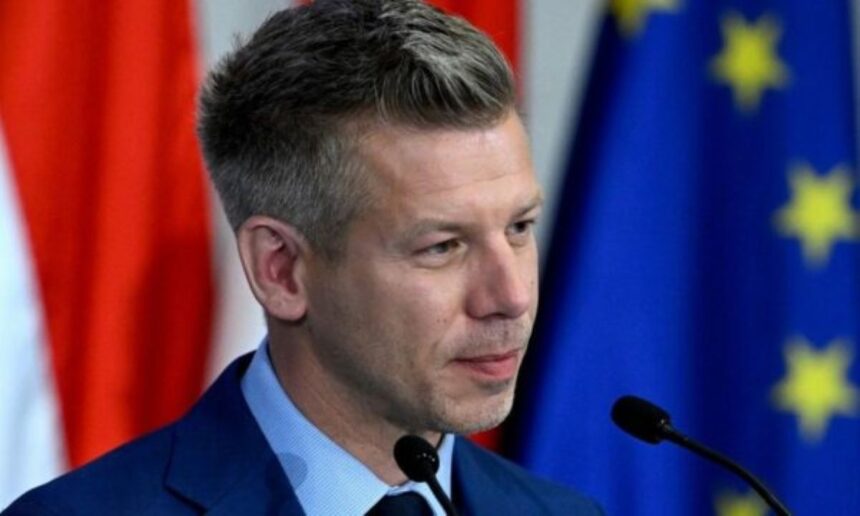
In his first official state visit to Austria since his historic election victory, the newly inaugurated Hungarian Prime Minister, Péter Magyar, issued a firm warning to Brussels regarding the expansion strategy of the European Union.
In a wide-ranging interview with the Austrian Press Agency (APA) following a bilateral summit with Austrian Chancellor Christian Stocker, Magyar insisted that the EU must honor its long-standing commitments to the Western Balkans before offering accelerated paths to Ukraine, warning that failing to do so would trigger a catastrophic collapse of EU credibility in the region.
   [THE MAGYAR INTEGRATION STRATEGY: MAY 2026]
   • Diplomatic Pivot:  Prioritize Western Balkan candidates over rapid Ukrainian expansion.
   • Threat Assessment: Severe loss of EU institutional credibility across the Balkan peninsula.
   • The Policy Line:    Every candidate state must follow identical, non-negotiable legal procedures.
   • The Referendum:    Hungary guarantees a popular vote on Ukraine's accession post-war.
Honoring Commitments to the Balkan Peninsula
Prime Minister Magyar, who led his center-right Tisza party to a landslide victory that dismantled the 16-year rule of the previous administration, used his platform in Vienna to reset Hungary’s neighborhood policy. He underscored that regional security in Southeastern Europe remains structurally tied to the security of the wider continent.
“Regarding accession, in principle, I would like to encourage European nations to first admit into the EU those candidates who have prepared for many years, who have given up so much, made so many commitments, and received so many promises, before promising some kind of status to others,” Magyar emphasized.
The Prime Minister voiced serious concerns that the Western Balkans—where nations have languished in the EU accession queue for over a decade—are being pushed aside due to short-term geopolitical sentimentality.
“We know that the stability and security of the Balkans are not only in the interest of the Balkans, but also of Europe,” Magyar added. “That is why I want to encourage everyone to first fulfill what we promised before.”
A Non-Negotiable Ten-Year Timeline for Kyiv
When questioned about his previous campaign promise to hold a public referendum in Hungary regarding Ukraine’s ultimate entry into the European Union, Magyar confirmed that the pledge stands—though he downplayed any immediate threat of a veto.
According to the Hungarian premier, Ukraine remains exceptionally far from satisfying the institutional criteria required for full membership, predicting that a realistic entry timeline is a decade away:
- Equal Standards: Magyar rejected any “two-speed” or preferential accession tracks, asserting that Kyiv must complete the exact same grueling chapters as every other sovereign applicant.
- The Post-War Condition: The proposed Hungarian referendum will only take place once the ongoing war with Russia has completely concluded and if the Ukrainian electorate still desires integration at that point.
- Sovereign Precedent: Magyar defended the referendum model as a normal exercise of national sovereignty, noting that several European democracies have historically deferred major expansion decisions directly to their citizenry.
Rebuilding Central European Alliances
The Vienna visit marks a rapid diplomatic tour for the new Hungarian government, following an immediate trip to Warsaw to meet with Polish Prime Minister Donald Tusk. Under Magyar’s leadership, Budapest is aggressively attempting to distance itself from its previous pro-Kremlin, obstructionist reputation in Brussels, repositioning Hungary as a “constructive partner” within the EU and NATO.
While Austrian Chancellor Christian Stocker echoed Magyar’s enthusiasm for Western Balkan integration—calling enlargement “one of the most important geopolitical tools for peace and stability”—tensions remain regarding lingering Hungarian special taxes on foreign corporations.
Nevertheless, Magyar announced that Budapest and Vienna will hold a joint government summit in Gödöllő this September, alongside an initiative to revive a broader regional Visegrád Group (V4) cooperation format that could soon bridge economic ties directly into Croatia, Slovenia, Romania, and the Western Balkan states.