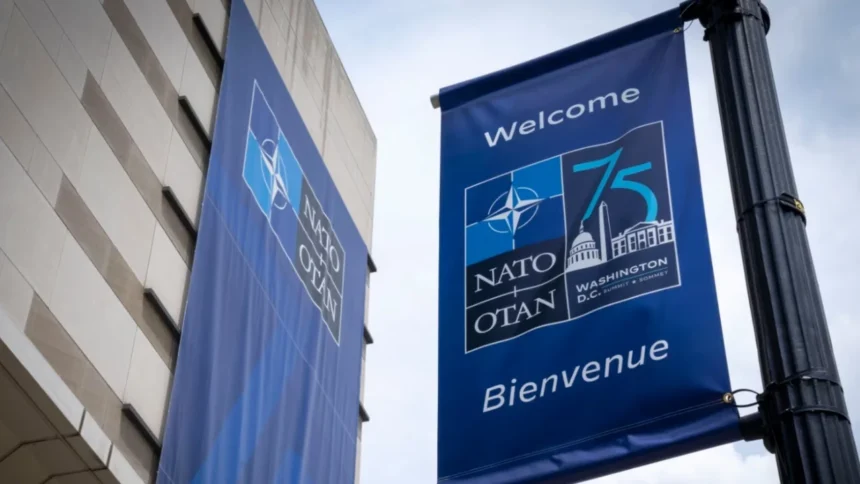
A high-stakes, two-day NATO Foreign Ministers’ meeting has officially commenced at Sofiero Castle in Helsingborg, Sweden, under a cloud of deep geopolitical friction. Hosted by Swedish Prime Minister Ulf Kristersson and King Carl XVI Gustaf, the summit—originally designed to finalize the blueprint for the upcoming July NATO Summit in Ankara—has been dramatically derailed by the escalating war against Iran and a looming structural realignment of American forces in Europe.
The summit highlights an emerging crisis of confidence across the Atlantic, characterized by intense European anxiety over Washington’s unilateral moves and sharp American resentment toward its continental allies.
   [HELSINGBORG NATO MINISTERIAL PROFILE]
   • Venue:            Sofiero Castle, Helsingborg, Sweden (Hosted by Sweden)
   • Key Diplomats:    Sec. Marco Rubio (USA), FM Johann Wadephul (Germany), Sec-Gen Mark Rutte
   • Flashpoints:      US troop withdrawal from Germany; Base access bans for the Iran War
   • Strategic Shift:  Redeployment of 5,000 US troops to the Eastern Flank (Poland)
   • Economic Target:  Acceleration of the historic "5% GDP Defense Spending Guideline"
The 5,000-Troop Shift: Abandonment or Eastern Realignment?
The primary source of immediate anxiety for European diplomats is U.S. President Donald Trump’s directive to withdraw 5,000 American service members from permanent bases in Germany. European officials are struggling to parse whether this signifies a broader U.S. decoupling from European security or a tactical reorganization.
Signals from the Pentagon suggest the latter. General Alexus Grynkewich, NATO’s Supreme Allied Commander, clarified that the net total of American personnel on the continent will remain steady, as the 5,000 troops removed from Germany are slated to be permanently forward-deployed to the Eastern Flank—specifically Poland.
NATO Secretary-General Mark Rutte sought to downplay the logistical shakeup, assuring allies that the operational defensive capabilities of the alliance remain completely intact.
Rubio Unleashes: “US Deeply Disappointed by NATO”
Despite the smooth assurances from NATO leadership, U.S. Secretary of State Marco Rubio set a combative tone before arriving in Sweden, explicitly warning that Washington is questioning the foundational value of its NATO membership due to a perceived lack of allied reciprocity.
“I don’t think anyone is surprised that the United States, and particularly the President, are currently very disappointed with NATO and what it represents,” Rubio declared bluntly.
The core of Washington’s fury stems from the refusal of several European member states—most notably Spain—to grant the U.S. military permission to utilize joint-access airbases on their territory to launch offensive air and drone strikes against Iran.
Rubio argued that if European allies deny Washington the use of continental infrastructure during an active conflict, the strategic utility of the alliance for the United States drops to zero. While noting that President Trump is not asking European allies to deploy their own fighter jets into the Middle Eastern theater, Rubio fiercely condemned their refusal to provide basic logistical and operational authorization: “We are very angry about this.”
Berlin Steps Up: Wadephul Claims a “Leadership Position”
Representing Germany at the summit, newly appointed Foreign Minister Johann Wadephul responded to the transatlantic pressure by indicating that Berlin is ready to embrace a heavier geopolitical burden.
Before departing for Helsingborg, Wadephul asserted that Germany envisions itself in a definitive “leadership position” as Europe transitions toward strategic autonomy. “The goal is a new burden-sharing arrangement that accurately reflects the economic and military potential of Germany and Europe,” Wadephul stated.
Simultaneously, Secretary-General Rutte pressed European defense ministers to drastically accelerate domestic arms procurement. Pointing to the historic agreement struck at last year’s summit in The Hague, where member states committed to a 5% GDP defense spending target, Rutte warned that the current pace of industrial defense production remains dangerously sluggish.
The Ukraine Peace Table: Who Gets a Seat?
With the White House systematically scaling back its diplomatic and financial footprint regarding the war in Ukraine, the Helsingborg summit has initiated tense parallel discussions on which European leaders will spearhead potential ceasefire and peace negotiations with Moscow.
While Russian President Vladimir Putin floated the name of former German Chancellor Gerhard Schröder as a mediator, NATO ministers unanimously rejected the proposal due to Schröder’s extensive ties to Russian state energy firms. Former Chancellor Angela Merkel also ruled herself out, stating that any effective mediator must be a sitting head of state.
Consequently, Finnish President Alexander Stubb has emerged as the leading European candidate to helm potential talks, given his unique position of maintaining communication lines with the Kremlin while preserving a strong working relationship with Donald Trump.
Softening the Atmosphere: Coalition for the Strait of Hormuz
To mitigate the fierce political fallout over the Iran war, European allies have offered Washington a major naval concession.
Under the joint command of France and the United Kingdom, a European naval coalition is rapidly mobilizing to secure the Strait of Hormuz and restore unhindered commercial navigation through the vital maritime chokepoint.
Gerd Müller’s Germany has agreed to contribute advanced mine-countermeasure and minesweeping vessels to the operation—though Berlin has attached a strict diplomatic caveat: German assets will only deploy once an international mandate is finalized and active shooting hostilities in the region cease.