Visitors walking through Serbian cities this week are hitting a literal wall of state-sponsored aggression. Across the country, from the capital of Belgrade to the remote towns of Vojvodina, public architecture and private homes have been forcefully converted into a chaotic, aggressive propaganda board for the ruling Serbian Progressive Party (SNS).
In what sociology and political experts are calling a highly coordinated campaign of “aesthetic terrorism,” the regime of President Aleksandar Vučić is increasingly deploying armed thugs, masked lookouts, and tactical vandals to systematically deface the nation. The goal? To visually intimidate dissenting citizens and stamp out a rising wave of university student protests.
   [THE REGIME'S WALLBOARD TACTICS: MAY 2026]
   • The Target Dominance: Defacing universities, public squares, and private homes.
   • Rhetorical Arsenal:   Tagging "Ustaše" (Fascists), "Terrorists," and "Killers" on dissident areas.
   • The Counter-Slogan:   Overwriting student flyers with the state motto "Srbija Pobeđuje".
   • Corporate Exemption:  Zero graffiti permitted inside the elite Belgrade Waterfront district.
The Anatomy of Facade Botting
The sudden explosion of aggressive, poorly spelled ulični grafiti (street graffiti) across Serbia is not an organic outburst of youthful delinquency. Instead, it serves as a calculated, institutional counter-offensive against the cross-country student movement operating under the banner “Studenti Pobeđuju” (Students Win).
When students began utilizing peaceful, decentralized Wi-Fi network renamings and small paper stickers to signal democratic dissent, the Vučić apparatus reacted with disproportionate institutional fury. National Assembly leaders, state-controlled tabloids, and Prime Minister Ana Brnabić openly mocked the youth before unleashing paramilitary “ultras” to physically reclaim the streets.
The regime’s response has rapidly devolved into a dark, historical irony:
- Desecrating Holocaust Memorials: In Bačko Petrovac, the regime’s slogan “Stop Blokaderskom Fašizmu” (Stop Blockader Fascism) was deliberately sprayed across a historic warehouse that originally belonged to a local Jewish family murdered at Auschwitz.
- Traffic Hazard Propaganda: The state’s competitive mantra, “Srbija Pobeđuje” (Serbia Wins), has been painted in massive letters directly across major traffic arteries, pedestrian crossings in Inđija, and high-speed roundabouts in Veternik, actively endangering motorists and children for the sake of political branding.
- Targeting Private Dwellings: In a severe escalation of property violations, citizens in regional towns who vocally supported local civic gatherings woke up to find their private family homes vandalized with targeted slurs like “Ustaše” (Croatian fascists) or “Piculići” (a derogatory term aimed at European Parliament members).
“Vučić’s psychological profile is driven by a state of ‘never enough,'” notes prominent marketing analyst Igor Avžner. “He completely controls the state institutions, the courts, and the mainstream media—yet he cannot tolerate a single independent voice on a sidewalk. This is an explicit message sent via batinaši (thugs) and kapuljaši (hooded enforcers) to a rebelling society: ‘We own you, and we are everywhere.’“
A Radical Continuum: From Vulin’s Murals to State-Guarded Hate
To understand the regime’s current reliance on street intimidation, analysts point to a long historical trajectory. In 2007, a young, ultra-nationalist Aleksandar Vučić was caught on camera personally taping over signs reading “Zoran Đinđić Boulevard” with posters honoring convicted war criminal Ratka Mladića.
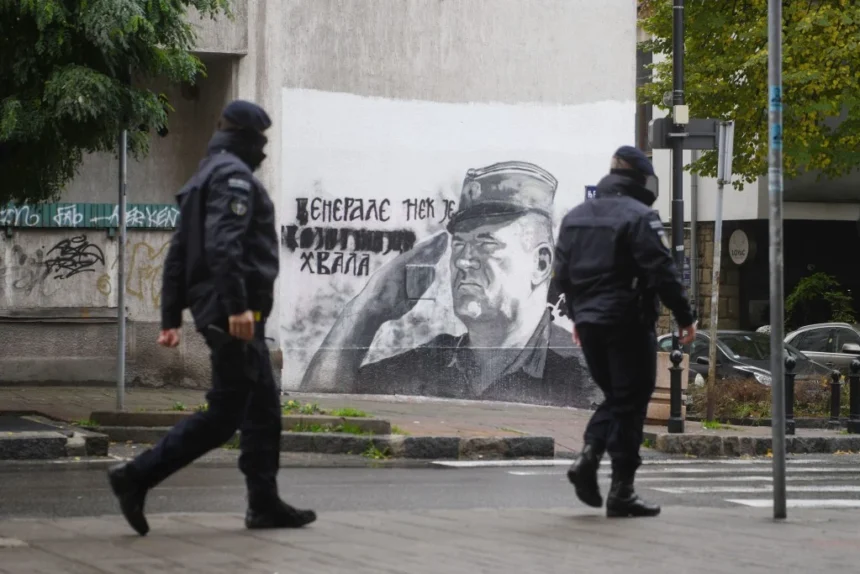
Nineteen years later, that exact opposition-era radical behavior has become standard state policy. By late 2023, independent monitoring watchdogs recorded over 250 state-protected murals celebrating Ratko Mladić in Belgrade alone. When human rights defenders Aida Ćorović and Jelena Jaćimović attempted to splash eggs at a Mladić mural on Vračar, the state apparatus deployed riot police to guard the painting and immediately arrested the female activists.
                [THE SELEKTIVNA PRAVDA (SELEKTIVNE JUSTICE) MATRIX]
                                         │
         ┌───────────────────────────────┴───────────────────────────────┐
         ▼                                                               ▼
   [PROTECTED STATE VANDALISM]                         [CRIMINALIZED CIVIL DISSENT]
   • 300+ murals of war criminals.              • Peaceful university sticky notes.
   • Slurs spray-painted on elementary school • Pre-election anti-corruption fliers.
   • Public property damage on highways.       • Anti-war symbols on public benches.
   STATUS: Fully guarded by plainclothes police. STATUS: Violent street beatings &          arrest.
The weaponization of street art also functions as a tool for political gaslighting. When right-wing elements under SNS direction plastered Belgrade with posters depicting opposition leaders wearing Albanian caps alongside Albin Kurti, the regime feigned ignorance. Yet, weeks later, one of the primary targets of those very “traitor” campaigns—Milica Đurđević Stamenkovski—was seamlessly co-opted into Vučić’s cabinet as a government minister, proving the ulični linč (street lynching) was merely a pre-planned theatrical staging tool.
The Iron Curtain of Belgrade Waterfront
The absolute proof that this vandalism is tightly regulated from the highest offices of the presidency lies in its strict, geographical boundaries. While historic university buildings, community nurseries, and public infrastructure are left to rot under layers of toxic nationalistic slurs, one specific zone remains pristine: Belgrade Waterfront (Beograd na Vodi).
The multi-billion-dollar luxury enclave—Vučić’s crown jewel of foreign investment and elite gentrification—features heavy private security, facial-recognition surveillance, and zero tolerance for spray paint.
     [VANDALISM SATURATION VS. REGIME REAL ESTATE]

     [Rural Towns / Public Universities]
     ██████████████████████████████ 100% Covered in State Hate Speech

     [Belgrade Waterfront Luxury Zone]
     ░░░░░░░░░░░░░░░░░░░░░░░░░░░░░░ 0% Tolerance / Absolute State Protection
“It is a highly corporate, perfectly executed sanitization project,” writes investigative journalist Sandra Petrušić. “While the rest of Serbia drowns in foul, aggressive state-sponsored graffiti, not a single drop of paint has ever touched the walls of Belgrade Waterfront. The message is clear: public space is a toilet for our political warfare, but our private luxury wealth is sacred.”
Escalation to the Boiling Point
As unmitigated corruption scandals rock the Ministry of Interior—most notably the visible power struggles surrounding controversial Belgrade Police Chief Veselin Milić—the regime is operating like a cornered animal.
“The collapse of Vučić’s genuine political potency is directly causing a progressive increase in state-sanctioned violence,” warns Oliver Tošković, a professor of psychology at the University of Belgrade. “When you suppress over half of a nation, blocking them from expressing their anxieties in parliament, on television, or through institutions, a revolt is inevitable.”
With the green light lit for violence, motorists have begun driving vehicles directly into student crowds, and opposition youth are regularly hospitalized after being jumped by unidentifiable men on the outskirts of Belgrade. By turning the country’s physical walls into extensions of its predatory tabloid machinery, the Vučić regime is not proving its strength—it is showcasing the frantic, desperate paranoia of an autocracy running out of time.