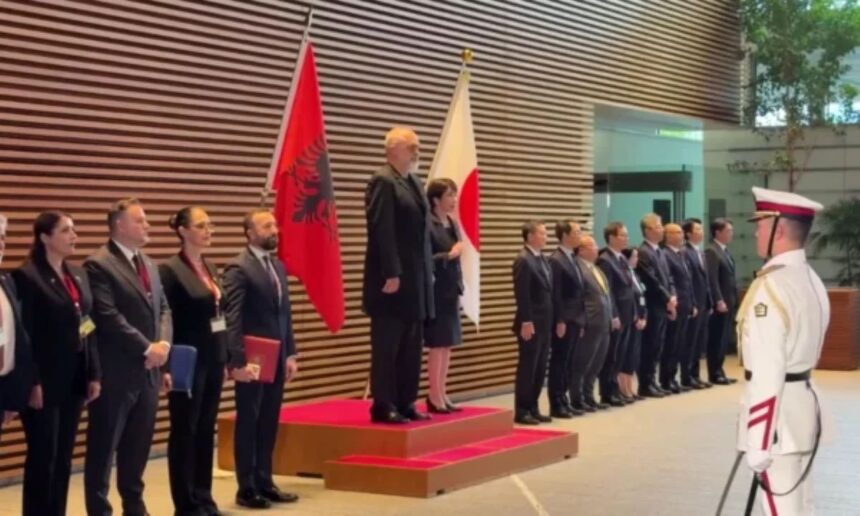
Albanian Prime Minister Edi Rama was received with full state honors in Tokyo today by his Japanese counterpart, Prime Minister Sanae Takaichi.
The high-level bilateral summit marks a significant diplomatic milestone, coming three years after Rama’s last official visit to Japan and representing the first formal face-to-face meeting between the two leaders since Takaichi made history as Japan’s first female Prime Minister.
Following an extensive closed-door security and economic review, the two heads of government issued a joint press declaration highlighting the interlocking security challenges facing the Euro-Atlantic and Indo-Pacific theaters.
   [JAPAN-ALBANIA STRATEGIC SUMMIT: HIGHLIGHTS]
   • Host City:        Tokyo, Japan
   • State Dignitaries: PM Sanae Takaichi & PM Edi Rama
   • Framework:        Western Balkans Cooperation Initiative (Established by late PM Shinzo Abe)
   • Core Alignment:   Albanian backing for a "Free and Open Indo-Pacific" (FOIP)
   • Security Maxim:   "The security of Europe, the Atlantic, and the Indo-Pacific is interconnected."
Anchoring Albania’s EU Integration Pathway
During her address, Prime Minister Takaichi highly commended Albania’s steady, constructive progress in its European Union accession negotiations. She explicitly reaffirmed that Tokyo will continue to deploy its diplomatic and developmental leverage to support Tirana’s integration into western institutional structures.
This support, Takaichi noted, operates under the structural umbrella of the Western Balkans Cooperation Initiative—a landmark geopolitical outreach framework originally launched by the late former Japanese Prime Minister Shinzo Abe.
“Albania is an important partner with whom we share common values and principles,” Takaichi stated. “We are pleased that Albania’s EU accession negotiations are progressing steadily. Japan will continue to strongly support Albania’s integration path.”
Intersecting Security: The Indo-Pacific and the Balkans
A core pillar of the summit was the explicit linkage of regional security architectures. Takaichi expressed deep gratitude for Albania’s proactive alignment with Japan’s maritime and geopolitical doctrine, specifically its vocal support for a “Free and Open Indo-Pacific” (FOIP).
                 [THE TWIN PILLARS OF THE UPDATED FOIP DOCTRINE]
                                       │
         ┌─────────────────────────────┴─────────────────────────────┐
         ▼                                                           ▼
   [AUTONOMY / VITALITY]                                      [SHARED RESILIENCE]
   Safeguarding independent supply chains and                 Uniting regional actors to withstand systemic
   sovereignty against unilateral territorial coercion.       pressures, creating a stronger, unified economic bloc.
The meeting coincided with the 10th anniversary of the FOIP declaration, prompting the Japanese government to introduce its newly updated, modernized vision for the doctrine. Takaichi explained that the revised framework elevates autonomy and resilience as core elements, aiming to fortify partner nations against external economic coercion or unilateral shifts in the rules-based international order.
A Comprehensive Partnership Matrix
Takaichi lauded Albania’s active, stabilizing diplomatic role within the historically complex Western Balkan landscape. As global geopolitical flashpoints multiply, both leaders emphasized that security vacuums can no longer be treated as isolated regional events.
| Strategic Domain | Agreement Baseline | Expected Diplomatic Impact |
| Balkan Stability | Japan recognizes Albania as an anchor of peace in Southeastern Europe. | Enhances Tirana’s profile as a reliable regional proxy for G7 democratic initiatives. |
| Updated FOIP Vision | Albania formalizes support for Japan’s new resilience-based maritime rules. | Seals a shared defense of open shipping lanes and anti-coercion frameworks. |
| Interconnected Security | Aligning Euro-Atlantic defenses with Pacific deterrence strategies. | Deepens intelligence sharing and joint political positioning at the United Nations. |
The summit concluded with both delegations committing to immediate follow-up ministerial rounds designed to translate the updated security architecture into tangible trade, technology transfer, and infrastructure investment pipelines between Tokyo and Tirana.