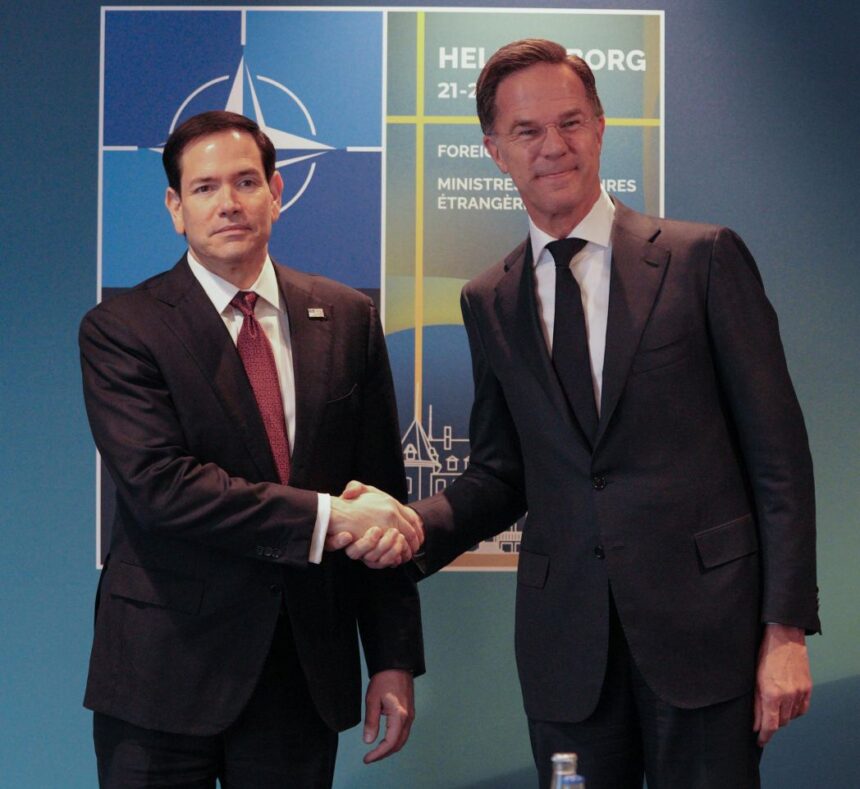
U.S. Secretary of State Marco Rubio held a highly critical, high-stakes bilateral summit today with NATO Secretary General Mark Rutte on the sidelines of the NATO Foreign Ministers’ Meeting in Helsingborg.
The meeting comes during a period of acute strain within the Alliance following recent geopolitical friction in the Middle East. While Rubio publicly struck a constructive tone regarding long-term defense deterrence, his demands ahead of the upcoming Ankara Summit highlight a firm Washington policy shift toward forcing European allies to achieve military self-reliance.
   [HELSINGBORG ALLIANCE BRIEF: MAY 22, 2026]
   • Principals:        U.S. Secretary of State Marco Rubio & NATO Sec-Gen Mark Rutte
   • Host Nation:       Sweden (Hosting its first ministerial since joining the alliance)
   • Core U.S. Mandate: Turn "The Hague" spending promises into tangible frontline capabilities.
   • Tactical Push:     Rapidly expand the transatlantic defense industrial production base.
   • Strategic Phrase:  "A stronger Europe means a stronger NATO."
Moving From Promises to Real Battlefront Readiness
Following the closed-door discussions, Secretary Rubio utilized social media platform X to issue an unequivocal mandate to European member states. Rubio insisted that the Alliance must use the upcoming July summit in Ankara to completely eliminate ambiguity regarding military production.
He stressed that the historic defense investment plan agreed upon at the previous summit in The Hague—where allies committed to reaching up to 5% of GDP spending by 2035—can no longer exist simply as line items on a budget.
“During my meeting with the NATO Secretary General, I emphasized that the Alliance must commit without any ambiguity at the Ankara Summit to rapidly ramp up defense production, expand our transatlantic defense industrial base, and turn spending pledges into real warfighting capabilities,” Rubio declared.
He framed the restructuring not as a withdrawal of American commitment, but as a necessary upgrade: “A stronger Europe means a stronger NATO.”
The U.S. Security Ultimeatum: The Burden Shifting Reality
The diplomatic pleasantries in Helsingborg mask deep underlying tensions. Before departing for Sweden, Rubio openly expressed Washington’s frustration with certain European allies who refused to grant the U.S. use of strategic military bases during recent regional operations in Iran.
The Pentagon is moving forward with plans to downscale certain conventional troop allocations within the NATO Force Model, a move Rutte acknowledged as an expected step toward ending European “over-reliance on a single ally.”
| Strategic Imperative | U.S. / NATO Baseline Position | Expected Structural Realignment |
| Industrial Production | Supply chains in both the U.S. and Europe are failing to produce enough conventional ammunition. | Opening new joint production lines across the Atlantic to secure stockpiles. |
| Command Restructuring | Transitioning responsibilities toward a “NATO 3.0” operational model. | Europe will assume the lead on all three Joint Force Commands; U.S. retains component leads. |
| Interoperability Safeguards | U.S. opposition to European protectionist trade laws that block American defense firms. | Eliminating regulatory hurdles to maximize weapon systems standardization. |
Freedom of Navigation and the Ukraine Cohort
Secretary General Rutte thanked the United States for maintaining the critical flow of American military hardware—including air defense interceptors for Patriot systems—which are increasingly being funded directly by European and Canadian allies.
However, Rutte and Rubio both emphasized that NATO’s security mandate is facing a wider geographic bottleneck. The two leaders heavily reviewed deteriorating maritime stability in the Middle East, specifically threats to the freedom of navigation in the Strait of Hormuz. Rutte noted that ministers are actively calculating how a unified transatlantic response can deter hostile state actions without compromising conventional defense lines along NATO’s Eastern Flank.