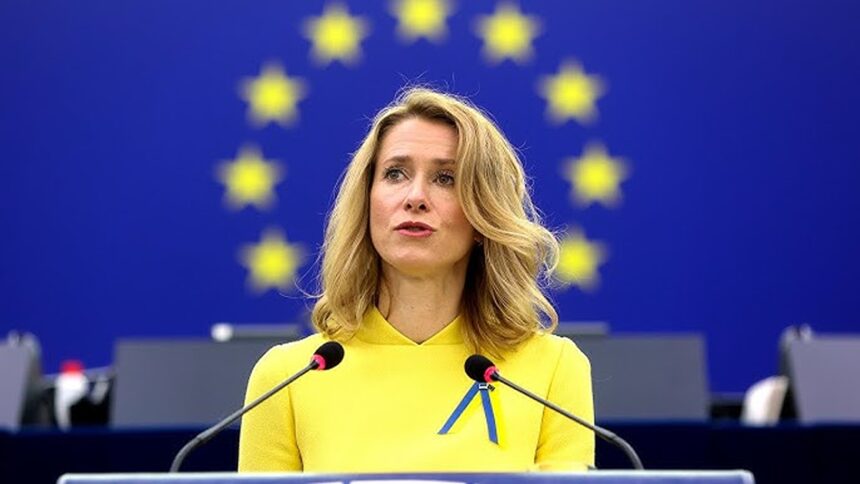
The European Union’s High Representative for Foreign Affairs and Security Policy, Kaja Kallas, confirmed on Thursday that EU member states are maintaining their full diplomatic presence in Kyiv. The decision directly contrasts with a sudden move by the United States to evacuate its personnel following explicit security warnings from Moscow.
The Kremlin recently issued highly targeted warnings to international missions in the Ukrainian capital, advising them to evacuate ahead of an imminent, intensified wave of strategic airstrikes.
“What we heard from Ukraine yesterday was that all embassies stayed except for one,” Kallas told reporters ahead of an EU Foreign Ministers summit in Cyprus. “All the Europeans stayed. America left.”
Standing Firm Against “Terror Tactics”
Kallas strongly condemned Moscow’s targeted threats against the international diplomatic corps, classifying the maneuvers as illegal coercion designed to psychologically fracture Ukrainian resilience. The vast majority of EU member states have issued coordinated public declarations affirming that their diplomatic staff will remain stationary in Kyiv.
According to the EU’s top diplomat, the threatened bombardment represents a clear pattern of asymmetric escalation in a conflict that has now raged for over four years.
“What they are doing now is actually increasing terrorist attacks—because you cannot describe it otherwise—creating fear within society,” Kallas declared during the ministerial assembly. “It has not worked for four years. I do not think it will work now.”
[Kyiv Diplomatic Stance Under Russian Air Threat]
├── European Union Core  --> Remaining In-Country (Refusing compliance with Moscow's warning)
├── International Blocs  --> Remaining In-Country (Maintaining strategic presence)
└── United States Mission --> Evacuated (Withdrawn following targeted missile warnings)
Escalating Sanctions and Regional Security Alignment
The diplomatic split over the evacuation of Kyiv arrives at a highly volatile moment for European security planners, who are concurrently managing multiple shifting geopolitical flashpoints.
| Conflict Theater | Current Operational Dynamic | EU Ministerial Focus |
| Ukraine-Russia War | Russia leveraging air supremacy threats to isolate Kyiv diplomatically. | Drafting a sweeping new package of economic sanctions to further cripple Moscow’s defense industrial complex. |
| Middle East Escalation | Direct military exchanges between the U.S. and Iran; intensified Israeli operations in southern Lebanon. | Assessing regional spillover risks and coordinating maritime defense lanes. |
| Balkan Stability | Leaked audio recordings exposing deep friction between Serbian President Aleksandar Vučić and local leaders. | Monitoring political instability in areas like Gračanica to prevent proxy interference. |
The Foreign Ministers’ summit is anticipated to finalize tougher compliance loops on existing sanctions while formally codifying the EU’s refusal to succumb to Moscow’s airspace ultimatums, reinforcing Brussels’ long-term geopolitical commitment to Ukraine.