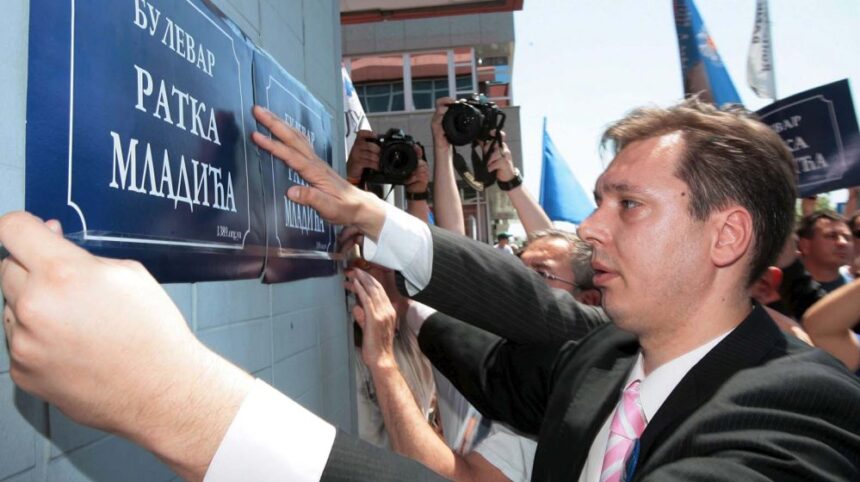
The arrest of former Bosnian Serb military commander Ratko Mladić in May 2011 prompted sharply contrasting reactions from Serbian and regional politicians. While some described the arrest as a necessary step toward justice and Serbia’s European integration, others condemned it or adopted deliberately ambiguous positions.
More than 15 years later, those earlier statements have taken on renewed significance following Mladić’s death and the state-linked honors surrounding his funeral in Belgrade.
Tadić: “The stain has been removed from Serbia”
Then-Serbian President Boris Tadić was the first senior official to address the arrest publicly after Mladić was captured in the village of Lazarevo near Zrenjanin.
Tadić described the arrest as an event that had “removed the stain from Serbia, all its citizens and the Serbian people wherever they live,” saying it brought an end to a difficult period in the country’s history.
He also said the arrest opened the door for Serbia to advance toward the European Union.
Tadić rejected suggestions that the timing of the arrest was politically calculated around the visit of then-EU foreign policy chief Catherine Ashton, saying Serbia had cooperated with the Hague Tribunal from the beginning.
He credited the Security Intelligence Agency, BIA, with making a major contribution to locating and arresting Mladić and said the state had fulfilled its responsibilities in accordance with the law.
Radicals: “A disgusting act”
The Serbian Radical Party took the opposite position.
Then-SRS vice president Dragan Todorović immediately announced protests following Mladić’s arrest. A demonstration was held several days later and ended in clashes between protesters and police, with arrests reported.
The Radicals described the arrest as a “disgusting act” and “one of the most difficult moments in Serbian history,” warning that it would not go unanswered.
Todorović portrayed Mladić as a symbol of the Serbian soldier and accused the government of taking away the country’s “honor and dignity.”
He later also accused Aleksandar Vučić of organizing incidents during the protest, an allegation Vučić denied.
Tomislav Nikolić: A deliberately ambiguous response
Tomislav Nikolić, who later became president of Serbia and had previously led the Serbian Progressive Party (SNS), responded to Mladić’s arrest in noticeably more cautious terms.
Nikolić said he was “truly surprised” by the arrest and described it as an operation that had apparently been prepared for a long time.
He argued that the arrest raised numerous questions for the Serbian government and criticized what he described as a lack of free media and transparency surrounding the operation.
Nikolić also said that, although the Hague Tribunal was seeking Mladić, Serbian authorities had never succeeded in presenting him to the public as a criminal or villain.
He said he had learned about the arrest from Zagreb.
Vučić: The arrest was a political decision by the authorities
A day after the arrest, then-SNS vice president Aleksandar Vučić read the party’s statement.
Vučić said the government had known Mladić’s whereabouts for a long time but had misled both the domestic and international public.
According to the SNS statement, Mladić had been arrested at a moment when the authorities considered it politically advantageous.
Vučić described the operation as a poorly staged political performance and accused the ruling Democratic Party of exploiting the arrest for partisan purposes.
However, like Nikolić, he did not clearly condemn the arrest or explicitly defend Mladić.
Instead, Vučić acknowledged that Serbia had an international obligation to arrest Mladić while simultaneously emphasizing what he described as a legal and moral obligation to arrest perpetrators of crimes against Serbs.
His position therefore combined acceptance of the international obligation with criticism of the government’s handling of the arrest.
Dačić: A technical account of the operation
Then-Interior Minister Ivica Dačić largely avoided political commentary.
On the day of the arrest, he provided details about the operation, saying no firearms had been used and that Mladić had not resisted arrest.
Dačić said the operation had been jointly carried out by the Ministry of Interior and BIA and confirmed that a man found in Lazarevo had subsequently been identified as Ratko Mladić.
Čedomir Jovanović: “The end of a decade of agony”
Liberal Democratic Party leader Čedomir Jovanović welcomed the arrest as the end of what he described as a decade of suffering and political agony.
Jovanović credited the governments of Zoran Đinđić and Boris Tadić with pursuing the process of cooperation with the Hague Tribunal and said Mladić’s arrest completed an obligation Serbia had to itself, its neighbors and its future.
He argued that bringing Mladić before the tribunal was not only important for the victims and their families, but also represented an opportunity for Serbian society to shed the burden associated with the crimes of the 1990s.
Reactions from Bosnia and Herzegovina
The arrest also drew immediate reactions from political leaders in Bosnia and Herzegovina.
Bakir Izetbegović, then a member of the Presidency of Bosnia and Herzegovina, called the arrest “a good day for Bosnia and Herzegovina.”
He said it was significant for victims of Mladić’s campaigns and for the future of Bosnia and the wider region, arguing that justice had been slow but inevitable.
Croatian member of the Presidency Željko Komšić said he was pleased that Mladić had been arrested and would face trial for his crimes.
Komšić argued that Serbian authorities had known where Mladić and former Bosnian Serb leader Radovan Karadžić were hiding and suggested that both had been used as leverage in Serbia’s negotiations with the European Union.
He said Mladić’s arrest came only after the EU had made cooperation with the Hague Tribunal an explicit condition for Serbia’s further European integration.
Dodik in 2011: Institutions Will Not Defend War Criminals
Milorad Dodik, who was then president of Republika Srpska and attended Mladić’s funeral in Belgrade in 2026, also reacted to the arrest.
At the time, Dodik said Republika Srpska’s institutions had neither defended nor intended to defend anyone who had committed war crimes, regardless of their nationality or religion.
He said Mladić’s arrest would not affect peace and stability in Republika Srpska and maintained that all individuals responsible for war crimes should be held accountable.
More than a decade later, Dodik’s presence at Mladić’s funeral has placed those earlier statements in a strikingly different political context.
A revealing contrast with 2026
The reactions from 2011 are particularly significant because several political figures who occupied different positions toward Mladić at the time have since become part of Serbia’s broader political establishment or have publicly participated in events surrounding his legacy.
Vučić’s 2011 position was neither an outright defense of Mladić nor an unqualified endorsement of the arrest. Instead, he framed the issue around Serbia’s international obligations while attacking the government’s political handling of the case.
The contrast with the political environment surrounding Mladić’s 2026 funeral has intensified scrutiny of how Serbian political discourse toward the convicted war criminal has evolved.
In 2011, Serbia’s cooperation with the Hague Tribunal and the arrest of Mladić were presented by the country’s pro-European leadership as necessary steps toward confronting the past and advancing toward the EU.
In 2026, the participation of senior Serbian officials, military representatives, members of the Serbian Orthodox Church and political figures from Serbia and Republika Srpska in Mladić’s funeral has prompted condemnation from Brussels and renewed questions about Serbia’s commitment to reconciliation and European values.
The evolution of the political rhetoric surrounding Mladić therefore offers a revealing window into Serbia’s unresolved struggle over the legacy of the 1990s wars — and over the meaning of its European future.