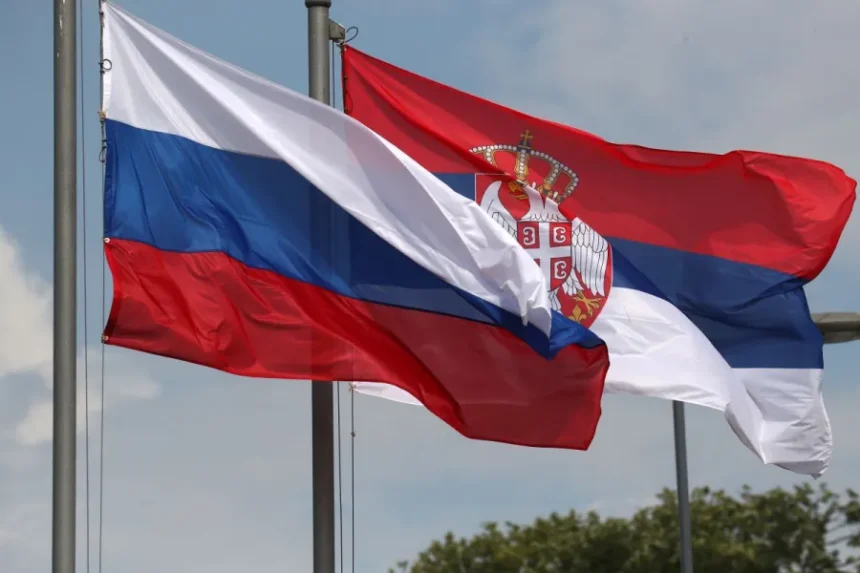
A joint investigation highlighted by the BBC has exposed an extensive, active network of dozens of Serbian-Russian organizations operating inside Serbia that are directly aligned with Kremlin-backed entities.
Despite official diplomatic shifts, these groups are successfully embedding Russian state propaganda into local media, political speeches, and public cultural events under the banner of historical Slavic “brotherhood.”
According to official data retrieved from the Serbian Business Registers Agency, numerous registered civic associations are actively collaborating with sanctioned state organs of the Russian Federation. At the center of this network sits the Pravfond foundation—an organization explicitly placed under strict European Union sanctions for acting as a tactical tool for Russian influence operations.
Inside the Kremlin’s Narrative Machine
The European Union has formally accused foundations like Pravfond and Russkiy Mir (Russian World) of functioning as weaponized conduits for asymmetric warfare. Rather than providing harmless cultural exchange, these groups fund media projects, public rallies, and digital campaigns aimed at poisoning public perception against the West and Euro-Atlantic integration.
[The Kremlin's Core Balkan Narrative Pipeline]
  Funding & Directives (Pravfond / Russkiy Mir)
                      │
                      ▼
  Local Delivery (Serbian-Russian Civic Networks)
                      │
                      ├─► "Denazification" Claims (Legitimizing the Ukraine invasion)
                      ├─► Manufactured "Russophobia" (Fanning regional victimhood)
                      └─► Anti-Western Sentiment (Stalling EU Expansion)
While Brussels flags these activities as subversion, the Russian Federation has officially rejected the allegations, maintaining that the funds exist solely to offer legal and consular “assistance to Russian citizens residing abroad.”
Beyond Politics: Deep Penetration of Serbian Civil Society
Security analysts warn that the danger of these organizations lies in their societal reach. Rather than merely lobbying high-ranking politicians, these networks are systematically targeting everyday public spheres.
“Serbian-Russian organizations serve to expand Russian influence across the entirety of Serbian society, injecting these narratives deep into social structures rather than just at the executive political level,” stated Srđan Cvijić, President of the International Advisory Committee at the Belgrade Centre for Security Policy (BCSP).
Belgrade’s Delicate Geopolitical Balancing Act
The revelation of this unchecked propaganda network underscores Serbia’s highly controversial position in European geopolitics. Belgrade remains one of the sole capitals on the European continent that has steadfastly refused to align with EU sanctions against Russia following the 2022 invasion of Ukraine.
| Geopolitical Friction Points | Strategic Alignment | Undercurrent of Tension |
| Sanctions Regime | Refusal to implement EU sanctions against Moscow. | Strains accession negotiations with the European Union. |
| Energy Sector | Heavily dependent on Russian energy infrastructure. | Complicated by the status and future of the NIS petroleum company. |
| Defense & Logistics | Maintains strategic communication lines with the Kremlin. | Severely strained by covert Serbian ammunition and arms exports flowing to Ukraine. |
Western intelligence reports emphasize that Moscow is intentionally using its deep-seated cultural presence in Belgrade to maintain a geopolitical foothold in the Western Balkans. By saturating the local information space with pro-Kremlin rhetoric, Russia continues to build a structural firewall designed to stall the European Union’s expansion into the region.