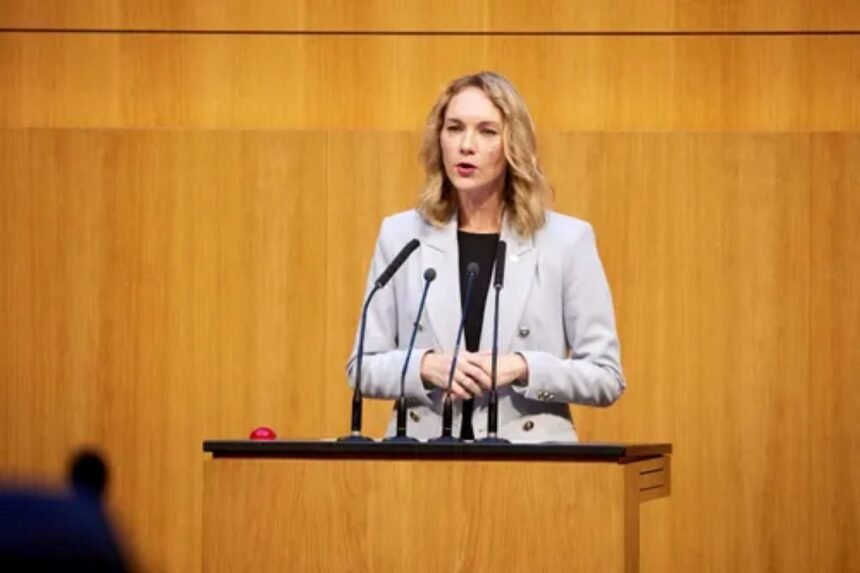
Following an official political mission to Belgrade, Pia Maria Wieninger, the European Affairs Spokesperson for the Social Democratic Party of Austria (SPÖ), has issued a sharp condemnation of Serbia’s current political climate. In an official dispatch carried by the Austrian press agency OTS, Wieninger voiced unconditional solidarity with Serbia’s democratic and pro-European forces, asserting that the state has reached a critical historical crossroads.
Wieninger’s working visit included a series of high-level meetings in the Serbian capital with pro-European opposition lawmakers, human rights NGOs, civil society representatives, and mobilized student leaders who have spearheaded months of civil demonstrations against the regime.
1. The Core Observations: Repression, Corruption, and Institutional Fear
The primary focus of Wieninger’s fact-finding meetings in Belgrade centered on what she identified as a systemic backsliding of democratic norms under the administration of President Aleksandar Vučić.
               [AUSTRIAN SPÖ EVALUATION OF SERBIA'S CROSSROADS]

  Current Authoritarian Pathway ────────────────► Necessary European Pathway

  • Persistent harassment of demonstrators.       • Formal freeze of EU accession funds.
  • Stalled probe into the Novi Sad tragedy.      • Deployment of targeted human rights sanctions.
  • Undermining Venice Commission rules.          • Total synchronization of voter registries.
Wieninger explicitly called out the state apparatus for utilizing intimidating police actions and administrative harassment to muzzle civic demonstrators. The SPÖ spokesperson emphasized that the ongoing, massive public protests across major Serbian cities are a direct, legitimate demand by ordinary citizens for the restoration of the rule of law and an authentically European future.
Pia Maria Wieninger (SPÖ): “I stand shoulder to shoulder with the citizens of Serbia who are taking to the streets to fight for democracy, human rights, and the rule of law. Serbia is at a definitive crossroads: it will either choose to continue down an authoritarian path or it will choose the European path.”
2. Concrete Electoral Mandates and Judicial Demands
Wieninger stated that if President Vučić intends to maintain a shred of international credibility regarding Serbia’s stalled EU accession process, his administration must immediately transition from superficial announcements to concrete, measurable reforms.
The SPÖ delegation outlined an immediate list of structural corrections necessary to guarantee an authentic democratic process ahead of Serbia’s upcoming elections:
- Independent Novi Sad Investigation: An immediate, absolute halt to executive interference regarding the legal investigation into the fatal infrastructure collapse in Novi Sad, allowing independent prosecutors to hold high-ranking political figures accountable.
- Adherence to International Baselines: Complete compliance and swift implementation of all outstanding regulatory recommendations issued by the Venice Commission and the OSCE/ODIHR.
- Voter Registry Clean-up: Undergoing a completely transparent audit and synchronization of the national voter lists to eliminate systemic electoral fraud tied to artificial residency manipulation.
- Press Protections: Re-establishing media pluralism by securing the functional independence of journalists and ensuring the safety of domestic and international election observers.
3. A Call for Hardline EU Pushback: Funding Freezes and Sanctions
Wieninger strongly endorsed the European Union’s recent shift toward a significantly tougher diplomatic posture against Belgrade. She labeled the freezing of EU pre-accession development funds over systemic judicial failures as a necessary, correct baseline signal.
However, the Austrian politician argued that Brussels must go further to isolate those directly organizing the state-sponsored crackdowns. She called for the immediate introduction of targeted, Magnitsky-style individual sanctions against specific Serbian government ministers and police commanders directly responsible for severe human rights violations against peaceful protesters.
Wieninger concluded by calling on the broader European political family to actively support the pro-European opposition as they attempt to channel the momentum from the streets into a unified, credible electoral alternative, warning that “Europe must not leave the citizens of Serbia standing alone on this path.”