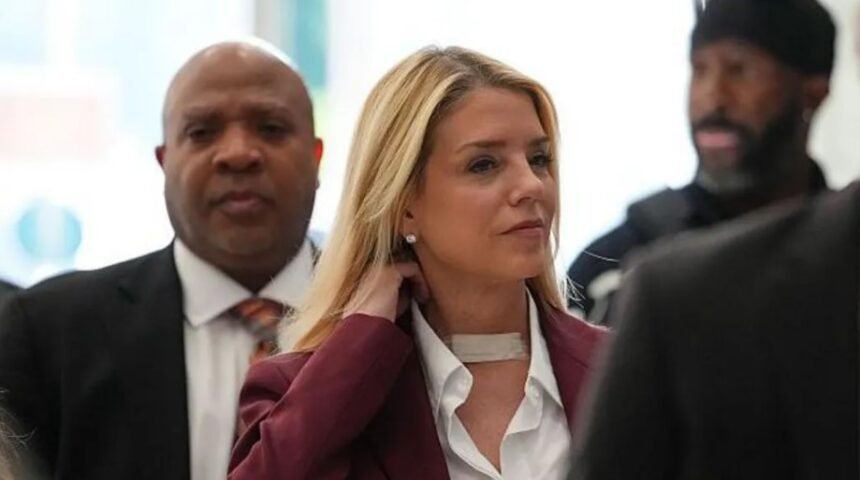
Former United States Attorney General Pam Bondi forcefully defended her record and the Department of Justice’s integrity on Friday, May 29, 2026, during a highly anticipated, closed-door deposition before the House Oversight Committee.
The high-stakes congressional hearing centered on the executive execution of the “Epstein Materials Transparency Act”—a piece of legislation signed into law by President Donald Trump mandating the public disclosure of declassified DOJ files regarding deceased sex offender Jeffrey Epstein.
Bondi, who left her post as Attorney General just weeks prior in April 2026, faced intense grilling from both sides of the aisle regarding allegations of bureaucratic stonewalling, political cover-ups, and the improper exposure of sensitive victim identities.
1. The Core Defense: “Unprecedented Transparence”
In her opening remarks obtained by investigators, Bondi rejected claims that the Trump administration deliberately withheld crucial evidence or protected high-profile individuals tied to Epstein’s international sex-trafficking ring.
Bondi asserted that under her stewardship, the Department of Justice undertook a massive logistical effort to review and clear archives that had been hidden from the public for years.
- Document Volume: The DOJ successfully processed and released nearly 3 million pages of internal investigative files, electronic communications, and deposition transcripts.
- Compliance: Bondi maintained that to the absolute best of her knowledge, the department thoroughly complied with the statutory parameters set by Congress, releasing everything legally permitted.
Former AG Pam Bondi:
“We demonstrated an unprecedented commitment to transparency in the searching, collection, and reviewing of the Epstein files… This was an extraordinarily complex and highly burdened process. I am proud of the record and the commitment to transparency under my direction.”
2. Bi-Partisan Friction: Cover-Up Accusations vs. Executive Privilege
Despite Bondi’s defense, the hearing quickly devolved into a political battleground, with lawmakers attacking her testimony from completely different operational angles.
                      [THE EPISTEIN DISCLOSURE CONTROVERSY]

  Republican Oversight Angle ───────────────────► Democratic Oversight Angle

  "Investigating potential DOJ mismanagement     "Accusing Bondi of a systemic cover-up
   and failure to fully declassify files          and using government lawyers to stonewall
   owed to the trafficking victims."             questions regarding President Trump."
The Republican Oversight Focus
Committee Chairman James Comer (R-KY) stated that the primary objective of the ongoing investigation is to determine whether “potential mismanagement” took place during the document dumps. Comer argued that consecutive presidential administrations had historically failed Epstein’s victims.
The inquiry was heavily pushed by Representative Nancy Mace (R-SC), who had publicly accused the DOJ of a “cover-up” in early 2026, triggering the formal subpoena that brought Bondi to Capitol Hill.
The Democratic Pushback
Following hours of testimony, committee Democrats vehemently accused Bondi and her legal entourage of structural stonewalling and evasive maneuvering.
- Robert Garcia (D-CA): Revealed to reporters that Bondi flatly refused to answer any substantive questions that directly intersected with or mentioned President Donald Trump.
- Melanie Stansbury (D-NM): Labeled the entire closed-door process an ongoing “cover-up,” detailing how active government and personal attorneys repeatedly intervened to block Bondi from answering specific operational questions about the active files.
3. The “Client List” Contradiction and Political Fallout
A major point of contention during the deposition was a highly controversial public statement made by Bondi in February 2025. During a media interview, Bondi explicitly claimed that an definitive “Epstein client list” was sitting directly “on her desk.”
The claim caused an international media frenzy, but the Department of Justice was subsequently forced to issue an embarrassing walk-back, formally stating that no such single, comprehensive “client list” document existed within federal databases. Lawmakers pressed Bondi to clarify whether she had intentionally misled the public or if specific files had been scrubbed prior to her resignation.
| Phase of Mandate | Key Event / Controversy | Operational Impact |
| Feb 2025 | Bondi claims an official “client list” is on her desk. | DOJ later denies the document exists, sparking cover-up allegations. |
| March 2026 | Representative Nancy Mace demands a congressional subpoena. | Bondi is formally ordered to testify before the House Oversight Committee. |
| April 2026 | President Trump replaces Bondi with Todd Blanche. | Bondi exits the DOJ under a cloud of bi-partisan criticism over redacted files. |
| May 2026 | Bondi testifies behind closed doors in Washington. | Government lawyers invoke privilege; Democrats call the process a sham. |
Furthermore, the document dumps faced severe backlash from civil liberties groups and victims’ rights advocates, who discovered that the DOJ had accidentally published unredacted materials that inadvertently risked exposing the real identities of Epstein’s underage victims.
Jeffrey Epstein died by an alleged suicide in a federal jail cell in 2019 while awaiting trial for sex trafficking. Following Bondi’s sudden departure in April 2026, her post was filled by Todd Blanche, who inherited the messy, ongoing legal and political fallout of the transparency act.