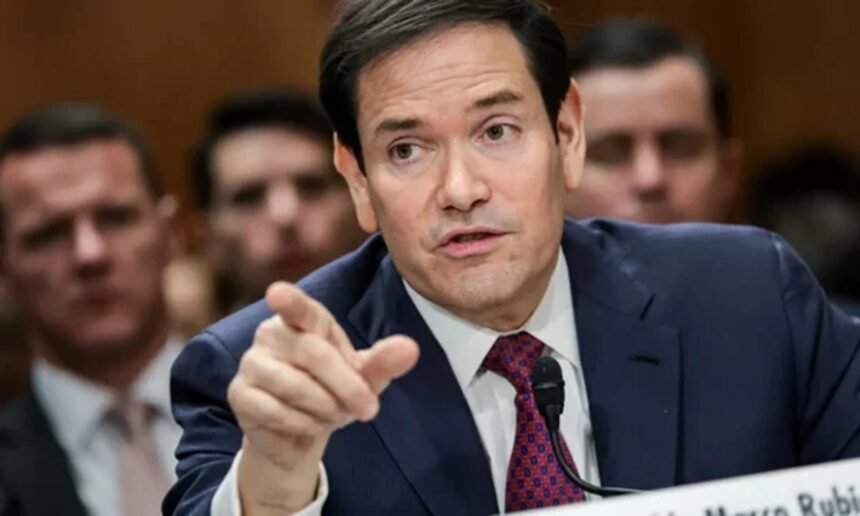
United States Secretary of State Marco Rubio announced on Tuesday, June 2, 2026, that the Trump administration is actively engaged in high-stakes negotiations with Iran, revealing that Tehran has expressed an unprecedented willingness to negotiate parts of its nuclear program.
Testifying before the Senate Foreign Relations Committee on the State Department’s budget request, Rubio provided the public with the administration’s most detailed breakdown to date regarding the diplomatic framework intended to halt the ongoing US-Israeli war with Iran. Rubio noted that an interim memorandum of understanding to extend the current ceasefire could materialize “today, tomorrow, or next week,” though he stressed that any final accord must satisfy rigorous congressional oversight.
The Two-Phase Strategy: Hormuz First, Nuclear Second
Secretary Rubio explicitly outlined a strict, sequential two-phase negotiating strategy. He informed senators that the United States will not entertain broader diplomatic agreements or offer concessions until Tehran completely relinquishes its aggressive blockade of regional trade.
[US-Iran Sequential Peace Framework]
PHASE 1: THE PREREQUISITE (Non-Negotiable)
  └── Iran reopens the Strait of Hormuz ──> Free transit, zero tolls, & mine clearance.
            │
            ▼
PHASE 2: Delineated Negotiations (30-90 Days)
  ├── Disposal of all highly enriched uranium reserves deep in mountain bunkers.
  └── Legal commitment to severe, long-term limitations or cancellation of enrichment.
To cross the threshold into phase two, Rubio demanded that Iran must clearly fulfill the following conditions in the waterway:
- Guaranteed Safe Passage: Commercial and international vessels must be permitted to transit international waters freely without being targeted by Iranian anti-ship missiles or loitering drones.
- No Transit Tolls: Iran must cease all unlawful attempts to levy arbitrary transit fees or tariffs on ships moving through the strategic chokepoint.
- Joint Mine Clearance: Tehran must actively cooperate in detecting and removing naval mines deployed throughout the Persian Gulf since hostilities escalated in late February.
Clarification on Sanctions Relief and the Enriched Uranium Bottleneck
During sharp questioning from committee members, Rubio dismantled rumors circulating in international markets that Washington had offered immediate economic relief simply to restore global oil transit lines.
“No, that has not been discussed,” Rubio stated firmly. “Iran will not get sanctions relief just because they open the Strait of Hormuz. Any sanctions relief is strictly condition-based, which means it must be in return for the reason those sanctions were put in place in the first place—their nuclear program.”
   [The Sanctions Equilibrium]
   Reopening Strait of Hormuz ──> Does NOT trigger Sanctions Relief ❌
   Nuclear Disarmament & Audits ──> TRIGGERS Phased Sanctions Relief
Once the Strait is cleared, Phase Two will require a specialized team of international nuclear experts to convene over a 30-to-90-day window. Rubio emphasized that the administration’s baseline demand includes the physical removal and foreign disposal of Iran’s highly enriched uranium stockpiles, alongside severe, verifiable caps on its domestic enrichment infrastructure.
Assessing Iran’s Degraded Military Capabilities
Defending the Trump administration’s decisions to launch intense, targeted military campaigns against Iranian installations, Rubio argued that the joint US-Israeli coalition had successfully achieved its objective of breaking Tehran’s conventional defense core.
According to the Secretary, specialized strikes have crippled Iran’s long-range ballistic missile production facilities and radar command networks. However, Rubio acknowledged that the asymmetric threat remains high, noting that Iran maintains a vast arsenal of low-cost, easily manufactured attack drones that continue to threaten regional stability.
He concluded by noting that while internal division and communication delays within the postwar Iranian regime—now led by Supreme Leader Mojtaba Khamenei—have slowed the pace of diplomacy, the United States remains committed to seeing if a verifiable diplomatic resolution can be finalized.