Today marks the 27th anniversary of the historic withdrawal of Serbian military and paramilitary forces from Kosovo, a pivotal moment that effectively brought an end to decades of repressive systemic occupation and triggered the birth of modern, self-governing Kosovo.
The withdrawal was the direct result of a crushing two-pronged strategic reality: the relentless ground campaign executed by the Kosovo Liberation Army (KLA) and the 78-day aerial bombardment campaign launched by NATO, which together forced the Yugoslav leadership into an unconditional military capitulation.
The Kumanovo Agreement: The Document of Capitulation
The legal architecture for the withdrawal was cemented on June 9, 1999, through the signing of the Military-Technical Agreement in Kumanovo (modern-day North Macedonia).
This historic accord was signed by two contrasting figures:
- General Sir Michael Jackson: The highly decorated British officer who would step forward as the very first supreme commander of the NATO-led KFOR peacekeeping mission inside Kosovo.
- General Nebojša Pavković: The then-Chief of General Staff of the Yugoslav Armed Forces, who was subsequently indicted, extradited, and convicted by the International Criminal Tribunal for the former Yugoslavia (ICTY) in The Hague for war crimes, crimes against humanity, and orchestrating mass deportations in Kosovo.
Following the signing, on June 10, 1999, NATO Supreme Allied Commander General Wesley Clark formally reported to the North Atlantic Council that the air campaign had successfully achieved its strategic core objective. Consequently, the devastating airstrikes were halted as columns of Serbian military vehicles began their complete, monitored exit from Kosovo territory.
The June 1999 Transition Timeline
 ├── June 9: Kumanovo Military-Technical Agreement signed
 ├── June 10: NATO halts 78 days of airstrikes as Serbian retreat begins
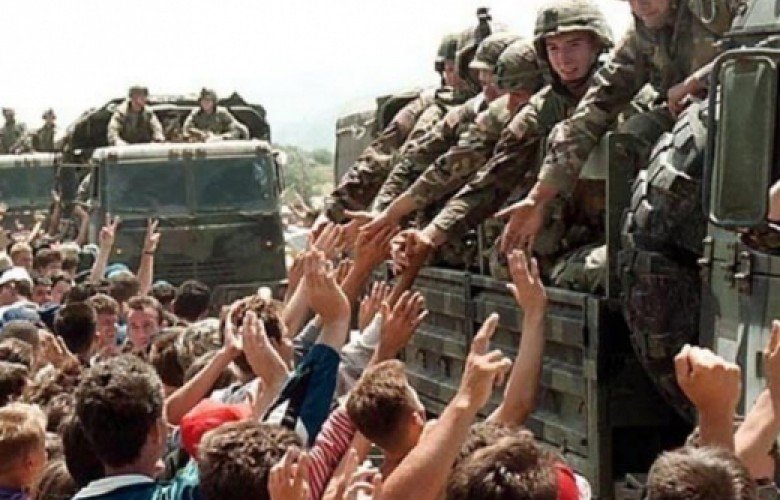
 └── June 12: KFOR troops enter Kosovo alongside the deployment of UNMIK
The Dawn of Global Administration and Sovereignty
The vacuum left by the departing Serbian forces opened the floodgates for a massive, coordinated international civilian and security deployment.
The Dual Pillars of the Transitional Era:
- KFOR (Kosovo Force): NATO deployed tens of thousands of international peacekeepers to permanently secure Kosovo’s state borders, enforce demilitarization, and establish a safe and secure environment for returning refugees.
- UNMIK (United Nations Interim Administration Mission in Kosovo): Under UN Security Council Resolution 1244, the United Nations established a sweeping interim civil administration. UNMIK assumed full executive and legislative control, building democratic self-governing institutions from scratch.
This intensive period of transitional global administration served as the foundational bedrock for the country, protecting the territory and paving the legislative path until Kosovo officially and irrevocably declared its Independence on February 17, 2008. Today, the anniversary stands across Kosovo as a solemn monument to the immense sacrifices of the liberation war and the critical international alliances that permanently altered the geopolitical landscape of the Balkans.