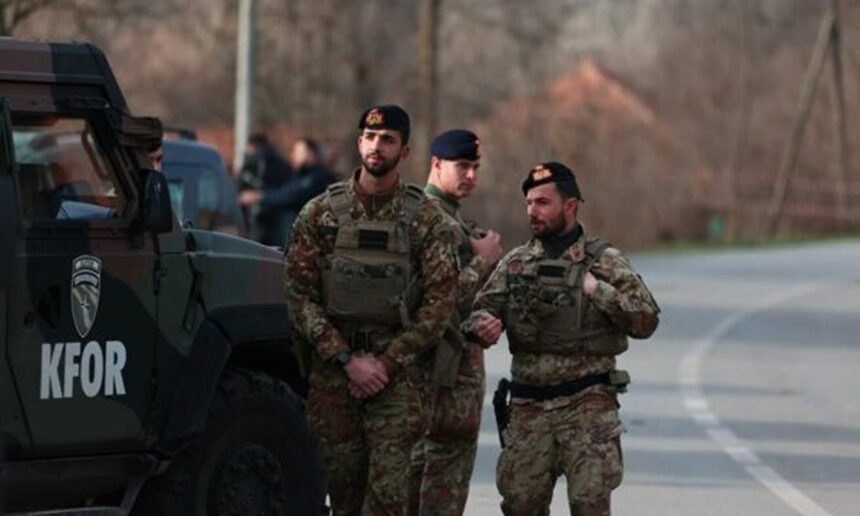
The NATO peacekeeping mission in Kosovo, KFOR, continues to be one of the main security guarantees in the country, with a total of 4,657 soldiers deployed from 31 countries worldwide.
According to the latest data, Italy provides the largest contingent with 907 troops, followed by the United States with 590, Hungary with 408, and Turkey with 382 personnel. These four countries together account for nearly half of KFOR’s forces in Kosovo.
Among the major contributors are also Germany with 308 soldiers, Poland with 247, Switzerland with 200, and Romania with 188 troops.
From regional countries, Albania contributes 126 soldiers, Croatia 151, and North Macedonia 70 troops.
Other participating nations include various European countries and NATO partners such as the United Kingdom, Finland, Greece, Austria, and Canada.
The Supreme Allied Commander Europe, U.S. Air Force General Alexus G. Grynkewich, said that NATO will gradually adjust the force supporting its peacekeeping mission in Kosovo (KFOR) over the coming year due to what he described as improvements in the security situation in the country.
“NATO and KFOR remain committed to security in Kosovo,” General Grynkewich said in a statement on June 12. “This commitment has contributed to increased stability as security organizations in Kosovo have become more capable. The current conditions provide an opportunity to optimize the size and posture of KFOR,” he added.
The NATO peacekeeping mission in Kosovo was deployed in 1999. From nearly 50,000 troops at the time of deployment after the end of the war, the mission now consists of around 4,600 peacekeepers from various countries.
KFOR is the third security responder in Kosovo, after the Kosovo Police and the EU Rule of Law Mission (EULEX). The mission is also responsible for security along Kosovo’s border with Serbia.
In a NATO statement marking the 27th anniversary of the entry of its troops into Kosovo following the alliance’s air campaign against Serbian targets, it was stated that the security situation has continued to improve in recent years. For this reason, NATO suspended the deployment of reserve forces to KFOR in January after nearly two years of continuous rotations.
“While the security situation in Kosovo remains generally stable, NATO will optimize the presence of KFOR and gradually adjust its current force posture over the coming year,” the alliance said.
The changes will be gradual and based on conditions on the ground and can be reversed if necessary, NATO added.
The alliance also recalled that it increased its deployment by nearly 1,000 additional troops following tensions and violence in 2023, including “unprovoked attacks against KFOR peacekeepers in Zvečan.” This reinforcement was described as the largest in over a decade.
On May 29, 2023, 93 KFOR personnel were injured during clashes with Serbian protesters who opposed the installation of Albanian mayors in four Serb-majority municipalities in the north. Injuries were also reported among protesters.
So far, several individuals have been convicted for the violence in Zvečan.
In addition to securing the border between Kosovo and Serbia, KFOR also has a role in maintaining security in the northern part of Kosovo.
Under a 2013 commitment, Kosovo cannot deploy the Kosovo Security Force (KSF) — which is in the process of transforming into an army — in the north without prior approval from KFOR.
This commitment was made through a letter sent by then-Prime Minister Hashim Thaçi to then-NATO Secretary General Anders Fogh Rasmussen. It remains in force today despite changes in the KSF mandate.
NATO also said it continues to support the dialogue on normalizing relations between Kosovo and Serbia, facilitated by the European Union, calling on both sides to resolve disputes and reach a settlement that respects the rights of all communities.
“This is key for long-term security in Kosovo and stability in the region,” KFOR stated.
General Grynkewich also said NATO remains committed to the Western Balkans, describing it as a strategically important region for the alliance, whose security is directly linked to Euro-Atlantic security, adding that NATO will not allow a security vacuum to emerge.