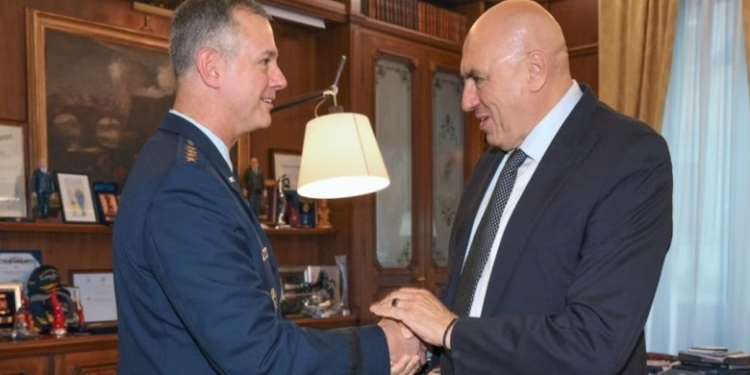
Italian Defense Minister Guido Crosetto hosted U.S. Air Force General Alexus G. Grynkewich, NATO’s Supreme Allied Commander Europe (SACEUR), for a high-level security meeting in Rome.
The defense talks focused on evaluating current security threats across the European continent, with a strong emphasis on maintaining stability in Kosovo and coordinating military strategy along NATO’s Southern Flank.
Stabilizing the Western Balkans and the Southern Flank
During the bilateral session, General Grynkewich expressed deep gratitude to Italy for its substantial military assets and personnel dedicated to the alliance’s joint operational defense.
- The Kosovo Mandate: The leaders conducted a thorough assessment of active operations in the Western Balkans. Italy remains one of the largest troop contributors to NATO’s KFOR mission in Kosovo, a presence viewed by both officials as crucial to preventing regional flare-ups.
- The Southern Flank: The commanders mapped out response protocols for geopolitical volatility impacting Mediterranean security corridors, reinforcing defensive positions against unconventional security threats.
NATO Continental Defense Brief (June 2026)
========================================================================
SACEUR Commander --> General Alexus G. Grynkewich, USAF.
Host Representative--> Guido Crosetto, Italian Minister of Defense.
Primary Operations --> KFOR (Kosovo Stabilization) & Southern Flank Security.
Strategic Doctrine --> Reinforcing the "European Pillar" beyond EU borders.
========================================================================
Reinforcing NATO’s “European Pillar”
A central theme of the Rome summit was the long-term structural evolution of transatlantic defense coordination. Crosetto and Grynkewich extensively discussed the concept of building a more autonomous “European Pillar” within NATO.
The leaders noted that this continental defense architecture must be robust enough to project stability beyond the territorial borders of the 27 European Union member states. This joint position aligns closely with recent E5 defense declarations in Berlin, where continental powers pledged to take greater operational responsibility for shared transatlantic security while keeping Western partners integrated.