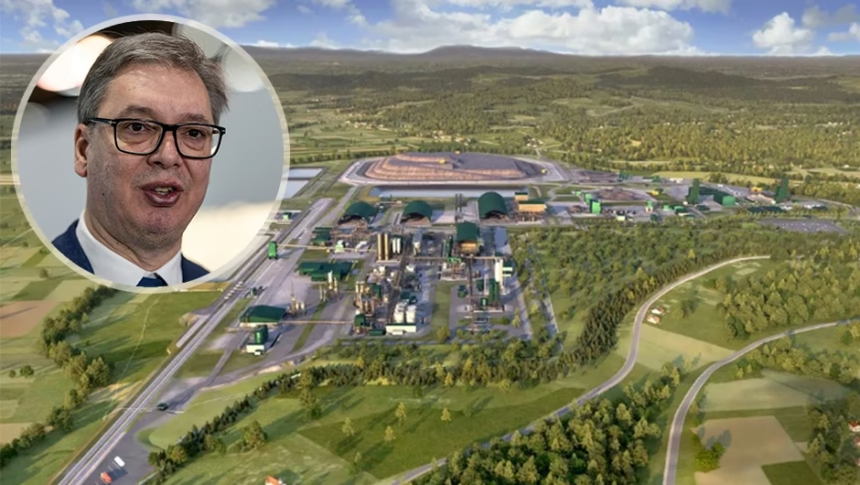
A joint investigative report published by the Balkan Investigative Reporting Network (BIRN) and German magazine Der Spiegel has exposed Jörg Heeskens, a long-time adviser to Serbian President Aleksandar Vučić, as the central operative driving Germany’s behind-the-scenes push to secure lithium mining rights in western Serbia.
The investigation, compiled from six months of freedom of information requests from German federal institutions, reveals that Heeskens has been funded entirely by the German government while operating from inside the Serbian presidential palace. The arrangement has triggered intense constitutional, legal, and national security questions in Belgrade, highlighting a geopolitical strategy critics call “stabilocracy”—where Western powers tolerate democratic backsliding in exchange for economic or raw material concessions.
Thirteen Years as the President’s “Shadow”
Heeskens has served as Vučić’s close confidant continuously since September 2013, advising him across his tenures as Minister of Defense, Prime Minister, and ultimately within the presidential cabinet at Andrićev Venac.
The depth of their personal relationship was colorfully illustrated by Vučić himself during a February 2023 factory opening for German automotive giant Continental, where the president remarked: “I call him ‘my Swabian’ [German], he calls me ‘my wild Serb.’ That is how we exchange compliments.”
The Institutional Footprint of Jörg Heeskens (2013–2026)
========================================================================
Funding Source      --> Exclusively German Government via GIZ (since Aug 2020).
Total Budget Floor  --> €1.3 Million allocated for his GIZ partnership through Dec 2026.
Real Estate Status  --> Owner of a luxury 112 m² apartment in the controversial Belgrade Waterfront.
Private Interests   --> Co-owner (41.6% stake) of Serbian fruit company "Happy Hazelnuts d.o.o."
========================================================================
However, legal experts warn the arrangement circumvents domestic law. Nemanja Nenadić, Executive Director of Transparency Serbia, pointed out that under Serbia’s Law on the President, Heeskens holds no official state title, as formal advisers must be appointed by official decree and paid via the domestic state budget.
Following inquiries from BIRN and Der Spiegel, Heeskens quietly scrubbed his LinkedIn profile, changing his title from “Adviser to the President” to a vague note stating he simply “works in the office of the President.”
The Lithium Timeline: A Premeditated Deception
The core of the BIRN exposure outlines an aggressive, institutional partnership signed on August 25, 2020, between Vučić and then-German Economy Minister Peter Altmaier. While the Serbian public was kept entirely in the dark, official activity reports show this alliance was explicitly designed to secure Serbian lithium for European battery supply chains and e-mobility.
The investigation proves that the Serbian government’s highly publicized decision to “permanently halt” Rio Tinto’s $2.4 billion Jadar lithium project in January 2022—issued by then-Prime Minister Ana Brnabić ahead of tense general elections—was a deliberate political fabrication.
The Public Cancellation
January 2022
Prime Minister Ana Brnabić declares the Jadar project “absolutely finished” following massive, nationwide environmental street blockades.
The Berlin Secret Agreement
May 4, 2022
Just one month after winning re-election, Vučić and Heeskens fly to Berlin. German Chancellor Olaf Scholz’s office internally notes that Vučić explicitly wishes to “continue the Jadar exploration project despite domestic opposition.”
EU Memorandum Pre-Planning
Early 2024
Internal German memos reveal that the EU-Serbia Strategic Partnership Memorandum on Critical Raw Materials—signed during Scholz’s July 2024 Belgrade visit—was engineered months in advance of the Serbian Constitutional Court ruling that legally revived the mine.
Financial Mobilization
January 2025
The German government formally allocates €4.9 million to directly embed German mining experts into Serbian regulatory bodies to accelerate Jadar’s environmental and operational permitting.
Construction Deadlines Locked
June 30, 2025
Internal minutes from a meeting between Heeskens, Vučić’s chief of staff Ivica Kojić, and Rio Tinto executives confirm the multinational is “highly satisfied.” Mine construction is slated for summer 2026, with commercial extraction locked for late 2028 or early 2029.
“Stabilocracy” in Action
The revelation has drawn sharp condemnation from regional academic and political analysts. Florian Bieber, a professor at the University of Graz who popularized the term “stabilocracy,” stated that the cache of German documents proves Berlin operated as an active accomplice in misleading the Serbian electorate.
Prof. Florian Bieber: ““The German government is effectively supporting the constitutional abuse that Vučić carries out by controlling everything. If any document faithfully embodies a stabilocracy, it is this one. It signals: ‘We don’t care who is legally in charge.’ Constitutionally, the president has nothing to do with the Green Deal, mining, or economic policy. Furthermore, it shows the German government knew Serbia never actually abandoned the project, making them complicit in a massive cover-up.””
While mass student and civic protests continue to rock Belgrade over the country’s environmental slide and institutional corruption, Berlin’s Ministry of Economic Affairs and Climate Action (BMWK) robustly defended the partnership to journalists. The ministry stated the bilateral track has been “highly successful” in expanding German corporate footprints and providing “intensive counseling” to help Belgrade shape its administrative framework for mining approvals.
Neither President Vučić nor Jörg Heeskens responded to detailed lists of questions submitted by BIRN and Der Spiegel ahead of publication.