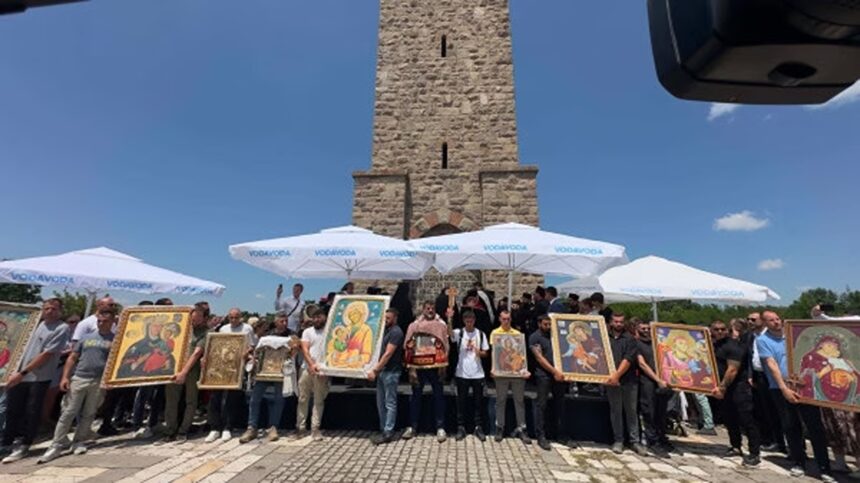
The Serbs’ Vidovdan celebration at Gazimestan concluded with songs and religious prayers. Hundreds of Serbs from Kosovo gathered to mark the so-called “Vidovdan” holiday.
Due to the gathering of Serbs at Gazimestan, located near Obiliq, long traffic queues formed on the Prishtina–Mitrovica main road.
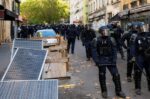
Police checked whether participants were carrying any symbols that could incite interethnic hatred.
According to police officers on the ground, the situation remained calm.
June 28 marks the anniversary of the Battle of Kosovo, during which the coalition of Balkan armies was defeated by the Ottoman Empire.
Following this defeat, the peoples of the Balkans were either conquered by the Ottomans or forced to become vassals of the Sultan.
The Albanian princes continued to fight, with Skanderbeg being the most distinguished among them. Serbia became part of the Ottoman Empire.
The Battle of Kosovo took place on June 28 (June 15 according to the old calendar), 1389, on the Kosovo Plain, between the coalition of Balkan armies led by Prince Lazar and the Ottoman forces commanded by Sultan Murad I (reigned 1360–1389).
The battle was fierce, and both leaders—Prince Lazar and Sultan Murad—as well as many other princes, were killed. Both armies were almost completely destroyed.
However, the Ottoman Empire had the resources to raise a new army in a much shorter period of time.
The Balkan peoples were unable to recover quickly, and most of them eventually fell under Ottoman rule.
There is very little historical documentation about the Battle of Kosovo, and much of the available information is contradictory.
For this reason, the event is known today more for the myths surrounding it than for firmly established historical facts.
Under the rule of Sultan Murad I, the Ottomans expanded their control from Anatolia into the Balkans.
In the summer of 1389, Sultan Murad arrived in Kosovo, where he confronted the coalition of Balkan princes.
Although the battle is often described as a conflict between Serbs and Turks or between Christians and Muslims, historical facts indicate otherwise.
On one side were the Ottomans, whose army also included soldiers from various peoples and their vassal princes, including Christians.
On the other side stood a coalition of Balkan princes, among them many Albanian princes.
It is known that Prince Lazar was killed in the battle, but the exact circumstances of his death remain unknown.
Another Serbian prince, Vuk Branković, realizing that the battle could not be won and seeking to save as many soldiers as possible, withdrew from the battlefield.
In Serbian historical narratives, Branković is portrayed as a traitor, and his withdrawal is presented as the cause of Prince Lazar’s death.
Sultan Murad I was also killed during the battle. He is believed to have been killed by Miloš Obilić, one of the principal heroes in Serbian stories and legends about the Battle of Kosovo.
Murad’s son, Bayezid I, became Sultan and continued the Ottoman campaign of expansion in the Balkans for a time. However, in 1403, he was defeated near Ankara by the Mongol forces of Timur.
This created an opportunity for Albanian rulers to strengthen their positions. During this period, families such as the Balsha, Dukagjini, and Zaharia families emerged in Northern Albania; the Kastrioti, Topia, Arianiti, Muzaka, and Gropa families in Central Albania; and the Shpata and Zenebishi families in Southern Albania.
During the same period, Venice succeeded in taking control of the coastal cities stretching from the Bay of Kotor to Arta. Budva, Ulqin, Shkodra, Lezha, Durrës, and Parga, which were important centers of trade and exchange with the country’s interior, became part of what is historically known as Venetian Albania.