June 28 marks the anniversary of the Battle of Kosovo, fought in 1389 on the Kosovo Plain between a coalition of Balkan rulers led by Prince Lazar and the Ottoman forces commanded by Sultan Murad I.
The battle resulted in heavy casualties on both sides, with both Prince Lazar and Sultan Murad I killed during the fighting. Although neither side achieved a clear tactical victory, the Ottoman Empire possessed the resources to quickly rebuild its army, while the Balkan principalities were unable to recover at the same pace. In the decades that followed, much of the region either came under Ottoman rule or became Ottoman vassal states.
Albanian princes continued to resist Ottoman expansion, with Gjergj Kastrioti Skanderbeg later emerging as the most prominent leader of that resistance. Serbia eventually became part of the Ottoman Empire.
Historians note that contemporary sources on the Battle of Kosovo are limited and often contradictory. As a result, the event has become as well known for the national myths and legends surrounding it as for the established historical record.
Although the battle is often portrayed as a conflict between Serbs and Ottomans or between Christians and Muslims, historical accounts indicate a more complex reality. The Ottoman army included troops from various peoples and Christian vassals, while the opposing coalition consisted of rulers from across the Balkans, including several Albanian nobles.
Prince Lazar was killed during the battle, although the exact circumstances remain uncertain. Serbian nobleman Vuk Branković withdrew his forces after concluding that the battle could not be won, a decision that later Serbian epic tradition interpreted as an act of betrayal.
Sultan Murad I was also killed during the battle. According to Serbian tradition, he was assassinated by Miloš Obilić, one of the central heroic figures in Serbian folklore surrounding the Battle of Kosovo.
Following Murad’s death, his son Bayezid I became sultan and continued the Ottoman expansion in the Balkans until his defeat by Timur’s forces near Ankara in 1402. This temporary setback created an opportunity for Albanian noble families—including the Balshaj, Dukagjini, Zaharia, Kastrioti, Topia, Arianiti, Muzaka, Gropa, Shpata, and Zenebishi families—to strengthen their regional positions.
During the same period, the Republic of Venice expanded its influence along the Adriatic coast, incorporating important coastal cities from the Bay of Kotor to Arta into what became known as Venetian Albania.
Milošević and the Political Legacy of Vidovdan
On June 28, 1989, then-Serbian President Slobodan Milošević delivered his landmark speech at Gazimestan during the commemoration of the 600th anniversary of the Battle of Kosovo.
The event took place shortly after Kosovo’s autonomy had been revoked, a move that triggered widespread protests across the province.
Attendance estimates varied significantly. Serbian and Yugoslav sources claimed that up to two million people attended, while Reuters estimated the crowd at around 300,000.
During the speech, Milošević declared:
“Again, we are engaged in battles and facing battles. They are not armed battles, although such battles cannot yet be excluded.”
The statement was widely interpreted as foreshadowing the conflicts that would later erupt during the breakup of Yugoslavia.
Twelve years later, on the same date—June 28, 2001—Milošević was extradited to The Hague by Serbian authorities to stand trial for war crimes, including crimes committed during the Kosovo conflict.
Vidovdan Today
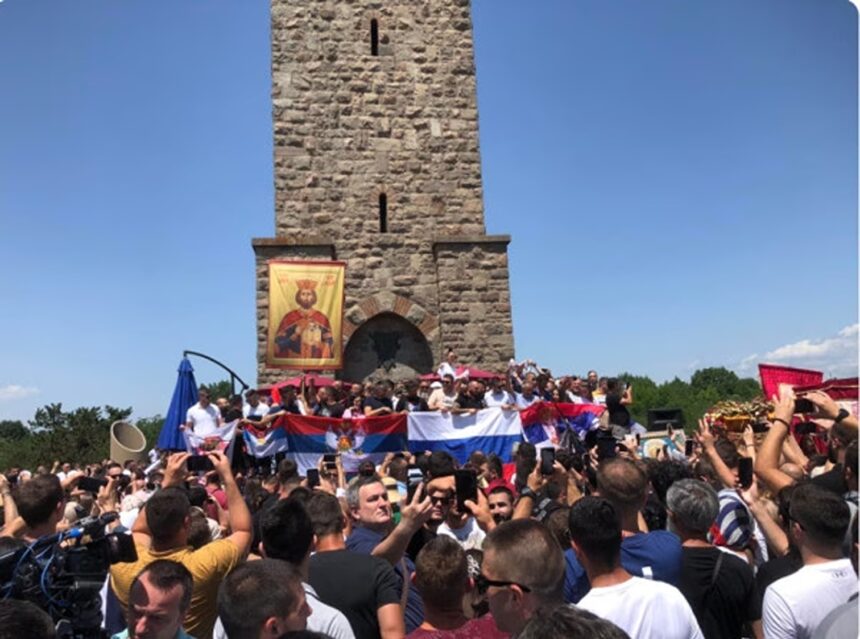
Every year on June 28, Serbs observe St. Vitus Day, known as Vidovdan, through religious ceremonies and commemorations held at sites such as Gračanica Monastery and the Gazimestan Memorial near Obiliq.
Ahead of the 2025 commemorations, the Kosovo Police announced a comprehensive operational security plan aimed at ensuring public safety, maintaining public order, regulating traffic, and managing border crossings throughout the country.
Authorities have urged all participants to avoid provocations, respect the law, and follow police instructions. Temporary traffic restrictions and road diversions may also be implemented during the events.
Last year, on June 10, the Municipality of Gračanica approved a decision allowing the celebration of Vidovdan with Serbian state symbols and flags. However, on June 12, the Basic Court in Pristina overturned that decision, ruling that Serbian state symbols and flags could not be officially displayed during the event.
In its reasoning, the court stated that such a decision could provoke interethnic tensions, particularly if perceived as favoring one community in contradiction with Kosovo’s legal framework. The ruling also emphasized that the organized display of another state’s symbols by a municipal authority, without authorization from Kosovo’s central institutions, could pose a risk to public order.