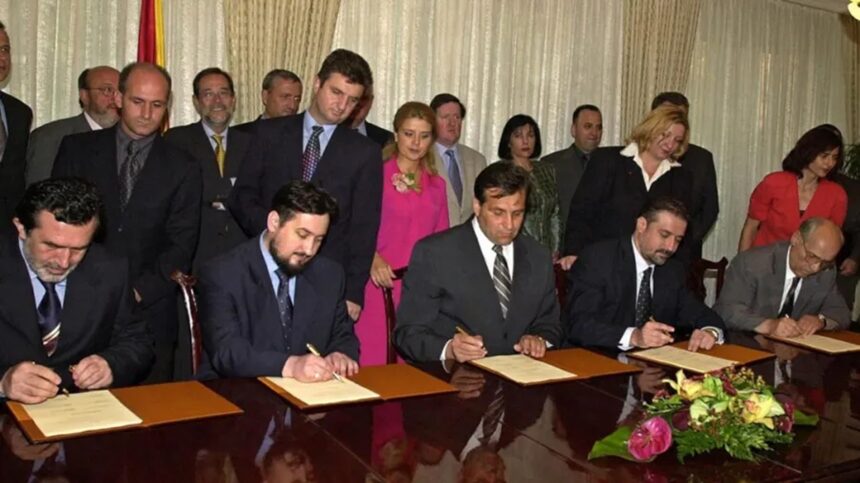
On July 5, 2001, the Government of Macedonia and Albanian insurgents reached a peace agreement that marked a crucial step toward ending the armed conflict in the country.
The agreement paved the way for the Ohrid Framework Agreement, which was formally signed on August 13, 2001, in Ohrid and brought the conflict to an end.
The breakup of the former Socialist Federal Republic of Yugoslavia (SFRY) and Macedonia’s declaration of independence triggered profound political, social, and economic changes. Political pluralism emerged through the creation of parties that were largely organized along ethnic rather than ideological lines.
As a result of the transition, unemployment rose sharply, while poverty, corruption, organized crime, and economic instability became widespread. A weakened economy, political scandals, corruption, and deteriorating interethnic relations further destabilized the country.
The 1991 Constitution significantly reduced the constitutional rights previously enjoyed by ethnic Albanians under the 1974 Constitution, leading Albanian lawmakers to refuse to support its adoption in parliament.
The period between 2000 and 2001 was marked by severe unemployment, with around 400,000 people out of work and approximately 80,000 families relying on social assistance. The privatization process remained incomplete, accompanied by numerous bankruptcy proceedings.
Although Albanian political parties participated in parliament and the governing coalition included Albanian ministers, ethnic Albanians remained underrepresented in the public administration and state institutions. Albanian political leaders continued to express dissatisfaction with their status and political rights.
Interethnic tensions escalated through demonstrations by Albanians demanding greater collective rights and counter-protests by ethnic Macedonians opposing those demands.
The armed conflict began in February 2001 near the village of Tanuševci, close to Skopje, and later spread to the regions of Kumanovo, Lipkovo, Tetovo, and Skopje.
During the conflict, the National Liberation Army (NLA/UÇK) carried out attacks against Macedonian security forces, mobilized segments of the Albanian population, and conducted military operations. Government security forces responded with heavy weaponry, arrests of suspected NLA members and supporters, military operations, and the establishment of police checkpoints throughout affected areas.
The fighting forced thousands of civilians to flee their homes, becoming either refugees or internally displaced persons. Both sides suffered casualties, while homes, property, religious sites, and cultural monuments were damaged or destroyed.
The international community became increasingly involved throughout the conflict. Initially, it condemned the NLA’s actions and labeled the group as terrorist, but later encouraged the Macedonian government and parliament to address the political grievances raised by the Albanian community.
Under international mediation, a broad coalition government was formed, bringing together VMRO-DPMNE, SDSM, PDSH, and PPD.
Representatives of the European Union and the United States played a central role in drafting and facilitating the Ohrid Framework Agreement, while NATO subsequently deployed forces to Macedonia to support the implementation of the peace process.
The Ohrid Framework Agreement was officially signed by President Boris Trajkovski, Prime Minister Ljubčo Georgievski, Branko Crvenkovski, Imer Imeri, and Arbën Xhaferi, with international mediators François Léotard and James Pardew signing the document as official witnesses.