
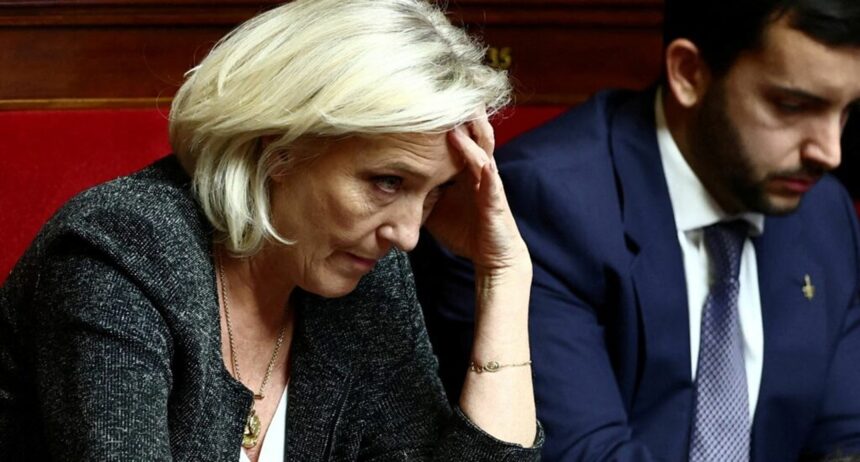
Marine Le Pen is set to face one of the most decisive moments of her political career on Tuesday, as the Paris Court of Appeal is expected to deliver a ruling that could directly shape the 2027 French presidential election. The leader of the National Rally, known for her strong criticism of the European Union, risks seeing her ambitions for the Élysée Palace severely undermined. The decision comes at a time when opinion polls rank her party among the favorites to win the next presidential election.
The embezzlement case
According to international media reports, the case centers on allegations of misappropriation of European Parliament funds dating back more than a decade, during Le Pen’s tenure as a Member of the European Parliament.
In 2024, Le Pen and several of her allies stood trial over allegations that they defrauded European taxpayers of approximately €4.5 million between 2004 and 2016 by employing parliamentary assistants who allegedly worked primarily for the party’s domestic political activities rather than carrying out their official duties within the European Parliament.
Although the defendants denied any wrongdoing and described the case as a political witch hunt, the court found the prosecution’s evidence convincing.
Among the evidence presented was a message from one defendant requesting to meet the Member of the European Parliament they was supposedly working for several months after their contract had already begun. In another instance, an assistant was found to have exchanged only a single message with their assigned MEP during an eight-month period of employment.
Le Pen was found guilty and sentenced to five years of ineligibility from holding public office.
The 57-year-old former MEP was convicted at first instance and barred from holding public office for five years, effectively excluding her from the 2027 presidential race to succeed Emmanuel Macron, a contest in which she had been leading in most opinion polls.
Le Pen immediately appealed the ruling, triggering an expedited appeals process. While she had consistently maintained her innocence, she later acknowledged in court that she may have violated the law without realizing it. Her legal team subsequently challenged the original ruling on technical legal grounds, arguing that the ban was disproportionate.
Le Pen’s chances remain limited
Despite the shift in legal strategy, Politico reports that Le Pen’s prospects remain limited. She has recently adopted a less confrontational tone, stating that she will not run for president if the ban is upheld or if she is required to wear an electronic monitoring bracelet.
“It no longer depends on me. But I will continue to fight. I will remain an activist. And if I am only an activist, then I will be an activist,” Le Pen said regarding her presidential ambitions.
Meanwhile, National Rally president Jordan Bardella is performing even better than Le Pen in recent opinion polls.
Even if Le Pen is ultimately barred from running, Europe still faces the possibility that France’s next president—the leader of the European Union’s second-largest economy—could be a far-right politician committed to fundamentally weakening Brussels.
Brussels pushes back
The European Parliament’s Director-General, Didier Clety, testified on January 15, presenting evidence that could prove decisive in determining Le Pen’s political future. Appearing before the historic courtroom at the Paris Palace of Justice—where Philippe Pétain was convicted of treason more than 80 years ago for collaborating with Nazi Germany—Clety accused Le Pen and her party of systematically using European Parliament funds to pay assistants who, in reality, worked for the party’s political machinery in France, a practice prohibited under EU rules.
At the opening of the appeal proceedings, Le Pen told the court that if an offense had been committed, then so be it, but insisted that she had never believed she had committed even the slightest violation. She argued that she had acted transparently and had not been sufficiently warned about the applicable restrictions.