Concerns are growing among neighboring countries following China’s test of an intercontinental missile. The Chinese navy is showcasing its military capabilities and challenging the United States in the Pacific.
Strong criticism followed after the Chinese Navy conducted a missile test in the South Pacific on Monday. According to the state-run Xinhua News Agency, a nuclear-powered submarine launched a missile carrying a dummy warhead into international waters. Chinese authorities said the test was successful.
Australian Foreign Minister Penny Wong said the move undermines regional security. Japan urged China to reconsider its actions. Winston Peters also expressed concern, stating that New Zealand does not want China to use the South Pacific as a missile testing ground.
“We are deeply concerned about China’s testing of nuclear-capable weapons in the South Pacific.”
The Pacific was no stranger to nuclear weapons during the last century. Bikini Atoll, now part of the Marshall Islands, hosted numerous U.S. nuclear weapons tests after World War II. For decades, the post-war security order in the Pacific was dominated by the United States.
Missile with a range of up to 12,000 kilometers
It is precisely this security order that China is now challenging. Although official Chinese media have not released technical details about the test, nationalist military experts on Chinese social media speculate that the missile was the JL-3 (Julang-3).
According to retired Lieutenant Colonel Zhang Junshe of China’s Naval Research Institute, the JL-3, also known as “Giant Wave-3,” is still under development. It is expected to have a maximum range of approximately 12,000 kilometers and the capability to carry multiple nuclear warheads. Three successful tests were reportedly conducted between 2018 and 2019.
“This missile is not intended for frontline battlefield targets but rather for strategic objectives such as command centers, military bases, and critical energy infrastructure,” Zhang said, describing it as a comprehensive deterrent.
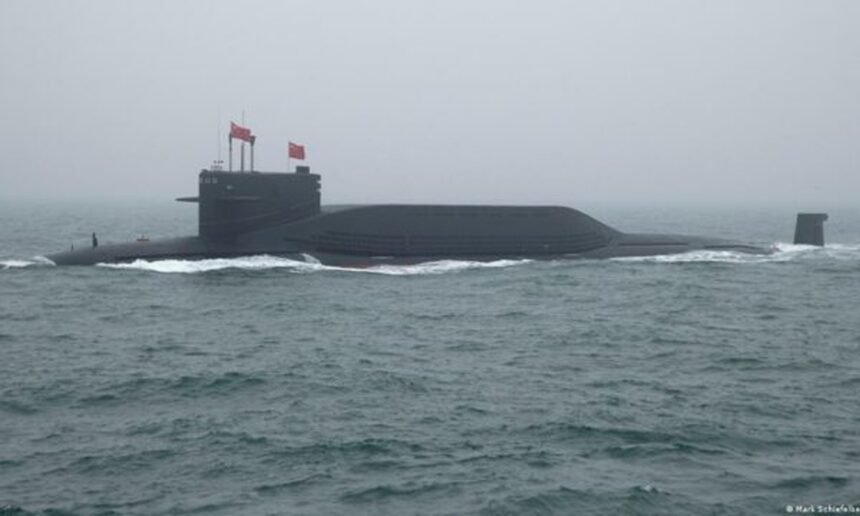
The JL-3 is believed to have been launched from a Type 094 Jin-class submarine. These 135-meter-long nuclear submarines can remain at sea for up to 70 days with a crew of 120 sailors. China currently operates six Jin-class submarines, although experts say a modified submarine may also have been used.
According to the Nuclear Threat Initiative, China also possesses dozens of nuclear-powered attack submarines.
Strengthening nuclear second-strike capability
Even if China’s other military assets were neutralized, a ballistic missile submarine would still be capable of launching a retaliatory nuclear strike, Zhang argued. Operating from international waters would allow China to target virtually any location across the Pacific.
In September 2024, China launched another intercontinental missile carrying a dummy warhead from mainland China into the South Pacific. The missile reportedly landed in a designated area near French Polynesia. It was China’s first publicly acknowledged long-range missile test into international waters in more than 40 years.
As with that launch, Beijing stated that all coastal states had been informed in advance and emphasized that the exercise was not directed against any specific country.
Challenging the U.S.-led security order
China seeks to reshape the strategic balance in the Pacific. Beijing has repeatedly expressed concern over the extensive U.S. military presence and that of its allies near China’s borders. The Chinese government aims to ensure it can survive an initial military strike and carry out a credible retaliatory response if necessary.
At the same time, China continues to maintain its official no-first-use nuclear policy, pledging not to initiate a nuclear attack.
According to Felix Heiduk of the Stiftung Wissenschaft und Politik (SWP), China is increasingly challenging the U.S.-led regional security architecture through rapid military modernization, expanded security partnerships, and the militarization of much of the South China Sea.
During the summer of 2024, 29 countries participated in major U.S.-led military exercises around Pearl Harbor, involving approximately 40 warships.
Rising security concerns
Security concerns are also increasing in Australia. Analysts Sam Roggeveen and David Vallance of the Lowy Institute wrote in a June 2026 study that China’s Rocket Force represents the country’s most effective long-range strike capability against Australia.
They noted that, in the event of a major regional conflict, military bases across northern Australia could become potential targets.
Until recently, publicly available evidence suggested that missiles launched from mainland China could not reach all parts of Australia. However, the recent submarine-launched missile test in the South Pacific has significantly altered those assessments.
Speaking during the NATO summit in Ankara, Mark Rutte described the missile test as a message directed at NATO.
“This once again shows that we must not be naïve,” Rutte said. “And we are not naïve.”
Although NATO remains primarily focused on Europe, discussions about expanding security cooperation with partners in the Indo-Pacific—including countries such as Japan—have become increasingly prominent in recent years.