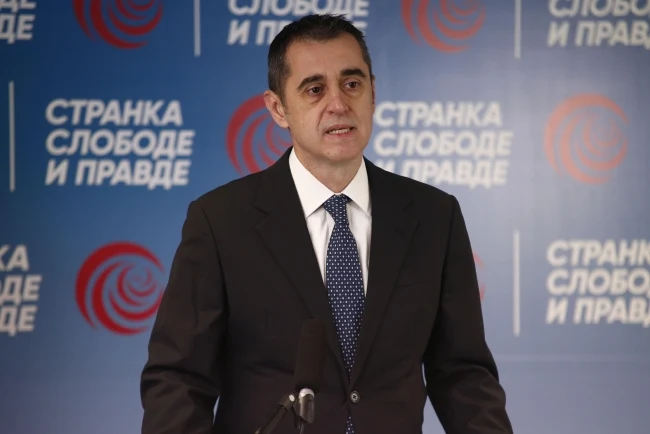
The Vice President of the Party of Freedom and Justice (SSP), Dušan Nikezić, sharply criticized the Serbian government’s latest €500 million borrowing, stating it is definitive proof that “Serbia’s public finances are falling apart.”
Nikezić warned that the ruling coalition’s recently announced pre-election financial measures will be funded entirely on the backs of citizens through newly accumulated national debt.
The Contradiction of “€5” Billion on the Account
Nikezić pointed out the stark contradiction in the government’s economic PR, pointing directly to the financial maneuvering behind Belgrade’s cash reserves:
“Vučić’s government is the only one in the world that boasts of having five billion euros in its account, only to then borrow another 500 million euros. They only have that money on the account because they borrowed five billion euros in the first six months of the year and postponed the payment of a two-billion-dollar loan to the United Arab Emirates.” — Dušan Nikezić, Vice President of the SSP
High Interest Rates Compared to Regional Peers
The SSP vice president described the new €500 million debt as highly unfavorable and untransparent. He compared the 4.75% interest rate Serbia secured to the significantly lower rates obtained by neighboring EU member states:
                  [ Sovereign Borrowing Interest Rates ]
                                     |
         +---------------------------+---------------------------+
         |                           |                           |
         v                           v                           v
   [ Slovenia ]                  [ Croatia ]                 [ Serbia ]
      3.12%                         3.25%                       4.75%
The Opposition’s Counter-Plan: “Serbia After Vučić”
With snap elections looming by early December, Nikezić announced that the SSP has finalized a comprehensive transition plan titled “Serbia After Vučić.”
This blueprint details the exact steps required to dismantle what the opposition calls a deeply corrupt system:
- First 24 Hours: Immediate emergency measures to stabilize the financial system and stop untransparent borrowing.
- First 100 Days: Institutional audits and the launch of anti-corruption reviews of major state contracts.
- First 6 Months: A total overhaul of the economic model to reduce dependence on high-interest foreign debt and restore fiscal transparency.