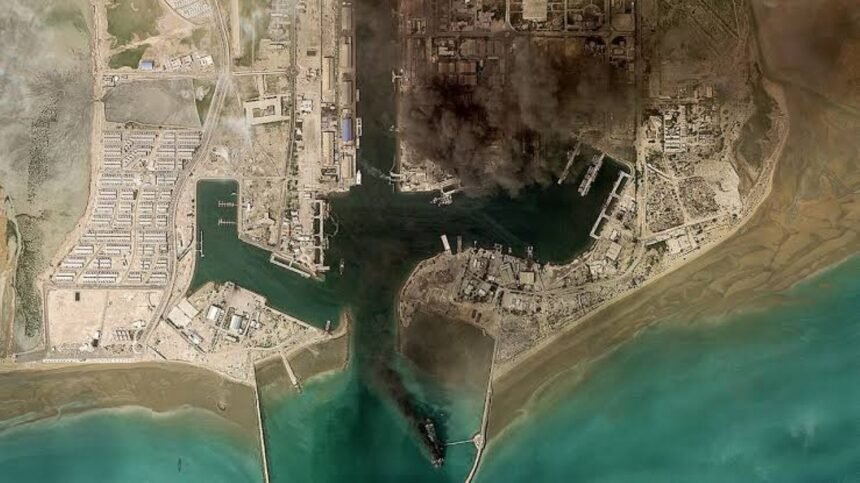
Just a month after the United States and Iran signed a temporary truce intended to halt hostilities between the US, Israel, and Iran, military clashes have reignited in the Persian Gulf.
The breakdown of the peace agreement centers on a dispute over the Strait of Hormuz. Tensions flared when the US advised commercial vessels to bypass the strait entirely, routing instead near the coast of Oman—a move Tehran viewed as a direct challenge to its sovereign authority over the strategic waterway.
In response, Iran resumed targeting ships utilizing what it labels “unauthorized” routes. The US retaliated with targeted airstrikes on military assets in southeastern Iran, while Tehran launched strikes against Gulf bases hosting US forces.
The Geopolitics of the Strait of Hormuz
The port city of Bandar Abbas sits directly on the northern shore of the Strait of Hormuz, the world’s most critical maritime energy chokepoint.
During peacetime, more than 20% of global petroleum and liquefied natural gas (LNG) exports flow through this narrow gap. Under the temporary June peace agreement, Iran committed to granting safe passage to commercial shipping for 60 days while discussing joint management of the strait with Oman. However, conflicting interpretations of the treaty’s terms quickly collapsed the fragile ceasefire.
Bandar Abbas under Heavy Bombardment
Since late February, Bandar Abbas has emerged as the primary target of US military operations. According to tracking data compiled by the Armed Conflict Location and Event Data Project (ACLED), at least 96 strikes have targeted the immediate area.
Roughly one-third of these operations have hit high-value targets, including:
- Naval Infrastructure: Submarine repair facilities, shipyards, and maintenance docks.
- Tactical Air Defenses: Coastal radar installations and mobile surface-to-air missile positions.
- Command Leadership: A strike earlier this year killed the high-ranking Commander of the Islamic Revolutionary Guard Corps (IRGC) Navy, Alireza Tangsiri.
A New Era of Warfare: US Deploys Unmanned Sea Drones
The conflict marked a historic military milestone on Sunday, July 12, 2026, when US Central Command (CENTCOM) released footage confirming the first-ever operational deployment of maritime strike drones in combat.
The Strategic Calculus: Fleet vs. Shore Infrastructure
While US operations have successfully damaged or destroyed over 155 Iranian naval vessels and patrol boats, military experts warn that neutralizing Iran’s maritime leverage is not just a matter of sinking its fleet.
“Bandar Abbas is the heart of Iran’s naval logistics. If you heavily degrade this base, you structurally break Iran’s ability to operate at sea over the long term.”
— Bilal Saab, former Pentagon official and Senior Fellow at TRENDS US
Despite the heavy losses to its conventional navy, Iran’s defensive strategy is highly asymmetric. Tehran relies heavily on shore-based anti-ship missiles, aerial kamikaze drones, and naval mines deployed by small, fast-moving civilian craft that do not require formal harbor facilities.
By systematically targeting dry docks, shipyards, and maintenance facilities in Bandar Abbas, the US strategy aims to inflict irreversible structural damage on Iran’s capacity to rebuild or sustain its naval force.