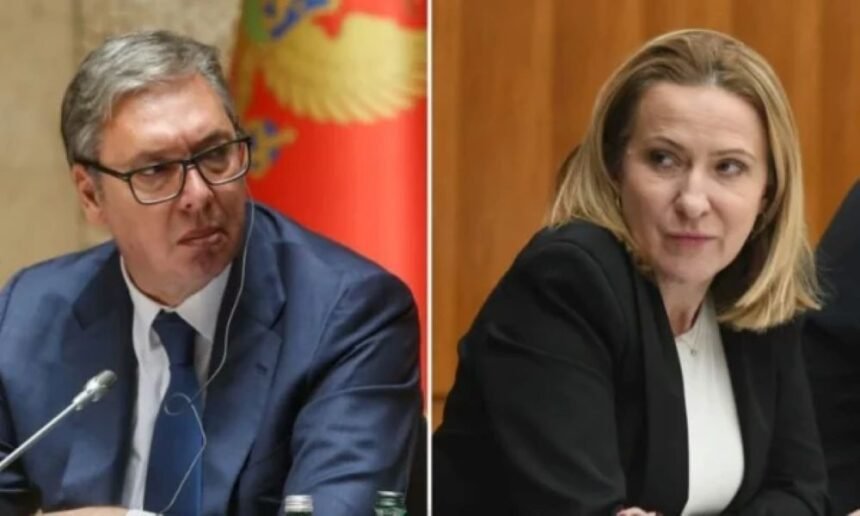
Serbian President Aleksandar Vučić has attempted to defuse the growing international and domestic outrage sparked by state minister Snežana Paunović’s comments, in which she admitted she would have “ethnically cleansed Kosovo” in 1998.
However, in his attempt at damage control, Vučić triggered fresh criticism by reinforcing Belgrade’s long-standing narrative: claiming that ethnic cleansing in Kosovo was actually committed against Serbs, not Albanians.
The Official Distancing: “Not My Policy”
Addressing reporters, Vučić explicitly stated that Paunović’s remarks do not represent his personal vision or the official stance of the Serbian government:
“This statement does not reflect the will or policy of the President and the Government of Serbia. We must be responsible. Our policy is dialogue, compromise, talks, and never ethnic cleansing. Period.”
— Aleksandar Vučić, President of Serbia
While Vučić dismissed her interview as “careless and insufficiently responsible,” he stopped short of issuing a formal condemnation or calling for her dismissal—a move widely demanded by the Serbian opposition and civil rights groups.
The Strategic Pivoting: Shifting the Blame
Instead of addressing the historical reality of the late 1990s—where Slobodan Milošević’s forces systematically expelled hundreds of thousands of Kosovo Albanians—Vučić pivoted to Belgrade’s traditional defensive talking points:
- The “250,000” Claim: Vučić declared that “250,000 Serbs, not Albanians, were ethnically cleansed” from Kosovo in the aftermath of the 1999 war. This matches the narrative pushed by SPS leader Ivica Dačić, who previously cited a figure of 240,000 displaced Serbs.
- The “Victim” Label: In a highly controversial defense, Vučić claimed that Snežana Paunović herself is a “victim of ethnic cleansing,” referencing her background as a Kosovo-born Serb who relocated to central Serbia.
- Dismissing Pristina’s Sanctions: Commenting on Kosovo’s decision to declare Paunović persona non grata, Vučić dismissed the move, claiming Pristina has “declared all of us personae non gratae” and that its official declarations carry no real weight.
Why This Pivot Matters Geopolitically
For international observers, Vučić’s response is a classic example of bilateral diplomatic posturing. By publicly calling for “peace and compromise”, he attempts to soothe worries in Brussels and keep Serbia’s EU integration process on life support.
Yet, by immediately utilizing historical revisionism to downplay the documented ethnic cleansing of Albanians, he continues to appease his nationalist base at home—illustrating the deep, unresolved ideological roots of the Milošević era that still dictate Serbia’s modern state apparatus.