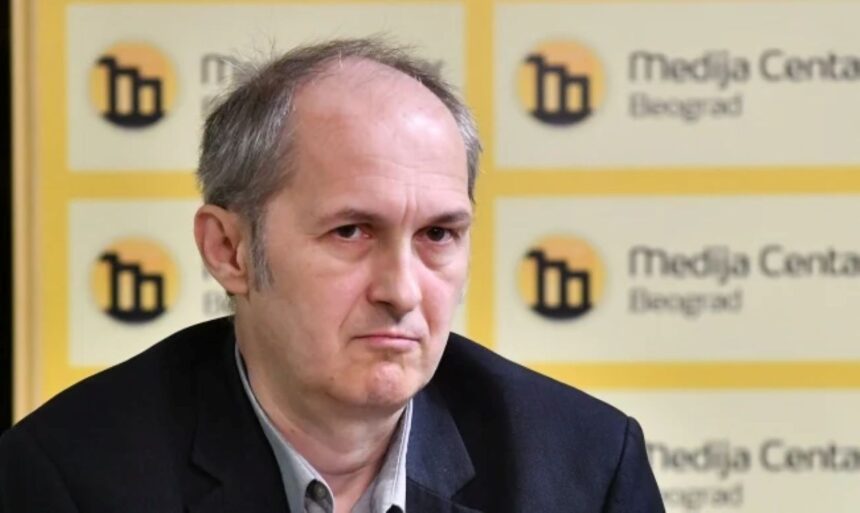
Gojko Božović, writer and one of the founders of the civic initiative ProGlas, has accused Serbia’s ruling Serbian Progressive Party (SNS) and President Aleksandar Vučić of launching an aggressive pre-election campaign aimed at deepening social divisions and radicalizing the political atmosphere ahead of the expected parliamentary elections.
In an interview with Beta news agency published on Tuesday, Božović argued that the ruling party is seeking to mobilize its supporters while discouraging political opponents through fear, polarization and propaganda rather than substantive policy proposals.
“There is no real politics in the SNS campaign because the party has lost its legitimacy,” Božović said, claiming that the government’s key domestic and foreign policy agendas have failed.
He criticized Serbia’s foreign policy, alleging that the government adapts its messaging to different international audiences without pursuing what he described as Serbia’s national interests.
“In Moscow they talk about a ‘color revolution,’ in Washington about Antifa, in Brussels about threats to stability in the Balkans, and in Beijing about the need for centralized authority,” Božović said. “There is nothing in that which serves Serbian society.”
Božović also criticized the government’s domestic policies, saying economic management has left many citizens dependent on state assistance, while anti-corruption promises have given way to what he described as widespread corruption.
He further argued that the authorities have largely avoided discussing Kosovo during the campaign despite previously presenting it as a central political issue.
According to Božović, the SNS campaign has increasingly relied on spectacle rather than political debate.
“They began with tents in ‘Ćaciland’ and continue with campaign rallies under tents. Instead of politics, they are turning public life into a fairground and a circus,” he said.
He predicted the ruling party would continue using state resources and welfare payments as campaign tools while intensifying rhetoric to deepen political polarization.
Božović also expressed concern over reports that individuals with criminal backgrounds could again be used to intimidate voters during the election campaign, alleging that similar tactics had been employed during previous local elections.
“The aim is to restore an atmosphere of fear—to discourage some citizens from voting and remind others how they are expected to vote,” he said.
The ProGlas co-founder further claimed that employees in public institutions continue to face political pressure and intimidation, arguing that many public sector workers, pensioners and welfare recipients are subjected to economic and political coercion.
He acknowledged the ruling party’s dominance across much of Serbia’s media landscape but argued that its influence has weakened, pointing to the growing grassroots mobilization led by the student movement.
Božović cited recent polling by CRTA indicating that the student-backed electoral list currently holds a lead of around 10 percentage points over the SNS, arguing that Serbia has entered a genuinely competitive political environment for the first time in more than a decade.
“The old model of governing through spin and propaganda has collapsed under the momentum of the student movement,” Božović said, adding that many citizens now believe political change is achievable.