
Kosovo ranks among the countries with the highest level of parliamentary representation in the Western Balkans, with one member of parliament representing an average of 13,354 citizens, according to a comparative analysis published by the Centre for Civic Education (CGO) of Montenegro.
According to the report, Montenegro has the highest level of parliamentary representation in the region, with one MP representing an average of 7,699 citizens. It is followed by Kosovo (13,354), North Macedonia (15,306), Albania (17,158), and Serbia (26,588), while Bosnia and Herzegovina has the lowest level of representation, with one member of the House of Representatives representing 84,075 citizens.
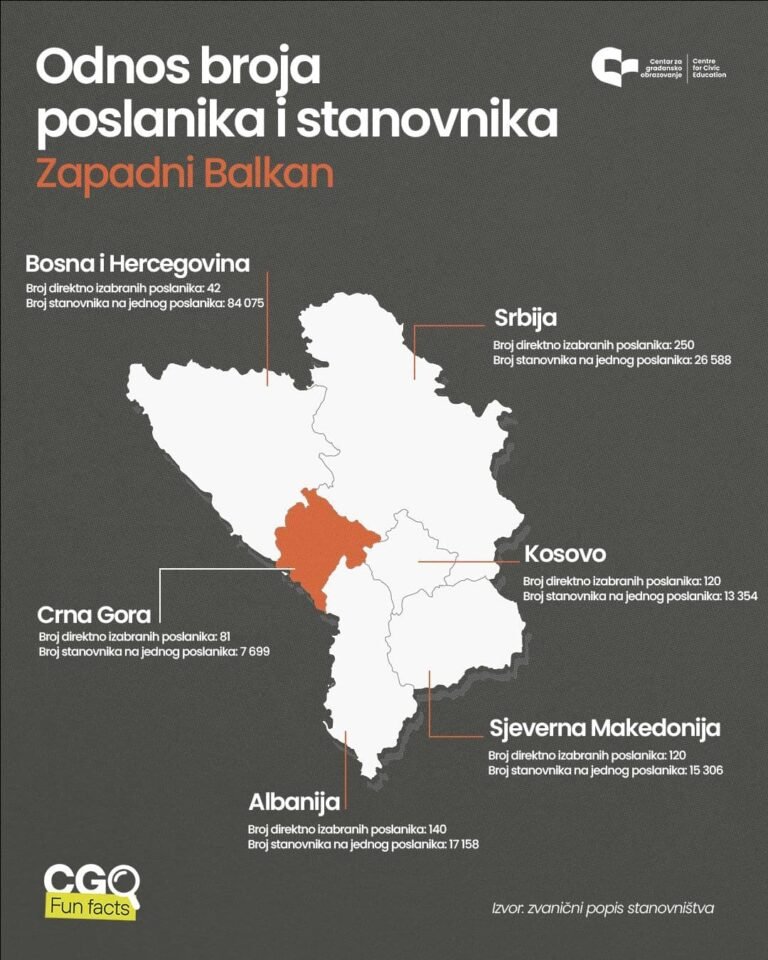
CGO emphasizes that these figures do not necessarily reflect the quality of parliamentary performance, but rather open a broader discussion about the relationship between the number of MPs, the cost of maintaining legislatures, and the concrete results they deliver for citizens.
According to the organization, stronger parliamentary representation is meaningful only if it is accompanied by greater accountability, higher-quality legislative work, stronger oversight of the executive branch, and better accessibility of elected representatives to the public. Otherwise, it merely becomes an additional public expense without delivering proportional benefits to citizens.
The analysis notes that, for countries with bicameral parliaments, such as Bosnia and Herzegovina, the comparison is based on the lower chamber, whose members are directly elected by citizens. Population figures are based on the most recent official census data.
CGO also compared the ratio of MPs to population across European Union member states. Malta ranks first, with one MP representing 6,577 citizens, followed by Luxembourg (10,732), Estonia (13,186), Cyprus (16,489), Latvia (18,932), and Slovenia (23,433).
At the other end of the spectrum are the EU’s largest countries, where each MP represents significantly more citizens: Italy (147,428), Spain (140,366), Germany (131,270), France (119,726), and the Netherlands (116,503).
CGO concludes that the number of members of parliament is not, by itself, an indicator of the quality of democracy. Rather, democracy should be measured by the accountability, performance, and results elected representatives achieve in serving the public interest.