The Alliance of Independent Social Democrats (SNSD) will make the withdrawal of decisions imposed by High Representative Christian Schmidt a condition for participating in the formation of Bosnia and Herzegovina’s state-level government, party officials have said.
Srđan Mazalica, head of the SNSD parliamentary group in the previous convocation of the Republika Srpska National Assembly, told Sputnik that the party considers 111 changes introduced by Schmidt during his tenure to be unconstitutional because they were not adopted through Bosnia and Herzegovina’s parliamentary procedure.
According to Mazalica, the party will demand that the decisions be declared invalid and removed from the country’s legal system during negotiations on forming the new state-level government following the recent general elections.
“Yesterday, at the SNSD presidency meeting, we received information about the decisions of the High Representative that were not adopted by the Parliamentary Assembly of Bosnia and Herzegovina and did not go through parliamentary procedures,” Mazalica said.
He argued that publishing decisions on the website of the Office of the High Representative (OHR) did not provide them with sufficient legal legitimacy.
Mazalica also claimed that institutions including the Central Election Commission and the Central Bank of Bosnia and Herzegovina had implemented Schmidt’s decisions despite the lack of parliamentary approval.
He said the SNSD believes this undermined the country’s sovereignty, Constitution and legal system.
SNSD Says State-Level Government Is Not Its Immediate Priority
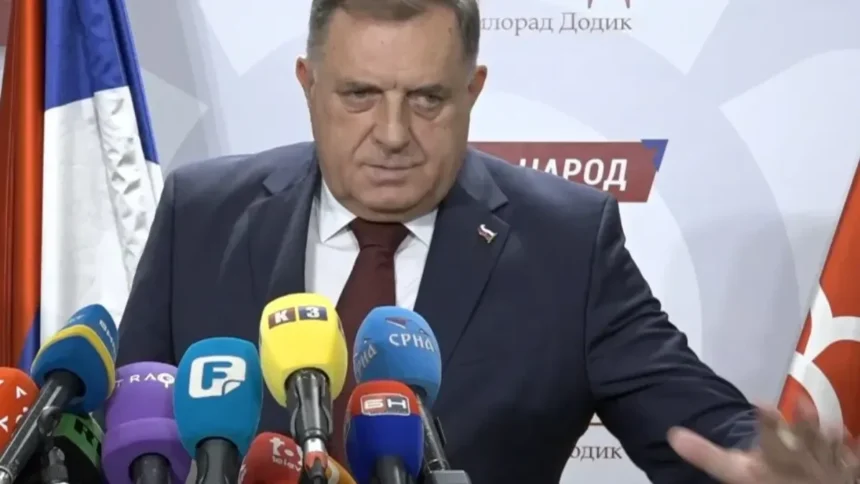
SNSD leader Milorad Dodik has said the party achieved a significant result in Republika Srpska’s parliament, where it expects to hold a two-thirds majority, making it an important factor in the formation of Bosnia and Herzegovina’s state-level government.
Dodik said the party’s policy would be based on what he described as strict adherence to the Dayton Peace Agreement and that it would seek the withdrawal of decisions imposed by successive high representatives.
Mazalica said the SNSD was not in a hurry to form a new state-level government, arguing that its immediate priorities were the formation of a government in Republika Srpska and the adoption of the entity’s budget and other necessary documents before the end of the year.
He added that the SNSD already has ministers in the state-level government and sufficient political influence to prevent decisions from being adopted without its participation.
However, he insisted that the formation of a new government would depend on whether other parties accepted the demand concerning Schmidt’s decisions.
Criminal Code and Election Law Amendments at the Center of Dispute
Mazalica said the SNSD’s objections also concern amendments to Bosnia and Herzegovina’s Criminal Code, including provisions that enabled prosecutors to bring charges against Dodik.
He further claimed that more than 100 of the 111 changes imposed by Schmidt concerned the country’s Election Law.
Other measures he cited involved amendments to legislation governing citizenship, electricity and the regulation of the electricity transmission system.
Mazalica also criticized decisions concerning the financing of political parties, claiming that measures imposed by Schmidt required private commercial banks to transfer public funds intended for the SNSD and the United Srpska party to an account at the Central Bank.
He described the measures as illegal and illegitimate, arguing that they had been introduced without consultation with the relevant domestic institutions.
Other Parties Reject SNSD’s Demand
Mazalica acknowledged that Bosniak political parties oppose the SNSD’s demand but said his party would not participate in forming the state-level government unless the issue was resolved.
He argued that the speed of government formation and the implementation of other reforms considered important by political parties in Bosnia and Herzegovina would depend on the outcome of those negotiations.
Schmidt’s use of the Bonn Powers, which allow the High Representative to impose legislation and remove officials under the international framework overseeing the implementation of the Dayton Peace Agreement, has been a longstanding source of political dispute in Bosnia and Herzegovina.
The SNSD’s position now places the status of those decisions at the center of negotiations over the country’s next state-level government.