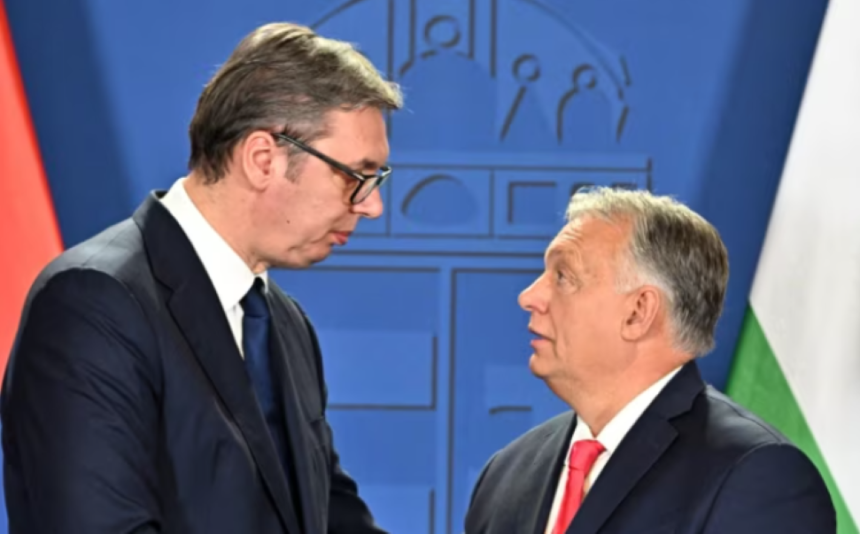
Once considered nearly untouchable, former Serbian President Aleksandar Vučić and former Hungarian Prime Minister Viktor Orbán have suffered electoral defeats but are showing no signs of abandoning their political ambitions.
The two populist leaders recently appeared together in a social media video with a defiant message: “We will be back.”
Vučić lost power after 14 years, while Orbán’s 16-year tenure came to an end following this year’s elections. The two politicians, who maintained close political and personal ties for years, share several similarities.
Their electoral defeats were preceded by accusations from political opponents of widespread corruption, abuse of power, illicit enrichment and the political capture of state institutions.
However, Milan Nič, a senior researcher at the German Council on Foreign Relations, told Radio Free Europe that the first major difference between the two emerged in how they responded to their electoral losses.
“Viktor Orbán practically disappeared from public life for a week. He traveled to the United States for a football tournament. This had serious consequences for the morale of his party, Fidesz. The party appeared demotivated, and it was unclear who was actually leading it,” Nič said.
According to him, public support for Fidesz fell significantly after the election, by approximately 10 to 15 percentage points.
Nič said Vučić managed to avoid making the same mistake.
“If you follow his public communication, you will see that he primarily addresses his own voters, party structures and various informal networks connected to his political system,” he said.
Although power formally remains in the hands of Vučić’s Serbian Progressive Party (SNS) until the new government and parliament are established, the days following the election have been marked by increased prosecutorial activity, arrests of senior police officials and investigations into the work of state institutions.
“Friends in difficult times”
One week after Serbia’s election, Orbán visited Vučić at his parents’ home on the outskirts of Belgrade.
In a video published on social media, the two said that “true friends become even closer in difficult times.”
Asked what political benefits the two populist leaders might gain from continuing their cooperation while in opposition, Nič said similarities between their political systems make such cooperation likely to continue.
“This is in the interests of both of them, because they also have close personal relationships. I do not think anyone should be surprised that their cooperation will continue,” he said.
“However, it is important to remember that they learned from each other long before these political developments. They exchanged experiences, including electoral strategies, but that did not prevent them from suffering political defeats,” Nič added.
What brings them together?
Populist policies, mutual political support and close personal ties have been recurring features of the relationship between Orbán and Vučić.
Both leaders have also faced strong criticism from Brussels over what critics describe as the erosion of democracy in their respective countries.
József Makai, a journalist at the Hungarian investigative outlet Átlátszó and a lecturer at Kodolányi University in Székesfehérvár, described their systems as hybrid regimes in which a “façade of democracy” remained in place while the state and media were brought under political control.
“Both systems relied on a strong, nationalist leader who claimed to defend the interests of the state and the nation,” he said, while emphasizing that the two regimes were not identical despite their similarities.
Another common feature was their close relationships and cooperation with Russian President Vladimir Putin, Chinese President Xi Jinping and Milorad Dodik, the former president of Republika Srpska.
The two former leaders were also linked by joint projects between their countries, some of which faced allegations of insufficient transparency, corruption and agreements shaped by personal political connections.
One prominent example was the modernization of the Budapest–Belgrade railway line, carried out by a Chinese company under agreements signed by the governments of both countries.
The new governments in Serbia and Hungary have announced plans to review contracts and agreements concluded by their predecessors.
What changed in Hungary after the change of government?
In the months after Péter Magyar and his Tisza party took power, a process began to establish accountability for former state officials.
The Hungarian Parliament established the National Office for the Recovery and Protection of Assets.
The institution has the authority and responsibility to investigate the misuse and non-transparent management of public funds, as well as recover state assets that were unlawfully transferred into private ownership.
In October, former Central Bank Governor György Matolcsy, one of Orbán’s close associates, was arrested on suspicion of financial fraud and the misuse of public funds.
“This was unimaginable. If someone had told me before the election that Matolcsy would spend Christmas this year in pretrial detention, I would have found it difficult to believe,” Makai said.
He argued that it would be unrealistic to expect everyone who had allegedly “plundered the state for 16 years” to end up in prison overnight.
“You cannot simply open a case and say that we are putting Orbán on trial because he was prime minister for 16 years and created the system he created. This is not revolutionary justice, but the rule of law doing its job. Everyone must be tried in an individual case, and that takes time,” he said.
Hungary has also joined the European Public Prosecutor’s Office (EPPO), opening the way for investigations into allegations of misuse of European Union funds during Orbán’s time in office.
Is the circle closing around Orbán?
Makai also recalled the so-called “gold convoy affair” in March this year, when Hungary’s Counter Terrorism Centre (TEK), shortly before the parliamentary election, stopped armored vehicles belonging to Ukraine’s state-owned savings bank. The vehicles were transporting cash and gold from Austria to Ukraine under what Ukrainian officials described as routine procedures.
Ukrainian officials were detained, and the incident became one of the main issues in Orbán’s election campaign. During the campaign, he accused Ukraine of interfering in Hungary’s election.
Investigations conducted after the change of government found that the actions of Hungarian authorities had lacked a legal basis.
A subsequent investigation was launched to examine suspicions that the former prime minister had personally ordered the seizure of the shipment.
“We are seeing that this was an operation serving the election and the campaign. This is a case in which the investigation has come quite close to Orbán, and I think it could put him in a very difficult position,” Makai said.
He added that it was difficult to determine whether Orbán currently felt secure in Hungary, given the ongoing investigations into the alleged misuse of public funds.
“What we can see, however, is that his daughter and son-in-law have moved to London. They have also begun selling part of their business empire,” Makai said.
“I think they are trying to withdraw, and this may be a sign that they want to be somewhere else, where they perhaps feel a little safer,” he added.
What is happening in Serbia after the election?
In the first days after the SNS electoral defeat, investigations began into the previous activities of public institutions.
Davor Macura, the owner of Belgrade-based Alta Bank, was also detained.
Macura, who is considered close to the Serbian Progressive Party, is one of four Serbian businessmen against whom Republican U.S. Congressman Joe Wilson has requested sanctions in a letter to Secretary of State Marco Rubio.
Two days before Macura’s detention, the National Bank of Serbia revoked Alta Bank’s operating license.
The central bank said the bank’s financial position had deteriorated significantly and could worsen further.
Serbia’s Organized Crime Prosecutor’s Office subsequently launched an investigation into suspicions that money had been transferred out of the bank and abroad.
Vučić himself said he was not afraid of being arrested because, according to him, he had neither signed documents nor made decisions involving money.
“I do not sign anything and have nothing to do with matters involving money. Therefore, nothing can be found against me in that regard,” Vučić told Pink TV on November 1. The broadcaster has supported the Serbian Progressive Party for years.
According to Nič, adapting to the new political circumstances has been more difficult for Orbán than for Vučić.
“Vučić has more opportunities to maintain his political influence because he has not yet fully relinquished power,” he said.
“What happened in Hungary within a month or a month and a half after the election would probably be the best possible scenario for Serbia and the Student List. In Hungary, Fidesz genuinely handed over the ministries and state administration to the new government. In other words, there was a complete transfer of power,” Nič added.
Different political opponents
Both Vučić’s and Orbán’s governments were characterized by the weakening and near disappearance of traditional opposition parties, Makai said.
“Then students emerged in Serbia, while Péter Magyar emerged in Hungary. They managed to shake the system, suddenly confronting the governments of the time with a new challenge to which they did not know how to respond,” he said.
Nevertheless, the political opponents who defeated the two leaders were very different.
Orbán and his Fidesz party were defeated by a former member of their own political camp.
Two years before the election, Magyar distanced himself from the ruling party, accusing it of corruption and spreading propaganda.
He went on to lead Tisza, a pro-European, center-right party that secured a decisive electoral victory.
In Serbia, by contrast, Vučić’s political system was defeated by a student movement without a clearly identifiable leader or previous experience in electoral politics.
The students selected their candidates through open assemblies, choosing from among university professors, teachers, lawyers, farmers, artists and athletes.
The protests were triggered by the deaths of 16 people when a concrete canopy collapsed at Novi Sad railway station on November 1, 2024, just four months after the station had been officially reopened following renovation.
Government officials attended both reopening ceremonies, and Vučić and Orbán were present at the first one.