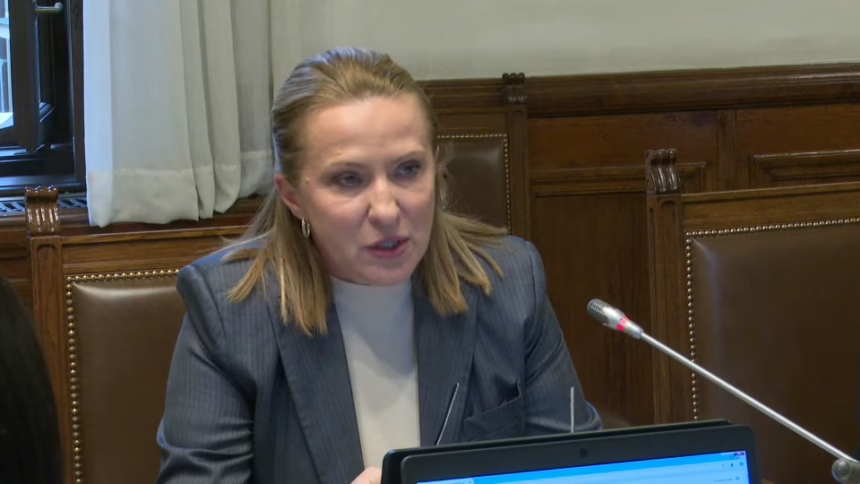
Serbian Minister of Public Administration and Local Self-Government Snežana Paunović, who recently sparked outrage by saying she would have carried out the ethnic cleansing of Kosovo had she been in Slobodan Milošević’s position in 1998, has denied reports that she continued receiving a salary from a defunct public institution in Kosovo for more than three years.
Responding to an investigation by Radio Free Europe/Radio Liberty (RFE/RL), Paunović dismissed the allegations as “a complete lie,” despite the report being based on public asset declarations she personally submitted to Serbia’s Anti-Corruption Agency.
She claimed the allegations were part of an effort to discredit and publicly lynch her.
“Do you really believe that someone in Serbia could shut down an institution with their own signature and continue receiving a salary from the state budget without the system noticing? That is on the same level as the ‘information’ that North Korea won the FIFA World Cup,” Paunović told the Serbian daily Danas.
However, the minister did not explain why her official asset and income declarations filed with the Anti-Corruption Agency stated that she continued receiving a salary as acting director of the “Pejë” Pharmaceutical Institution until 2025, when she was appointed minister.
According to her 2025 financial disclosure, published by the Anti-Corruption Agency, Paunović had officially served as head of the pharmaceutical institution for 11 years.
She also failed to explain official documents showing that, in 2021, while serving as acting director, she personally submitted the request to remove the institution from Serbia’s official registry.
Journalist Damjan Portić of Radio Goraždevac confirmed to RFE/RL that the “Pejë” Pharmaceutical Institution, headquartered in Goraždevac, no longer exists.
An analysis of Paunović’s official declarations indicates that during the 11 years she was formally listed as the institution’s director, she received approximately €146,000 in salaries from Serbia’s state budget.
Paunović further alleged that the media outlets reporting the story had failed to contact her before publication.
Radio Free Europe disputed that claim, stating it had sent questions to the minister’s office three days before publishing the investigation and had also contacted her media representative.
According to RFE/RL, neither the minister’s office, the Serbian government, the Office for Kosovo, the Republic Health Insurance Fund, nor the relevant ministries responded to questions concerning Paunović’s reported income or her role in an institution that had already ceased to exist.
The controversy comes just days after Paunović drew widespread condemnation for remarks in which she suggested that, had she been in the position of former Serbian President Slobodan Milošević in 1998, she would have carried out the ethnic cleansing of Kosovo. Although she later attempted to soften her statement, she did not retract its substance, saying only that she should have used the word “deportation” instead of “ethnic cleansing.”