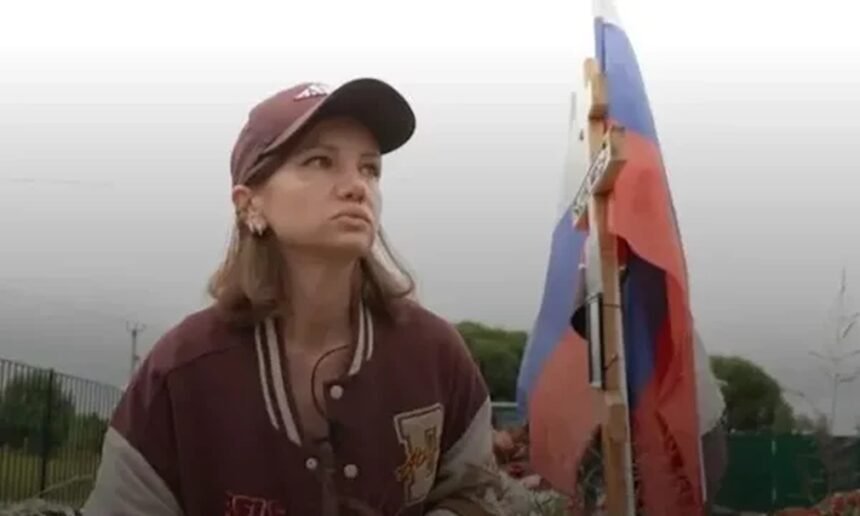
When Maria was informed by the Russian military that her 59-year-old father, Yuri, had been shot on the front line in Ukraine and later died from his injuries, she was devastated and left in shock.
Not only had she been unaware that her father had enlisted in the military, but she was also told that he had married just two days before being sent to the war.
“I am still in shock, and I still cannot accept what happened,” Maria said through tears, sitting at the kitchen table in her small apartment in St. Petersburg.
“At first, it felt like a dream. Even now, sometimes I wake up thinking that I only dreamed about it. But this is really happening,” she added.
The woman he had married, whom Maria says she had never met and had never heard her father mention, was 22 years younger than him. Following the marriage, she legally became his closest relative, making her eligible to receive the official death compensation.
“I have never spoken to this woman,” said Maria, 37. CNN is using only her first name to protect her privacy.
“I did not know what to tell her because I immediately suspected it was a scam,” she added. CNN attempted to contact Yuri’s widow for comment but was unsuccessful.
When a Russian soldier is killed in combat, his closest relatives receive an immediate military payment starting at 5 million rubles, approximately €55,000. The compensation is intended to provide financial security for soldiers’ families in the event of their death.
However, concerns are growing in Russia that the system is increasingly being exploited by women accused of deliberately entering sham marriages with vulnerable men shortly before they are sent to the battlefield. Russian officials and state media have referred to such alleged scammers as “black widows.” If the soldier is subsequently killed, the newly married woman may become legally entitled to the compensation, potentially excluding other family members.
Marriages on the Deathbed
In recent months, several cases have attracted public attention in Russia involving recruits allegedly persuaded to marry shortly before being killed at the front, or even while receiving treatment in military hospitals.
In one widely reported case involving an alleged “black widow,” a nurse at a military hospital was dismissed after being accused of marrying five soldiers under her care before they died from their wounds. She was accused of seeking access to compensation that would otherwise have gone to their closest relatives.
The issue has touched a sensitive nerve in Russian society, where concern is growing over the impact of the war in Ukraine, which the Kremlin continues to describe as a “special military operation.”
As economic pressures increase, fuel shortages worsen, casualties continue to mount and Ukrainian attacks inside Russia become more damaging, public criticism of alleged financial exploitation has intensified, along with calls for authorities to intervene.
“Families of participants in the Special Military Operation need protection from unscrupulous criminals, so-called ‘black widows,’ financial and telephone scammers, and predators targeting those who have received monetary payments,” said Leonid Slutsky, a prominent Russian parliamentarian who rarely criticizes the authorities. He said such crimes had reached “serious proportions.”
A Cynical Piece of Advice
Following Russia’s full-scale invasion of Ukraine in February 2022, the Kremlin actively encouraged Russian recruits to marry, potentially to strengthen family support or provide additional motivation for military service. The pro-marriage campaign also aligned with President Vladimir Putin’s promotion of so-called “traditional values” amid Russia’s demographic decline.
Authorities introduced procedures allowing newly recruited soldiers to marry quickly without the usual waiting period, while state television broadcast mass wedding ceremonies organized by local authorities.
Marriage to a soldier, particularly one expected to be deployed to the front shortly afterward, where the risk of death is extremely high, was even presented by some as a potential way to secure enough money to purchase an apartment.
In a podcast recorded last year in the Siberian city of Tomsk, a real estate agent offered a shocking and deeply cynical suggestion.
“I am a 30-year-old woman, but if I want to buy an apartment, where am I supposed to get the money?” asked host Darya Cherdantseva.
“It’s simple,” real estate agent Marina Orlova replied. “Find a man serving in the Special Military Operation, and when he is killed, you receive 8 million rubles, around €88,000,” she said, laughing.
“Many women are buying cheap apartments this way these days. It’s a business,” Orlova added.
Both women were later prosecuted, sentenced to community service and required to apologize to soldiers and their wives.
Public Outrage
Russian courts have also intervened in other high-profile cases, including a public dispute between the mother of a Russian soldier from Ryazan and a local woman he had met and married during a brief leave from the front.
The soldier, Georgy Kostyrko, met Angelina Varyukhina online and married her just 10 days later before returning to his military unit.
According to Kostyrko’s mother, the newlywed soon began posting photographs and videos with other men on social media, while her son had filed for divorce. He was killed in the war before the divorce proceedings were completed, leaving Varyukhina legally entitled to the death compensation.
Varyukhina later gave a different account, saying the accusations were intended to damage her reputation and that she and Kostyrko had reconciled after an argument. She said the photographs with other men had been posted only to make Georgy jealous.
Ultimately, a court removed Varyukhina’s status as the closest family member, but the case sparked widespread public outrage.
There have also been disturbing allegations that members of Russia’s security forces helped organize “black widow” schemes, allegedly working with women to send newly recruited husbands into particularly dangerous missions in exchange for a share of the compensation if they were killed.
Last year, Russian media reported an investigation in Primorsky Krai in the country’s Far East into an alleged scheme involving an officer, a sergeant and a military accountant. They were accused of recruiting vulnerable men, including orphans and people without close relatives, arranging marriages for them and then sending the recruits to highly dangerous positions on the front line, where they were more likely to be killed.
There have been no public updates on the case since.
Meanwhile, in St. Petersburg, Maria took CNN journalists to her father’s former apartment, which has since been sold. She remains convinced that the property was also obtained through fraud.
Behind a damaged door, the new owners insisted that the purchase had been completely legal and that they had never met the seller.
But the money, the alleged widow and Maria’s father were all already gone.