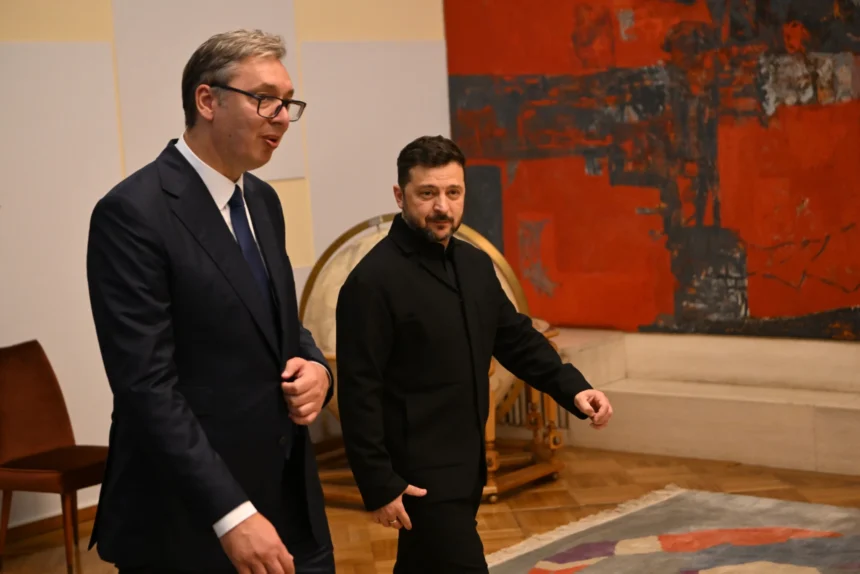
Ukrainian President Volodymyr Zelensky’s visit to Serbia has highlighted the increasingly delicate balancing act pursued by Serbian President Aleksandar Vučić between Kyiv, Moscow and the European Union, while Russia has so far avoided directly criticizing Belgrade over the visit.
The visit, described as a short and tightly controlled but historic encounter, has drawn attention because of what was left unsaid as much as what was publicly discussed. Analysts cited by Serbian outlet Radar Nova argue that Moscow’s restrained response reflects a broader calculation: despite growing tensions over Serbia’s contacts with Ukraine, the Kremlin remains reluctant to risk losing Belgrade as one of its few remaining European partners.
British journalist and political analyst Tim Judah told Radar that the meeting was driven largely by political pragmatism and could benefit both Vučić and Zelensky.
“Realpolitik,” Judah said, arguing that both leaders have interests they can pursue through cooperation and that the meeting is likely to be viewed positively in several EU capitals.
The visit came shortly after former U.S. Ambassador to Serbia Christopher Hill discussed Serbia’s role in supplying significant quantities of ammunition that ultimately reached Ukraine, reportedly through third countries such as Poland and the Czech Republic.
Judah said Serbia’s arms exports had become an important element of Vučić’s relationship with the West, arguing that Belgrade’s contribution to Ukraine had helped shield the Serbian president from some Western criticism over domestic political issues.
Russian journalist Andrei Kalitin, cited by Radar, said Moscow was closely monitoring Serbia’s military exports to Ukraine. He argued that communications between the Kremlin and Vučić’s government were conducted largely through discreet diplomatic, intelligence and security channels.
Russia’s Foreign Intelligence Service has previously accused Serbian defense companies of supplying ammunition to Ukraine through intermediary countries. Vučić has denied direct Serbian arms deliveries to Kyiv while acknowledging that Serbian-made weapons could reach conflict zones after being sold to third countries.
Radar also cited previous reporting by Reuters and the Financial Times concerning Serbian arms exports and alleged deliveries to Ukraine through intermediaries.
Moscow avoids direct criticism
Despite the political significance of Zelensky’s visit, Moscow has so far refrained from directly attacking Vučić or the Serbian government.
According to Kalitin, this restraint is deliberate. Serbia remains one of the few European countries that has not joined Western sanctions against Russia, and an aggressive Russian response could push Belgrade closer toward Brussels and Kyiv.
Another factor is Moscow’s interest in maintaining room for maneuver with Vučić. By accepting Belgrade’s explanation that Zelensky’s visit reflects pressure from the EU and Serbia’s candidate status rather than a fundamental foreign-policy shift, the Kremlin can preserve its relationship with Serbia while continuing contacts behind the scenes.
Russian officials have instead focused much of their public criticism on the West.
Russian media coverage has similarly emphasized issues such as a protest in Belgrade supporting Russia, heightened security surrounding Zelensky and a confrontation involving German journalist Michael Martens, rather than directly targeting Vučić.
Radar argues that this approach allows Moscow to signal dissatisfaction without forcing Serbia to make a definitive choice between Russia and the West.
“The Kremlin will not directly criticize Vučić or the Serbian government,” Kalitin said, arguing that Russia has few political partners left internationally and would be reluctant to risk losing Belgrade.
No immediate rupture with Russia
The analysis cited by Radar suggests that Zelensky’s visit is unlikely to fundamentally alter Serbia-Russia relations as long as Belgrade continues to reject sanctions against Moscow.
Vučić has repeatedly sought to maintain relations with both Russia and Western governments, while presenting Serbia as an independent actor capable of maintaining ties with competing geopolitical blocs.
The pattern has included contacts with Ukraine alongside continued refusal to impose sanctions on Russia.
According to Judah, this is not necessarily a strategic realignment but rather a continuation of Vučić’s longstanding approach of keeping both sides engaged without fully committing to either camp.
The issue of Russian energy supplies, however, could eventually place greater pressure on Belgrade.
Energy remains a key pressure point
Serbia remains heavily dependent on Russian energy, while Western pressure on Belgrade to reduce its reliance on Russian gas is expected to continue.
The future of Serbia’s energy relationship with Russia, including the ownership structure and status of the oil company NIS, could therefore become more consequential than the Zelensky visit itself.
Judah argued that Russia’s influence over Serbia could gradually decline as Belgrade faces increasing pressure to diversify its energy supplies.
For now, however, Moscow appears willing to tolerate Vučić’s engagement with Kyiv rather than risk provoking a decisive shift toward the EU and Ukraine.
Zelensky’s visit has therefore exposed the limits of Serbia’s balancing strategy but has not, at least for now, produced a decisive break with Moscow. The central question remains whether Vučić can continue maintaining close ties with Russia while simultaneously deepening Serbia’s engagement with Ukraine and the European Union.