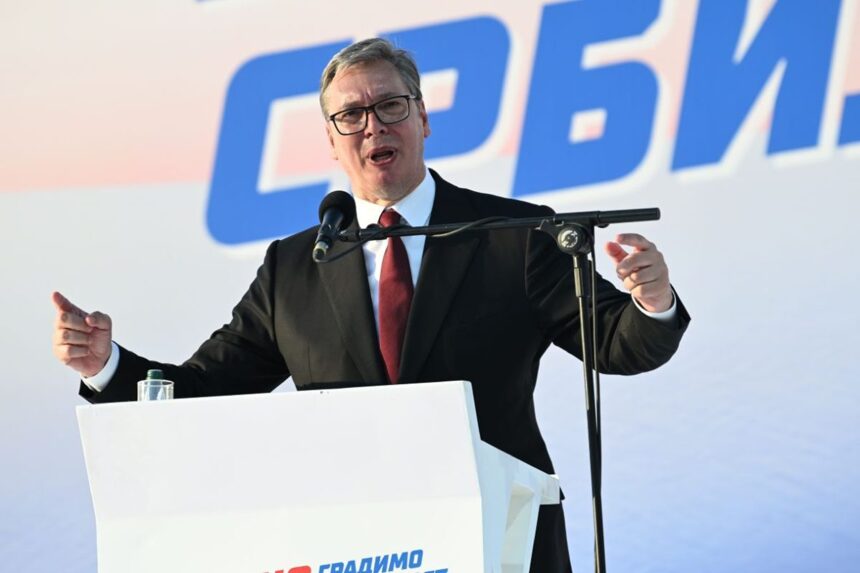
Serbia is facing a troubling political proposition: change the Constitution so Aleksandar Vučić can effectively manoeuvre around the existing limits on his presidency and return to the office after serving as prime minister.
The proposal, raised by National Assembly President Ana Brnabić, would allow a government led by Vučić to pursue constitutional changes that could eventually clear the way for his return to the presidency.
That is difficult to portray as ordinary constitutional reform. It looks like the political system is being asked to adapt to Vučić, rather than Vučić being required to respect the political system.
For more than a decade, Vučić has remained the dominant figure in Serbian politics. Now, as constitutional limits become an obstacle to another presidential term, members of his own political camp are openly discussing changing the rules.
The question is therefore not whether Serbia can amend its Constitution. It is whether it should be amended simply to accommodate the ambitions of the country’s most powerful politician.
The irony is hard to miss. Serbia’s leadership has repeatedly spoken about European integration, democratic reform and stronger institutions. Yet when the possibility arises that Vučić might have to leave the presidency, the proposed solution appears to be not stronger institutions, but a new constitutional arrangement that keeps him at the centre of power.
Vučić could become prime minister, retain control over the ruling political machinery and then seek the presidency again. Even if every procedural step were formally legal, the political message would be unmistakable: the rules can be rewritten when they stand between Vučić and another term in power.
That is precisely the kind of political culture democratic safeguards are supposed to prevent.
The issue is not whether Vučić is legally entitled to pursue another political position. He is. The issue is whether Serbia’s constitutional framework should be treated as a mechanism that can be redesigned around the career of one individual.
And that raises an uncomfortable question for the ruling establishment: if Vučić is genuinely confident in Serbia’s democratic institutions, why does the system need to be changed to keep him in the game?
Serbia does not need a constitutional loophole for Vučić. It needs institutions capable of surviving without him.
Because when a political system begins changing its rules to preserve one man’s power, the problem is no longer simply the politician.
The problem is the system that has decided he is indispensable.