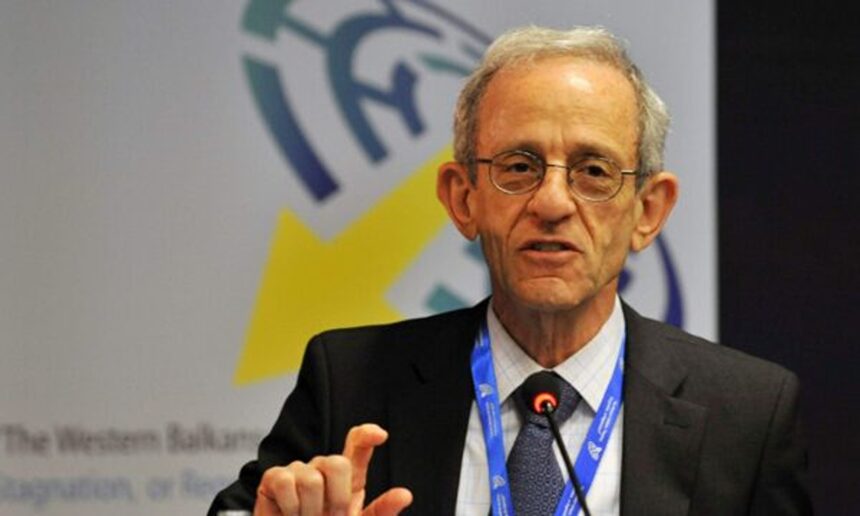
Daniel Serwer, a professor and senior fellow at the Johns Hopkins School of Advanced International Studies and an expert on political developments in the Balkans, has commented on Kosovo’s institutional crisis, the deadlock in the Assembly and the possibility of new elections.
Serwer said resolving the current situation requires cooperation among Kosovo’s political parties.
Asked whether Vetëvendosje or the opposition parties bear the main responsibility for the current parliamentary deadlock, Serwer said he did not want to assign blame to either side.
“I am more than 3,000 miles away. It is not for me to blame anyone. Parliamentary systems in many countries face problems like this. Kosovo is not unique in this regard,” he said.
Serwer also assessed the absence of a fully empowered president as a serious obstacle to the functioning of Kosovo’s institutions.
Asked about Prime Minister Albin Kurti’s insistence that an agreement on the election of a president should be reached before the Assembly is fully constituted, Serwer said the lack of a president with full powers was itself a significant institutional problem.
“The absence of a fully empowered president seems to me to be, in fact, a serious obstacle for Kosovo’s institutions,” Serwer said.
Regarding the possibility of Kosovo holding another round of early parliamentary elections, Serwer did not rule it out but expressed doubts that a new electoral process would resolve the crisis.
“I don’t think it is unrealistic, but I doubt it will be productive. A president cannot be elected without cooperation among the parties. That is precisely what is needed,” he said.
Serwer argued that Kosovo’s political parties should bear the primary responsibility for resolving the institutional crisis.
Asked whether the United States and the European Union should intervene more directly to help resolve the deadlock, he said he would prefer Kosovo’s political parties to address the situation themselves.
“I prefer that Kosovo’s political parties take responsibility. That is precisely why they received the votes,” Serwer said.
If the Assembly remains blocked, Serwer believes another round of elections could follow.
“I suppose there will be another round of elections, but in the meantime Kosovo is losing ground internationally. It is time to get back to work,” Serwer told Front Online.