Acting Kosovo Prime Minister Albin Kurti has emphasized the importance of gender equality as both a matter of social justice and a driver of economic development and democratic participation.
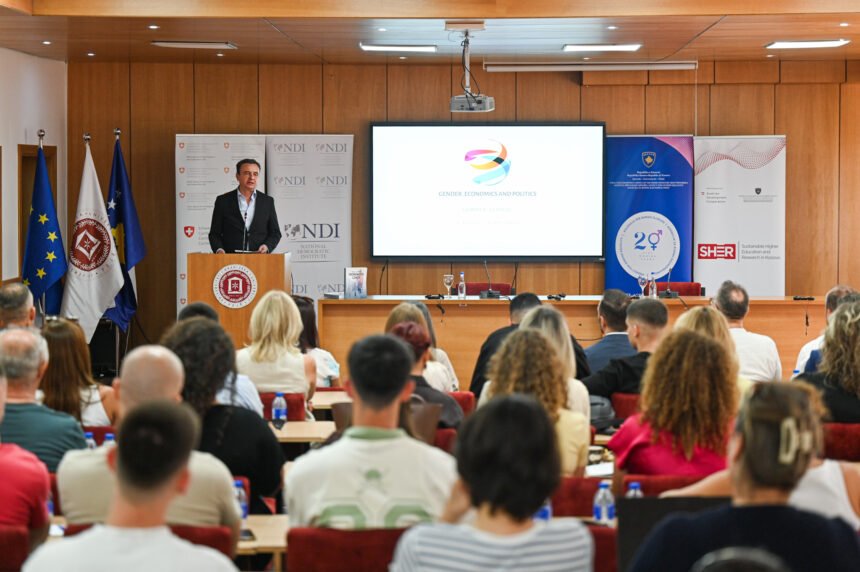
Kurti made the remarks while speaking with young people at the opening of the Summer School on Gender, Economy and Politics, held at Haxhi Zeka University in Peja.
He said the three themes addressed by the summer school are deeply interconnected, arguing that economic and political systems cannot be separated from questions of gender equality.
“Economy is not gender-neutral. Politics is not neutral toward the economy. And democracy cannot be complete if half of society faces greater barriers to working, owning property, leading and making decisions,” Kurti said.
He added that gender equality should not be viewed solely as a legal obligation or a sector-specific issue, but as a broader question of social justice, economic development and the quality of Kosovo’s democracy.
Government Programs Target Women’s Employment and Education
Kurti said that in recent years, the government has sought to translate the empowerment of women and girls into concrete policies, budget allocations and measurable results.
He cited government programs that have supported the employment of more than 12,000 women and said the Superpuna employment platform had helped connect young people with the labor market.
According to Kurti, nearly 23,000 young people have found employment through the platform, with women and girls accounting for 51 percent of beneficiaries.
He also highlighted investments in education and scholarships for girls pursuing STEM fields — science, technology, engineering and mathematics.
Kurti said 7,277 STEM scholarships had been awarded, including 7,042 to girls, representing 97 percent of the total.
He also pointed to support for maternity and child benefits, women’s entrepreneurship and women working in agriculture, as well as efforts to increase women’s representation in decision-making.
Through the “Government for Families” program, Kurti said, more than 4,000 people from households where no one had previously been employed have found jobs, with women accounting for 55 percent.
Under the Kosovo Generation Unlimited program, more than 3,000 young people have benefited from work placements, with women and girls making up nearly 60 percent of participants.
More Children in Early Education
Kurti also highlighted the expansion of access to early childhood education, saying the number of children enrolled in daycare facilities has increased significantly.
“In 2021, we had 5,555 children enrolled in daycare. In the 2024/2025 school year, by comparison, that number had reached 7,429, or around 33 percent more,” he said.
According to Kurti, 74 daycare facilities have either been completed or are currently under construction across Kosovo.
He said the objective is twofold: ensuring children have access to early education while giving parents — in practice, often mothers — greater opportunities for employment, education and self-employment.
Kurti Calls on Young People to Engage
Addressing students from different academic fields, Kurti stressed that gender equality should not be considered the responsibility of only those working specifically on gender issues.
He also called on young people to participate more actively in democratic life, arguing that democracy requires continuous civic engagement rather than participation only during elections.
“Democracy does not ask only for your vote, but for your voice, knowledge and engagement,” Kurti said, urging young people not to wait for elections or official positions before seeking to influence society.