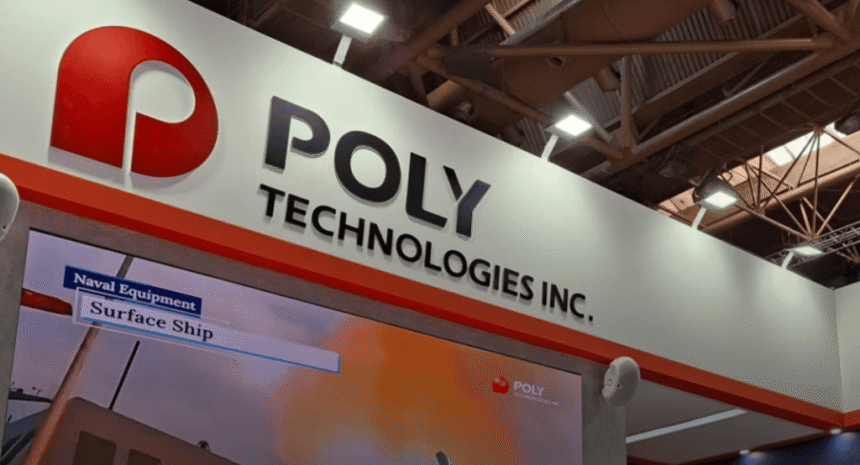
A Chinese state-owned arms manufacturer and trading company sanctioned by Western governments over its alleged cooperation with Russia is among the exhibitors at a military equipment fair organized in Sarajevo by the Ministry of Defense of Bosnia and Herzegovina and the government of the Federation of BiH entity.
Poly Technologies arrived at the Sarajevo exhibition with models of drones used by China’s People’s Liberation Army, counter-drone systems, guided missiles, grenades, rocket launchers and attack boats.
The company’s presence has raised questions about how a Chinese entity subject to Western sanctions was allowed to participate in an event organized by authorities in a country seeking NATO membership and EU accession and formally committed to aligning its foreign and security policy with the European Union.
Bosnian authorities did not respond to Radio Free Europe’s questions about how Poly Technologies passed the selection and approval process for the exhibition.
Sead Jusić, a former deputy defense minister of Bosnia and Herzegovina, told Radio Free Europe that the company’s participation should have been prevented through government screening procedures.
“This should not have happened,” Jusić said, arguing that multiple authorities should have approved the arrival of foreign companies, personnel, military equipment, weapons and ammunition.
He said the Ministry of Defense, Ministry of Security and Ministry of Foreign Trade and Economic Relations should have been involved in screening the participants.
Poly Technologies under Western sanctions
The United States placed Poly Technologies on its sanctions list in June 2024.
According to U.S. authorities, the Chinese company supplied Russia’s military-industrial sector with navigation systems for Mi-17 military helicopters, as well as other dual-use technologies that could support military applications.
The United Kingdom sanctioned Poly Technologies in April 2025 over activities that British authorities said contributed to Russia’s military capabilities and undermined Ukraine’s sovereignty.
The European Union added the company to its sanctions list in May 2025, alleging that it had supplied Russia with components for military helicopters. Canada and Ukraine have also imposed sanctions on the company.
Research organization C4ADS said it had identified more than 280 shipments from Poly Technologies to Russia in international customs and trade databases.
ImportGenius has separately reported that Poly Technologies supplied Russia’s Barnaul Cartridge Plant with enough gunpowder to manufacture at least 80 million rounds of ammunition.
The company’s presence in Sarajevo has therefore raised concerns about whether Bosnia and Herzegovina’s authorities adequately screened foreign exhibitors against sanctions and other security considerations.
What does the company’s presence mean?
The appearance of a sanctioned company at a military exhibition does not automatically constitute a violation of U.S. or European sanctions.
However, entering into certain business agreements or financial transactions with a sanctioned entity can expose individuals, companies or governments to sanctions risks, including potential secondary sanctions.
Haris Ćutahija of the Foreign Policy Initiative of Bosnia and Herzegovina said the episode illustrated a broader gap between the country’s formal commitments and their implementation.
“Bosnia and Herzegovina has aligned itself with EU foreign policy on paper, but not in practice,” Ćutahija told Radio Free Europe, arguing that institutions often act without meaningful consequences.
The issue is particularly sensitive because Bosnia and Herzegovina has committed to aligning its foreign and security policy with the EU while maintaining a complex internal political structure that can complicate the implementation of common foreign-policy decisions.
Other controversial exhibitors
Poly Technologies is not the only participant whose presence has attracted attention.
The exhibition includes 22 exhibitors from Bosnia and Herzegovina, five from Turkey, two from Slovenia, and one each from Egypt, China and the United States.
Among the participants is Turkey’s Presidency of Defense Industries, known as SSB. The institution was previously subject to U.S. sanctions following Turkey’s acquisition of Russia’s S-400 air-defense system.
The fair also includes Orao, a defense company from Republika Srpska that was investigated internationally in the early 2000s over allegations related to Iraq and violations of the United Nations arms embargo then in force.
Bosnia and Herzegovina has around 15 military-industrial companies. The United States has for years been the country’s largest arms customer, primarily purchasing ammunition and artillery shells, followed by markets including the Czech Republic, the Netherlands, Saudi Arabia and Egypt.
Sarajevo fair highlights Bosnia’s geopolitical balancing
The controversy comes as Bosnia and Herzegovina’s defense industry faces declining exports, with manufacturers citing difficulties securing raw materials, higher prices and longer delivery times caused by geopolitical changes and increased global demand for weapons.
Bosnia and Herzegovina generally does not export weapons to active war zones. Unlike Serbia, it has also not purchased weapons from China, with previous Chinese assistance reportedly limited to donations of vehicles and heavy equipment.
According to customs data provided to Radio Free Europe, Bosnia and Herzegovina has recorded no direct trade in weapons and military equipment with Ukraine or Iran since 2019.
The country’s most important foreign-trade partners remain EU member states and countries in the wider region, while China accounts for Bosnia and Herzegovina’s largest trade deficit.
The presence of Poly Technologies at the Sarajevo military exhibition nevertheless highlights the increasingly complicated environment facing Bosnia and Herzegovina as it seeks closer integration with the EU and NATO while remaining exposed to competing geopolitical and commercial interests.
The episode also raises questions about the effectiveness of Bosnia and Herzegovina’s institutional screening mechanisms and whether its formal alignment with Western foreign and security policy is being consistently applied in practice.