The message from Brussels is becoming increasingly difficult for Belgrade to ignore: a state funeral for Ratko Mladić or the participation of senior Serbian government officials in honouring him — is unacceptable to the European Union.
Thomas Byrne, Ireland’s Minister of State for European Affairs, whose country currently holds the rotating EU presidency, delivered the warning ahead of an informal meeting of EU and Western Balkan ministers.
Byrne said European officials were working “behind the scenes” on the issue and made clear that the glorification of Mladić cannot simply be dismissed as a private family matter.
“A state funeral would be unacceptable,” Byrne said, adding that the participation of senior government officials in paying tribute to Mladić would also be unacceptable.
His message comes after Mladić’s body was returned to Belgrade on a Serbian government aircraft on September 3. The coffin, covered with the Serbian flag, was carried from the aircraft by members of the Serbian Armed Forces, while Serbia’s Justice Minister Nenad Vujić accompanied the family.
The symbolism is difficult to miss.
This is the same Mladić who was sentenced to life imprisonment by the Hague tribunal for genocide, crimes against humanity and war crimes, including his responsibility for the Srebrenica genocide in which around 8,000 Bosniak men and boys were murdered.
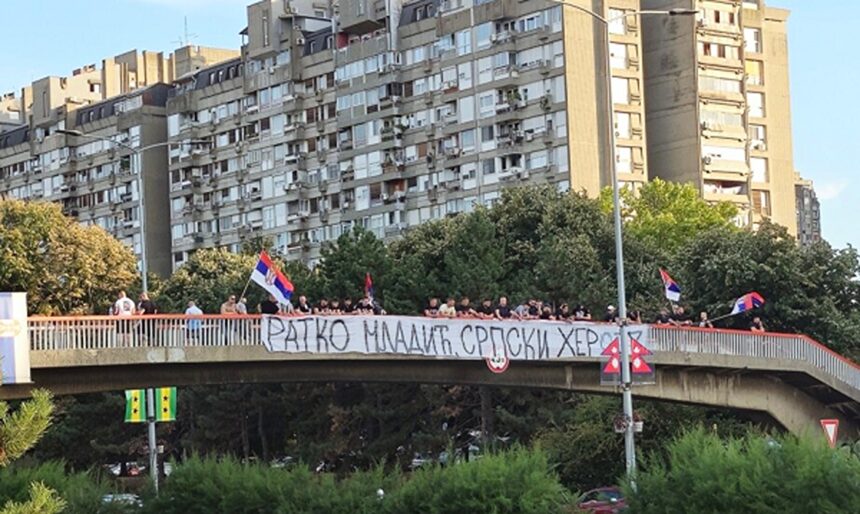
Yet Serbian officials have repeatedly discussed providing state support and honours. Justice Minister Vujić previously said Mladić would receive the highest state honours, while President Aleksandar Vučić said the Serbian state was prepared to provide logistical and security assistance surrounding the burial.
Now the EU is drawing a line.
The European Commission has already stated that glorifying convicted war criminals contradicts the EU’s fundamental values and has no place either inside the Union or in candidate countries.
Byrne described the wars and atrocities of the 1990s as “abhorrent” and stressed that their consequences continue to cause pain across the region and even within EU member states.
So this is no longer simply about a funeral.
It is about what kind of Serbia wants to enter the European Union.
A country cannot demand European integration while simultaneously elevating a convicted war criminal into a national symbol.
It cannot speak about reconciliation while honouring the man convicted over some of the worst crimes committed on European soil since the Second World War.
And it cannot ask Europe to look forward while refusing to confront the past.
The EU has spoken clearly.
The question now is whether Belgrade will listen or once again choose political mythology over accountability.
Mladić was convicted. His victims were real. The genocide was real. And glorifying those responsible will never become a European value simply because time has passed.