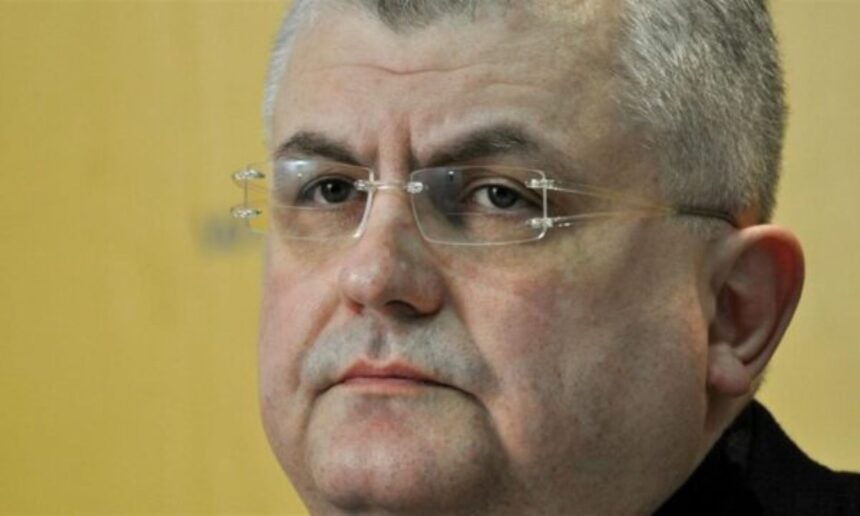
Serbian opposition politician Nenad Čanak has sharply criticized the state honors given to former Bosnian Serb military commander Ratko Mladić after his death, arguing that the decision undermines Serbia’s longstanding claim that it was not directly involved in the war in Bosnia and Herzegovina.
Speaking to N1, Čanak described Mladić as a convicted war criminal and said his glorification represented an insult to citizens in Serbia and across the region.
Čanak also challenged a narrative promoted by Serbian authorities that criticism of Serb nationalism amounts to portraying Serbs as a “genocidal people.” He argued that the phrase has been used by Serbia’s leadership to construct political controversies around claims that, in his view, were never made by its opponents.
Turning to Serbia’s historical relationship with the Bosnian Serb army, Čanak said Belgrade had a direct connection to Mladić because he and other officers were financially supported by Serbia during the war.
“For the entire period in which he was committing genocide, he was paid by Belgrade, as were his officers,” Čanak said, referring to Mladić’s position within the military structure through which officers were paid.
His comments come amid renewed controversy in Serbia over the public honors and ceremonies surrounding Mladić following his death. Mladić was convicted by the International Criminal Tribunal for the former Yugoslavia of genocide, crimes against humanity and war crimes and sentenced to life imprisonment.
Čanak accuses Serbia of glorifying Mladić
Čanak strongly criticized Serbian media for previously giving Mladić platforms on national television, including appearances in programs where he was presented in a favorable or personal manner.
He argued that such treatment contributed to the normalization and glorification of a figure convicted of some of the gravest crimes committed during the Bosnian war.
Čanak also linked the continued glorification of Mladić to what he described as the influence of Russian propaganda and Serbia’s domestic political calculations.
According to Čanak, the decision by President Aleksandar Vučić not to attend Mladić’s funeral should be viewed as part of Belgrade’s broader balancing strategy between the European Union and Russia.
He argued that Vučić could use his absence to reassure European partners while allowing Serbian state institutions to organize what Čanak described as unprecedented military honors for Mladić.
“This balance is being maintained all the time, in order to satisfy approximately both sides,” Čanak said.
Serbia’s role in the Bosnian war
Čanak said the state treatment of Mladić creates a contradiction with Serbia’s longstanding official position that it did not participate in the war in Bosnia and Herzegovina.
He argued that the presence of Mladić’s body in Serbia, combined with the state honors surrounding his burial, should be viewed as evidence of a much deeper relationship between Belgrade and the wartime Bosnian Serb military leadership.
Čanak went further, arguing that Bosnia and Herzegovina could now pursue a claim against Serbia for wartime damages.
“From today, since Ratko Mladić’s body is in Serbia, Bosnia and Herzegovina can sue Serbia for war damages in Bosnia and Herzegovina before international judicial bodies,” he said.
He claimed that the burial and state honors provided overwhelming evidence that Serbia had participated in the war and was an aggressor.
Čanak said such an interpretation would amount to recognition of Serbia’s involvement in the conflict.
“Absolutely,” he responded when asked whether the decision could be interpreted as an acknowledgment of aggression.
However, his comments represent a political and legal argument rather than an established judicial finding. The question of Serbia’s responsibility for the Bosnian war has previously been addressed in international proceedings, including the International Court of Justice’s 2007 judgment, which found Serbia responsible for failing to prevent genocide at Srebrenica and for failing to punish its perpetrators, but did not find Serbia itself directly responsible for committing genocide.
A broader confrontation over Serbia’s past
Čanak’s remarks reflect a wider dispute in Serbia over how the country should address its role in the wars of the 1990s and the legacy of figures such as Mladić.
While Serbian authorities have repeatedly sought to distinguish the Serbian state from the Bosnian Serb wartime leadership, critics argue that the continued glorification of convicted war criminals and the granting of state recognition to them undermines those distinctions.
For Čanak, the controversy surrounding Mladić is therefore not simply about a funeral. It is also about Serbia’s historical narrative, its relationship with the European Union and Russia, and the unresolved question of responsibility for the wars that accompanied the breakup of Yugoslavia.
The dispute is likely to keep questions of war crimes, regional reconciliation and Serbia’s relationship with its neighbors at the center of political debate.