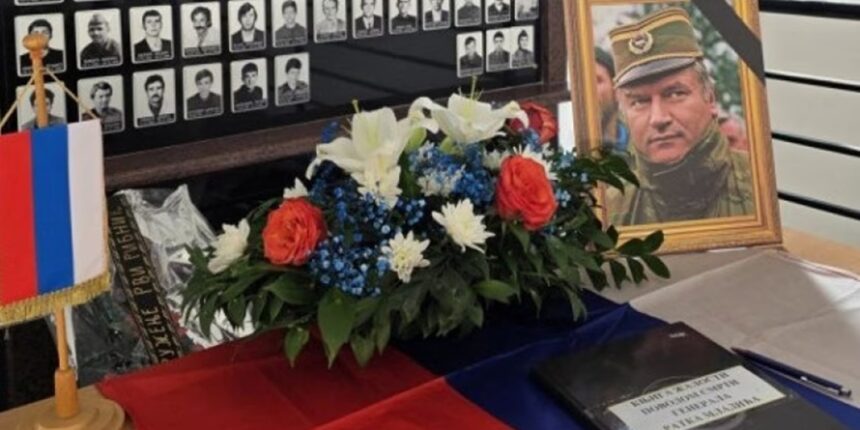
The European Union has increased pressure on Serbia following the decision to organize funeral ceremonies for Ratko Mladić, who was convicted of war crimes, crimes against humanity, and genocide.
In the first days following Mladić’s death on August 27, there were no public reactions from senior European Union officials in Brussels. The situation changed after his remains were returned to Belgrade, when it became clear that Serbian state institutions would be involved in organizing memorial ceremonies and the funeral.
Behind the scenes, European officials have been working to persuade Serbian President Aleksandar Vučić not to organize a state ceremony for Mladić.
However, members of the Serbian government are expected to attend the funeral, a development that has been met with criticism in Brussels.
The EU’s stance became more forceful on September 4, when Ireland, which currently holds the rotating presidency of the Council of the EU, and European Commissioner for Enlargement Marta Kos publicly addressed the issue.
Kos described Mladić’s funeral as an important test for Serbia and for the way it aligns itself with European values.
At the same time, the European commissioner canceled her planned visit to Serbia on September 9 and 10. The decision is linked to concerns over the glorification of Mladić.
The development comes at a sensitive time for Serbia, which is entering an undeclared pre-election campaign, while concerns have also been raised domestically over the alleged surveillance of opposition figures and civil society activists.
Meanwhile, Brussels is closely monitoring the case involving an alleged attempted attack using an explosives-laden drone at Leipzig Airport in Germany.
Two Serbian nationals have been arrested in Serbia on suspicion of involvement in the case, while the European Union has yet to issue a statement directly linking Serbian authorities to the alleged attack attempt.
In Brussels, the incident is being viewed in the broader context of the new security challenges facing Europe and as another indication that even NATO member states may become targets of provocations potentially linked to Russia.
The case is also expected to test NATO and its unity in the event of an escalation of threats of this nature.
The EU has also long expressed concerns over Serbia’s granting of citizenship to Russian nationals. The number of Russians who have obtained Serbian citizenship has increased significantly since the beginning of the war in Ukraine, raising security concerns among EU member states.
This is because Russian nationals who obtain Serbian passports can travel freely within the European Union’s visa-free area.
Several Baltic countries have called for restrictions on issuing visas to people with Russian backgrounds or ties, but the initiative has so far failed to gain broad support at the EU level.