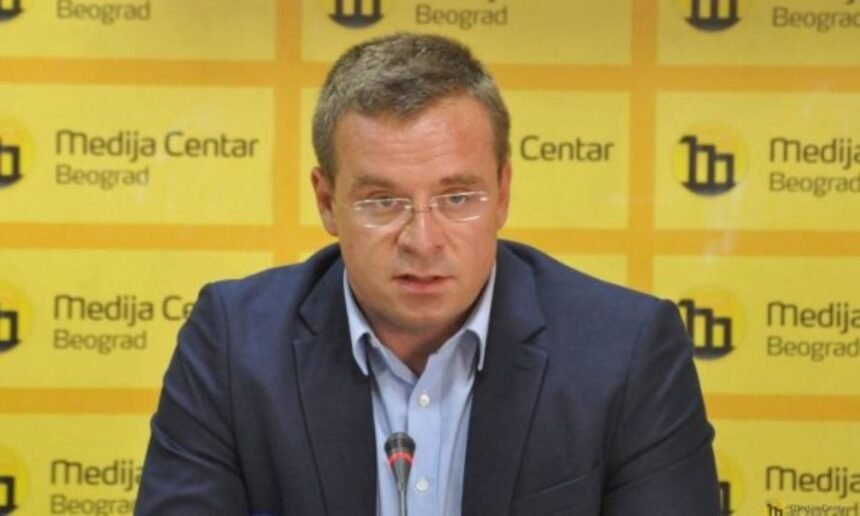
Serbian lawyer Čedomir Stojković has accused President Aleksandar Vučić of pursuing a “double game” over the Serbian state’s treatment of former Bosnian Serb military commander Ratko Mladić, who was convicted of genocide and other war crimes and sentenced to life imprisonment.
In a Facebook post following a ceremony held Saturday at the Serbian Army House in Belgrade, Stojković argued that, despite the messages Belgrade sends to Western governments, Serbian authorities honored Mladić at one of the country’s most prominent state and military facilities.
Stojković described Vučić’s approach as a “double game,” alleging that the Serbian president makes what he considers anti-European decisions while attempting to present them to Western governments as though he bears no responsibility for them.
According to Stojković, the ceremony at the Serbian Army House represented one of the most significant state honors Serbia has given Mladić.
The September 5 ceremony was attended by Serbian Justice Minister Nenad Vujić, Republika Srpska President Siniša Karan, two ministers from the entity government and former Serbian Prime Minister Nikola Šainović. Speakers reportedly described Mladić as a “great leader,” a “highly professional” officer and an “honest officer.”
Stojković argued that holding the ceremony at a Ministry of Defense facility amounted to a direct political message and that the Serbian government was thereby assuming political responsibility for honoring a person convicted of genocide.
He also criticized Belgrade’s approach to Serbia’s European Union integration, arguing that the glorification of Mladić is incompatible with European values.
The European Union has also strongly criticized the treatment of Mladić. EU Enlargement Commissioner Marta Kos canceled a planned visit to Serbia, saying that glorifying a person convicted of war crimes and genocide is incompatible with the values underpinning the EU accession process.
Mladić was convicted by the UN tribunal mechanism for crimes committed during the 1992–1995 Bosnian war. His final conviction included genocide in Srebrenica, persecution, deportation, murder, terrorizing civilians during the siege of Sarajevo and the taking of UN peacekeepers hostage.
The Youth Initiative for Human Rights in Serbia has separately argued that the state and military honors given to Mladić were unlawful, pointing to the removal of his military rank following his final conviction in 2021.
Stojković further argued that the episode illustrates what he describes as the functioning of political power in Serbia, where major government decisions in what he characterizes as an authoritarian system are ultimately decisions made by the president.
Mladić died on August 27 at the age of 84 while serving his life sentence in The Hague. His burial is expected to take place on September 7 at the Topčider Cemetery in Belgrade.